
Last updated: July 2026
Logan MT5 EA is a fully automated XAUUSD (Gold) Expert Advisor for MetaTrader 5 by Thierry Ouellet, a Canadian developer, running on the M15 timeframe. It launched in mid-2026 as his first published product, backed by three public live signals across two brokers at different risk levels.
View product details and current pricing.
Here is the thing to understand before anything else, because it shapes everything: Logan MT5 is a grid-recovery system. When a position moves against it, the EA can add further entries using ATR-based spacing with dynamic lot progression, and the resulting basket is closed together when it reaches its profit objective. There is no fixed per-trade stop loss. The developer is upfront about this — his own listing describes the ATR-based grid spacing and dynamic lot progression directly, and frames the product not as a grid-free system but as a more disciplined take on the grid concept. That honesty is worth something, and it is the right lens for evaluating the product.
We rate Logan MT5 EA 4 out of 5. The positive lean comes from genuine selectivity (six separate entry conditions must align before a trade opens, so the recovery grid engages relatively rarely), a properly documented entry methodology, a configurable daily drawdown limit that actually functions as a capital backstop, and one genuinely clean live signal with no account flows distorting it. The point we hold back reflects the grid architecture itself — no per-trade stop loss, dynamic lot progression, and a balance-versus-equity drawdown gap that shows how much floating loss a recovery basket carries — plus live records spanning only five and twelve weeks.
⚠️ Looking for a Logan MT5 EA “free download”? Don’t.
Every legitimate marketplace EA ships with built-in DRM or licensing. There is no working cracked file in existence — so a “free” copy is always one of two things:
- malware, or
- bait for a Telegram payment scam where you pay and get nothing.
The only safe routes are the MQL5 marketplace or a reputable reseller. CheaperForex offers Logan MT5 EA at a lower price than the marketplace — Get Logan MT5 EA at CheaperForex.
The Developer: Thierry Ouellet

Thierry Ouellet is a Canadian developer, and Logan MT5 is his first marketplace product — the result, he says, of years of manual trading and testing other people’s Expert Advisors before building his own.
A first-time developer is a legitimate consideration: there is no back catalogue to judge and no history of supporting products through updates. What partly offsets that is the unusual amount of methodological detail published. The entry logic is spelled out condition by condition, the recovery mechanism is described rather than obscured, and the risk controls are documented. Developers planning to oversell a black box do not usually publish a six-point entry checklist a sceptical buyer can pick apart — and with three public real-money signals across two brokers, the claims are checkable.
It Is a Grid EA — Here Is What That Actually Means
This is the most important section of this review. If you read nothing else, read this.
How it works. Logan MT5 opens a first position only when six conditions align. If the market then moves against that position, the EA can add further entries, spaced according to current ATR, with lot sizes progressing as the sequence extends. All positions in the resulting basket are closed simultaneously once the basket as a whole reaches its profit objective. There is no fixed stop loss on individual trades.
What that means in practice. Grid recovery systems produce very high win rates, because a losing position is not closed at a loss — it is held while further entries pull the basket’s average entry price closer to the market, and the whole set closes green. That is why the backtests show win rates above 90% and the live accounts show 84% and 94%. Those numbers are real, but they describe the mechanism rather than an edge: a grid converts many small losses into a smaller number of larger ones. You can see that directly in the backtest figures, where the average losing trade is roughly twice the size of the average winner.
The number that tells you the real story. Compare balance drawdown with equity drawdown in the published backtests. On the low-risk test, balance drawdown was 3.31% while equity drawdown reached 10.91%. On the medium-risk test, 5.53% balance against 20.68% equity. Balance drawdown is what got locked in; equity drawdown is how far underwater the account went while a recovery basket was open. That gap — roughly three to four times — is the floating loss the grid carries in normal operation. It is the honest measure of what you will actually watch on your screen, and it is the figure to size around.
What genuinely mitigates it here. Three things, and they are not trivial. First, selectivity: because six conditions must align, the EA trades relatively little (8.5% and 14.3% trading activity on the two live accounts), and the developer’s position is that most trades close on the initial entry without recovery engaging at all. Second, the live evidence supports that — maximum deposit load was just 4.1% and 5.6% on the two accounts, meaning that even at peak exposure the grid stayed shallow rather than committing large portions of margin. Third, the daily drawdown limit: once realised plus floating losses hit your chosen percentage, the EA stops opening new positions for the rest of the day, with an option to close everything immediately. That is a real circuit breaker, and it is the setting that matters most.
The residual risk, stated plainly. A grid system’s danger is not day-to-day; it is the rare, sustained, one-directional move that keeps extending the sequence. The developer states the system is designed to withstand adverse moves of over 100 points against the position, which is a meaningful tolerance but not an unlimited one — gold is entirely capable of trending further than that without pausing. The daily drawdown limit is the backstop, and how you set it determines your worst case far more than the strategy does. Configure it conservatively, and treat this as a controlled-risk allocation rather than a set-and-forget one.
The Entry Logic — Documented, Which Is Rare
The selectivity is what makes this grid different from the ones that blow up, so the entry filter deserves a proper look. Before opening a first position, the EA requires all of the following:
- Multi-timeframe EMA alignment — three exponential moving averages must agree across timeframes
- ADX trend strength confirmation — the move must have measurable directional strength, not just direction
- Tick volume comparison — current activity is weighed against recent market activity
- ATR volatility range check — volatility must sit within an acceptable band, so it stands aside in unusually wild or dead conditions
- Spread suitability — the current spread must be acceptable for execution
- Candle momentum — the current candle must show sufficient directional momentum
All six must be satisfied. That is a meaningfully tighter filter than most grid EAs apply, and it is the mechanism behind the low trading activity and shallow deposit loads on the live accounts. Publishing this detail also lets a buyer reason about when the system will and will not trade — the backtests show almost no Friday activity and entries clustered in specific session hours.
The Live Signals — Read the VT Markets One
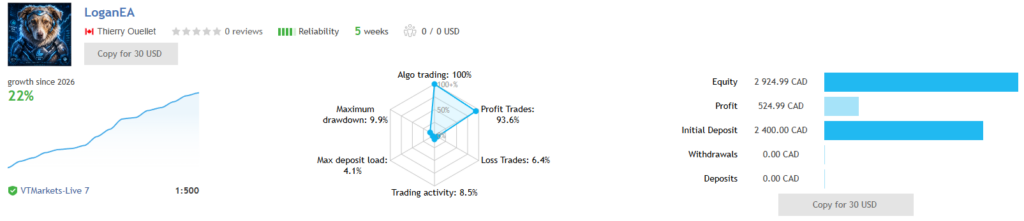
Three signals track the EA. The VT Markets account is the one to judge it by, because it is undistorted.
VT Markets (medium risk), 5 weeks. A CAD 2,400 initial deposit grown to about CAD 2,925, with zero deposits and zero withdrawals — so its roughly 22% growth is a genuine return on the starting balance, not a figure inflated by topping the account up. Note the currency is Canadian dollars, reflecting the developer’s location. Maximum drawdown was 9.9%, maximum deposit load 4.1%, trading activity 8.5%, and 93.6% of trades closed in profit. For a grid system, a sub-10% drawdown alongside a deposit load of only 4.1% is a genuinely reassuring combination: it says the recovery grid was not being leaned on heavily during this period.
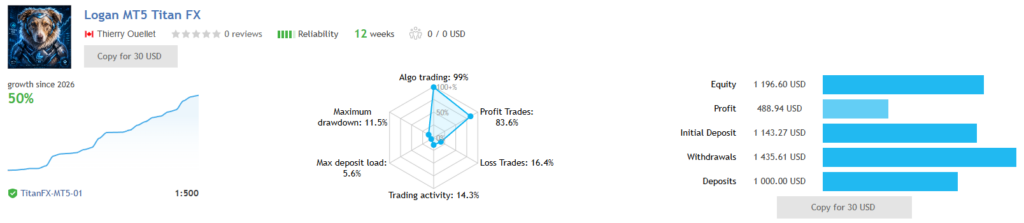
TitanFX (high risk), 12 weeks. This is the longer record, and its risk metrics are the useful part: an 11.5% maximum drawdown, a 5.6% maximum deposit load, 14.3% trading activity and 83.6% winning trades — a slightly more realistic win-rate distribution than the VT account, as you would expect at a higher risk setting. Its headline growth figure, however, is distorted by account flows: the account took about $1,000 in deposits and made roughly $1,436 in withdrawals against a $1,143 initial deposit, ending near $1,197 equity on about $489 of profit. Read against total capital deployed, the honest absolute return is closer to 23% over the twelve weeks — respectable, and much more useful than the headline. Note also that the higher risk setting produced a deeper drawdown than the medium one, which is exactly what you would expect and a useful sanity check that the risk tiers behave as labelled.
TitanFX (extreme risk). A third signal tracks the EA at an extreme risk setting. We have not analysed its figures here, so check it directly if you are curious — but the general principle holds: the drawdown at an extreme setting will be materially deeper than the 9.9% and 11.5% seen on the medium and high accounts, and for a grid system the extreme tier is not where a sensible buyer starts.
What the three together are worth. Publishing the same strategy at three risk levels across two brokers is genuine transparency — it shows the trade-off rather than just the best case. The limitation is time: five and twelve weeks have not yet met a sustained hostile move in gold, which is precisely the scenario a grid system needs testing against. Encouraging early evidence, not proof.
The Backtests — Two Risk Levels
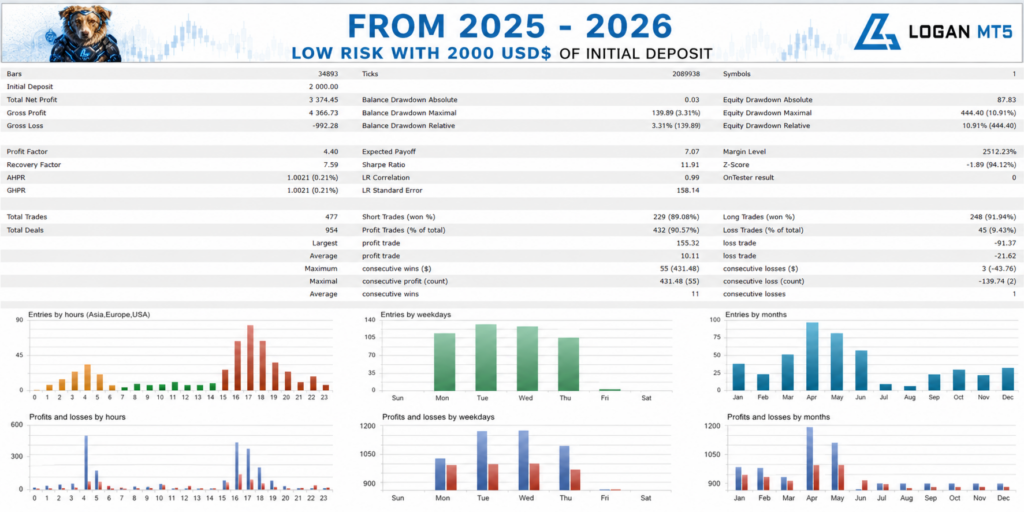
The developer publishes two backtests over the same 2025–2026 period and the same 477-trade sequence, differing only in the deposit backing them — which is a neat way to show how risk level works in practice. Risk here is essentially a function of how much capital stands behind the same trades.
Low risk, $2,000 deposit: about $3,374 net profit, a profit factor of 4.40, 90.57% winning trades, and the drawdown pair discussed above — 3.31% balance against 10.91% equity.
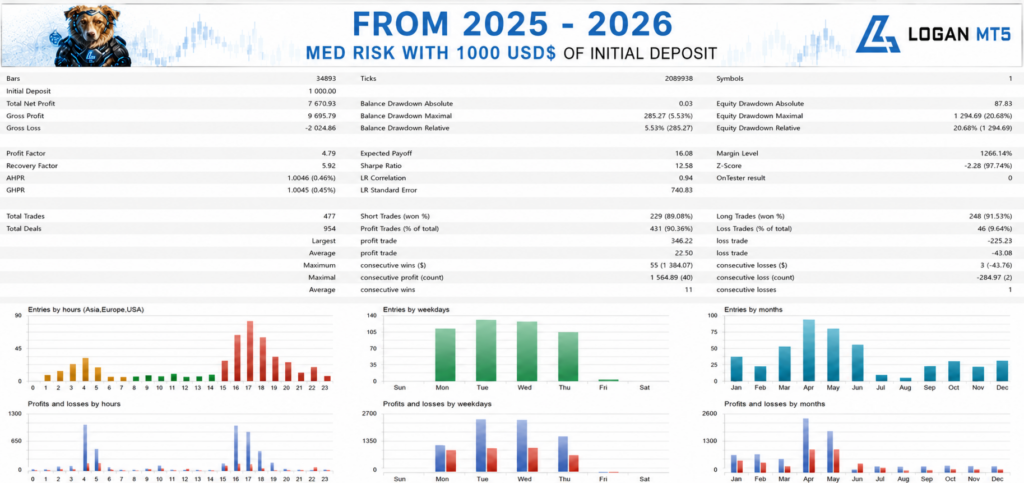
Medium risk, $1,000 deposit: about $7,671 net profit, a profit factor of 4.79, 90.36% winning trades — and equity drawdown rising to 20.68% against 5.53% balance drawdown. Same trades, half the capital, roughly double the return, and double the floating drawdown. That is the trade-off laid out plainly, and it is why the developer’s recommended balance ($2,000 or more) sits above the $1,000 minimum.
Honest notes on both. The window is roughly a year, which is short — it does not span multiple gold regimes, and for a grid system a longer test through a genuinely adverse trend would be far more informative. Profit factors above 4 are strong but should be read in the context of the grid mechanism producing them. And the “Sharpe ratio” readings on these reports (in the double digits) are not meaningful figures and should be ignored rather than treated as a selling point. Read the backtests for the balance-versus-equity relationship and the risk-tier comparison; that is where their real value lies.
The Audit Report — Useful, With a Caveat
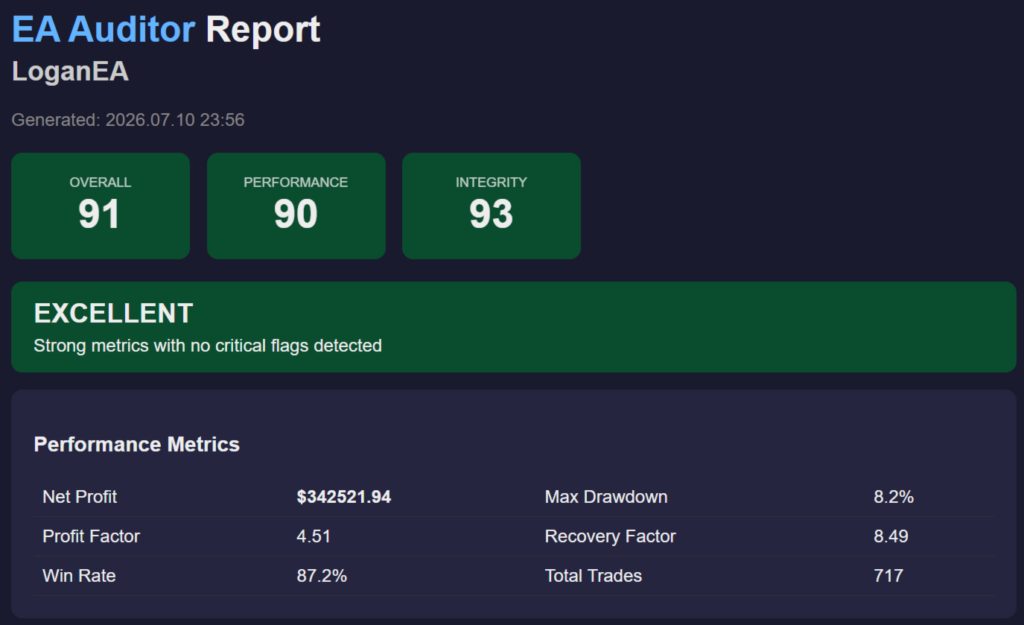
An automated EA audit report accompanies the product materials, scoring Logan MT5 at 91 overall, 90 for performance and 93 for integrity, with an “excellent” band and no critical flags detected.
The genuinely useful part is the integrity dimension. Automated audit tools of this kind typically screen for the tell-tale signs of misrepresented results — manipulated history, implausible tick data, results that cannot be reproduced. A clean pass there is a mild positive, and it is consistent with everything else we have seen: the numbers on this product hang together across the backtests and the live accounts rather than contradicting each other.
The caveat, and we would rather point it out than let a buyer trip over it: the performance dataset in this report does not match the published backtests. It cites 717 trades and a net profit above $342,000, where both published backtests cover 477 trades and net profits of roughly $3,374 and $7,671. So the report is evaluating a different run — presumably a much more aggressive risk setting, a larger deposit, or a longer period. Whatever the explanation, that six-figure net-profit number should not be read as an expected return, and we are not presenting it as one. Take the integrity finding and the absence of critical flags; leave the headline profit figure alone.
What Buyers Are Saying
Early marketplace feedback is positive, with a small number of reviews and a five-star average at the time of writing. The most substantive one engages with exactly the right question: that buyer, an experienced gold-EA user, contrasted Logan MT5 with typical grid bots that stack trades until drawdown spirals, and credited the ATR-based spacing and lot progression with adapting to volatility rather than blindly averaging down. Their observation was that most trades close profitably on the first entry, and that when recovery is needed it stays measured — capital preservation and steady growth being the appeal rather than spectacular returns.
That is a useful data point precisely because it comes from someone evaluating the grid mechanics with open eyes. The caveat is that the review base is small and young — early impressions from days or weeks of use, not verdicts on a difficult quarter. Weigh them as encouraging sentiment and let your own longer-window testing decide.
Who Logan MT5 EA Is For
It might be a fit if you:
- Understand and accept grid-recovery mechanics, and want a selective, filtered implementation rather than a constantly-trading one
- Value a documented entry methodology you can actually reason about, and a developer who states the grid architecture openly instead of hiding it
- Will set the daily drawdown limit conservatively and treat it as the real risk control
- Can tolerate watching floating drawdown two to four times deeper than realised drawdown while a basket is open
- Want to run at or above the recommended $2,000 balance rather than the $1,000 minimum, on one of the developer’s recommended brokers with a VPS
- Appreciate transparency across three live accounts at different risk levels, and read past distorted headline percentages to the underlying figures
Look elsewhere if you:
- Want a hard stop loss on every trade — this system does not use one, and closes baskets at a profit objective instead
- Are unwilling to hold floating losses at all, or need prop-firm-style intraday loss certainty on every position
- Require a long multi-year live record before buying a grid system — these signals span five and twelve weeks
- Would be tempted by the extreme-risk setting, or by running the $1,000 minimum at maximum lot sizing
- Prefer an established developer with a back catalogue — this is a first product
- Trade only on MT4 — this is an MT5 product
Our Verdict
We rate Logan MT5 EA 4 out of 5.
What earns the positive lean is that this is a grid EA built by someone who appears to understand why most grid EAs fail. The six-condition entry filter is a genuine constraint rather than decoration, and the live accounts bear that out: trading activity under 15%, maximum deposit loads of 4.1% and 5.6%, drawdowns under 12% on both. The methodology is documented in unusual detail, the daily drawdown limit is a real circuit breaker rather than a marketing bullet, and the VT Markets signal is a clean, undistorted 22% over five weeks. Publishing three signals at three risk levels, including the unflattering comparison between them, is the behaviour of a developer who expects to be checked.
What holds it at four is the architecture and the clock. There is no per-trade stop loss, lot progression is dynamic, and the backtests’ equity drawdowns run three to four times their balance drawdowns — the honest picture of what a recovery basket costs while it is open. Grid systems fail rarely and expensively, and neither a one-year backtest nor five and twelve weeks of live trading has put this one through a sustained adverse trend in gold. Add a first-time developer and a small review base, and there is less accumulated evidence than a higher score would require.
Practical recommendation: if you are comfortable with grid mechanics, this is one of the more thoughtfully constructed versions of the idea, and it is inexpensive to evaluate. Run it at or above the recommended $2,000 rather than the $1,000 minimum, set the daily drawdown limit conservatively and consider enabling the close-all option, stay on the medium risk tier rather than reaching for high or extreme, use one of the developer’s recommended brokers with a low-latency VPS, and demo it before committing real money — then run a small live account through at least one difficult stretch before you scale. Bought through CheaperForex at a lower price, that evaluation costs you very little.
How to Get Logan MT5 EA Safely
Two legitimate sources, and only two.
CheaperForex — the same EA at a lower price than the marketplace. Get Logan MT5 EA at CheaperForex.
The MQL5 marketplace — direct from Thierry Ouellet’s developer page. Here is the official MT5 listing, which also offers a free demo you can run in the strategy tester.
Anywhere else offering it free or via a Telegram seller is a trap — there is no working cracked file, only malware or pay-and-vanish scams.
Frequently Asked Questions
Is Logan MT5 EA legit, or a scam?
Legitimate. It is a published MQL5 marketplace product from Canadian developer Thierry Ouellet, with three public real-money live signals across two brokers, a documented strategy, and positive early reviews. The scams are the “free download” sites and Telegram sellers offering cracked copies that cannot exist — every legitimate marketplace EA is licence-protected, so a free copy is either malware or a payment scam. Legitimate does not mean low-risk, though: this is a grid-recovery system and needs to be configured carefully.
Does Logan MT5 use a grid, martingale or stop loss?
It uses a grid. When a position moves against it, the EA adds entries with ATR-based spacing and dynamic lot progression, closing the whole basket together at a profit objective. There is no fixed per-trade stop loss; the configurable daily drawdown limit is the capital backstop instead. The developer states this openly. What distinguishes it from typical grid robots is selectivity — six conditions must align before any trade opens — and the live accounts’ low deposit loads (4.1% and 5.6%) suggest the grid stayed shallow in practice.
Why is the backtest drawdown listed twice, and which number matters?
Both matter, and the gap between them is the point. Balance drawdown (3.31% low risk, 5.53% medium) is the loss actually realised. Equity drawdown (10.91% and 20.68%) is how far underwater the account went while a recovery basket was still open. For a grid system the equity figure is what you will watch on screen and what you should size around — expect floating drawdown roughly three to four times the realised figure.
Which live signal should I judge it by?
The VT Markets account, because it has no deposits or withdrawals distorting it: CAD 2,400 grown to about CAD 2,925 over five weeks, roughly 22% genuine growth, with a 9.9% maximum drawdown and a 4.1% deposit load. The TitanFX high-risk account is the longer record at twelve weeks with an 11.5% drawdown, but its headline growth percentage is inflated by account flows — its honest absolute return is nearer 23% on total capital deployed. A third account runs at an extreme risk setting, which is not where a sensible buyer starts.
What does the audit report actually tell me?
Its useful finding is the integrity score and the absence of critical flags, which suggests the published results hang together rather than showing signs of misrepresentation. Its performance figures, however, come from a different run than the published backtests — 717 trades and a six-figure net profit, versus 477 trades and low-four-figure profits in the official tests — so that profit number should not be read as an expected return. Take the integrity finding; ignore the headline.
How should I configure it for the lowest sensible risk?
Run at or above the developer’s recommended $2,000 balance rather than the $1,000 minimum, choose the medium risk tier rather than high or extreme, set the daily drawdown limit to a percentage you could genuinely tolerate losing in a day and consider enabling the option to close all trades when it triggers, and select the broker profile matching your account (there is a dedicated Exness setting). Then demo it before going live.
What broker, account and VPS do I need?
A hedge or netting account with XAUUSD and tight spreads; ECN or Raw Spread is recommended, with leverage of 1:100 or higher. The developer names VT Markets, TMGM, TitanFX, GlobalPrime and Vantage as recommended brokers. A low-latency VPS near your broker’s server is recommended so the EA can manage open baskets and evaluate its spread and session filters without interruption.
Why is it cheaper at CheaperForex?
The product is identical — the same EA and free lifetime updates. You pay less. For a grid-recovery system in particular you will want to demo it and then validate on a small live account with a conservative daily drawdown limit before scaling, so paying less to do that evaluation is the practical approach.