
ADI The Magic EA MT5 uses pullback entries with confirmation, multiple trading levels and account-based lot sizing. The developer describes predefined stop losses and trailing stops, with XAUUSDm gold on M30 shown in its original tester gallery.
Our assessment: its appeal is a configurable pullback framework with explicit sizing and exit controls. It suits traders who will compare trade levels and equity-risk settings. The key evidence limitation is the developer test’s 63.58% relative equity drawdown, ideal execution and profit-in-pips mode: its promotional dollar overlay is not verified live-money performance.
View ADI The Magic features & pricing

This review uses Developer’s ADI The Magic listing on MQL5 and its original gallery, checked October 1, 2026. We have not independently traded the supplied EA or reproduced the reports. The developer’s separate rental promotion is not the offer described on the linked CheaperForex product page.
What the pullback design is trying to do
ADI The Magic waits for a pullback and confirmation rather than entering every move. This can help avoid buying after a move is already extended, but a retracement can develop into a reversal. Its stop and trailing controls therefore matter as much as the entry description.
The overview allows multiple trading levels. It does not explain the spacing of all levels, whether losses alter later sizing, or how total exposure is capped. We have kept that description separate from a no-grid or no-martingale claim. A trader needs to understand the combined position, not only the percentage applied to one order.
Market and settings shown by the source
The developer’s original settings screenshot identifies XAUUSDm on M30. This establishes that the gallery test is a gold test; it does not demonstrate results across other markets. The symbol suffix belongs to the source broker and should be matched to your own broker’s gold instrument.
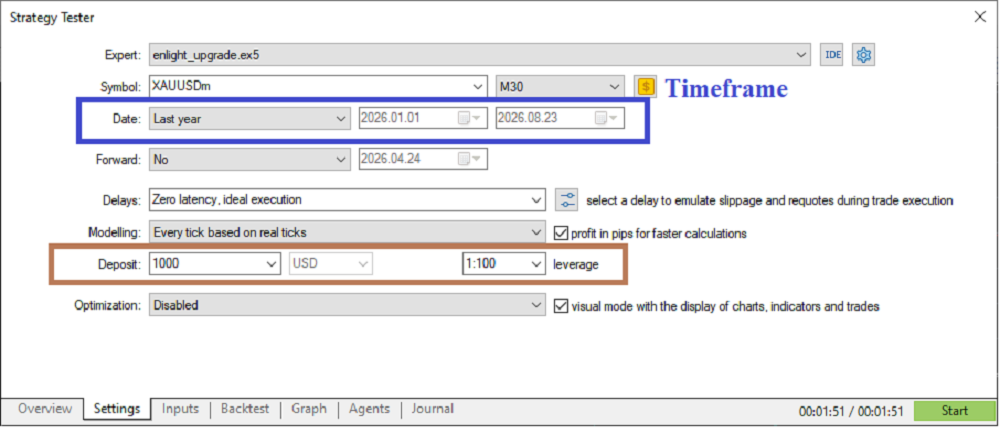
The settings panel runs January 1 to August 23, 2026, whereas the graph overlay and current overview name August 20 as the end date. It also displays an executable called enlight_upgrade.ex5. We cannot independently establish that file’s relationship to the current ADI version from a screenshot, so we retain the original image and the date discrepancy.
The run selects real-tick modeling with zero-latency ideal execution, no forward split and the profit-in-pips option. A USD deposit label in this setup does not justify interpreting every profit figure as a reproducible money return. Ideal execution also omits delays that can alter entry and exit prices.
The overview names an equity-risk input when sizing is enabled and suggests testing values from 0.5 to 5. The developer calls 3 its best-result setting for the proposed run. That is an optimization statement for that test, not a risk recommendation for every account. Keep the same period and execution assumptions when comparing different settings, then test outside the period used to select them.
Read the original tester images in context
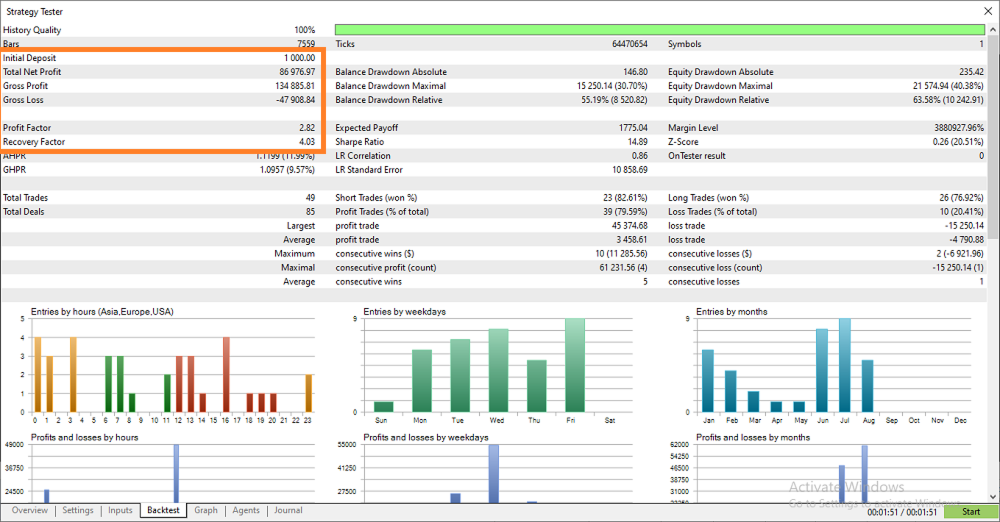
- History quality / sample
- 100% shown; 49 trades and 85 deals.
- Net result / profit factor
- 86,976.97 in the report’s displayed result units; profit factor 2.82. The associated setup has profit-in-pips mode checked.
- Winning trades
- 39 of 49, or 79.59%.
- Relative balance drawdown
- 55.19%, with 8,520.82 shown beside it.
- Relative equity drawdown
- 63.58%, with 10,442.91 shown beside it.
- Maximal equity drawdown
- 21,574.94, with 40.38% shown beside that different measurement.
- Largest losing trade
- −15,250.14 in the report’s displayed units.
The favorable end result came with substantial reported drawdown. Relative drawdown is the largest percentage decline measured from a peak; maximal drawdown is the largest absolute decline, which can occur at a different account size. Their percentages therefore need not match.
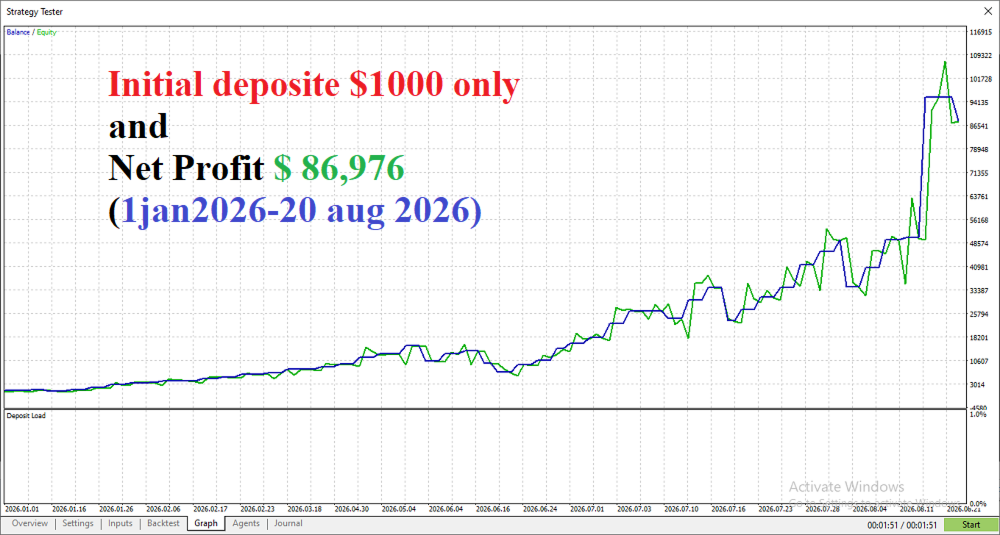
The source graph’s overlay promotes a large monetary return, but its associated settings show profit-in-pips mode. We have not adopted the overlay as a verified money-performance claim. The visible equity swings and the report’s 63.58% relative equity drawdown also deserve attention alongside the final balance.
The test ends immediately before ADI’s August 24, 2026 public release. Forty-nine historical trades over this period cannot establish the behavior of every configuration or a later build. Repeating the test with complete costs, money calculations and a separate evaluation period would provide more useful evidence than copying the headline result.
Documentation and buyer feedback
ADI The Magic had no public product reviews or posted buyer comments at our October 1, 2026 check. We have not substituted the author’s wider reputation for feedback on this particular product or imported third-party stars into CheaperForex ratings.
No separate public manual or live signal was linked from the requested overview or seller page at this check. The current listing is version 5.40, but the absence of a public release-history tab means the gallery images cannot automatically be assigned to that build. Original capture dates and the exact input files are not established by a promotional screenshot alone.
Comparing ADI The Magic with Gold Sniper by Nadim
Gold Sniper by Nadim EA MT5 is another product from Nadim Rafik Golandaj. Its public description identifies gold tests, a swing-confirmation setting, a one-trade-per-trend option and spread and volatility filters. The Gold Sniper by Nadim review examines its own screenshots and update history.
Shared authorship does not establish that the two EAs trade independently. Compare their actual inputs, entries and total market exposure before running them together. For ADI, the useful next step is a controlled test of the pullback levels and equity-risk input with the broker costs you expect to pay.