
Pivot Breakout EA MT5 trades XAUUSD on M30 using six selectable strategies that enter around predefined pivot-level breaks. It combines a rule-based entry framework with predefined stops, breakeven, trailing exits and time/news filters; the higher-risk strategies 2 and 3 are disabled by default.
Our assessment: the appeal is a straightforward gold breakout design with component switches and explicit trade protection. It suits traders who will measure actual lot exposure and execution on their own broker. Its public account has a promising dated result but a much shorter monitoring period than its 15-week history label suggests; two-minute average trades and MQL5’s copying-slippage warning make execution a central consideration.
View Pivot Breakout EA MT5 features and pricing

This review uses the developer’s Pivot Breakout listing, its original gallery, the linked shared guides and public MQL5 account, inspected October 1, 2026. We have not independently traded the supplied EA or reproduced its backtests. The public listing was published September 25, 2026 and identified version 2.15 at this check.
Six pivot strategies, with higher-risk options off by default
The core idea is to trade when price breaks a predefined pivot level, seeking a new directional movement. This is a rules-based strategy rather than the neural-network approach used by some of the author’s other systems. A breakout can continue or reverse; the stop and exit management remain important when the entry fails.
Each of the six components has its own enable switch. The developer recommends leaving the default configuration intact, including strategies 2 and 3 turned off because of their higher risk. A meaningful comparison starts with that unchanged baseline, then evaluates one change at a time using the same period, costs and sizing.
The detailed overview says historical testing reached five simultaneously open trades and 21 pending orders. Its shorter feature list compresses this into an ambiguous “5 / 21” position count. We use the more specific description: pending orders have not yet become filled positions, but can add exposure when several trigger. The historical count is not a verified hard limit on every possible configuration.
Lot sizing: a small Risk Level number is not a tiny loss percentage
The listing names 0.04 as the signal’s Risk Level. The linked PrizmaL user guide defines this input as lot volume per 1,000 USD of capital, using either balance or equity in automatic mode. It also describes a fixed-lot mode. Do not read 0.04 as 0.04% risk per trade.
Cash exposure depends on the actual lot, gold contract size, stop distance and how many trades are open. The listing associates inputs 0.02, 0.03 and 0.04 with expected drawdowns of 10%, 15% and 20%. Those are developer expectations, not enforced loss ceilings or evidence that future losses stop at those levels.
- Recommended chart
- XAUUSD M30 in MetaTrader 5.
- Account mode
- Hedging; the overview lists Standard, ECN, Raw, Cent and Micro account types.
- Starting guidance
- Minimum deposit 500 USD, leverage 1:30 or greater. Lower leverage can require more margin for the same positions.
- Sizing modes
- Fixed lots, automatic sizing from equity, or automatic sizing from balance in the shared guide.
- Risk changes
- The shared guide says a new Risk Level applies to subsequent trades, not positions already open.
- Non-USD accounts
- The guide describes automatic or specified currency conversion; its special guidance for cent currencies is to leave the conversion-pair field blank.
The linked manual predates this EA’s September release and covers the wider PrizmaL family. Check that the supplied build exposes the described controls. For non-USD accounts, verify the conversion pair and resulting volume; for cent accounts, a displayed balance is not directly comparable with a dollar account. Assign unique Magic Numbers if running multiple instances.
Time, news and internal exits
The developer advertises a predefined stop on each trade, breakeven and trailing management, with no grid, martingale or averaging. The shared guide describes the principal SL/TP and trailing logic as internal, so it should not be assumed that every distance is freely adjustable.
Broker Time means the trading server’s actual UTC offset. It affects time filters, news, Friday and New Year handling; the broker’s office location does not establish that offset. Check seasonal changes rather than setting it from your own clock.
The guide says its news filter uses MT5’s built-in calendar without an external WebRequest. It blocks new entries around selected events and leaves existing positions and their stops/targets unchanged. A news pause is therefore not a promise that the account has no exposure during a release.
The linked account: separate history from public monitoring
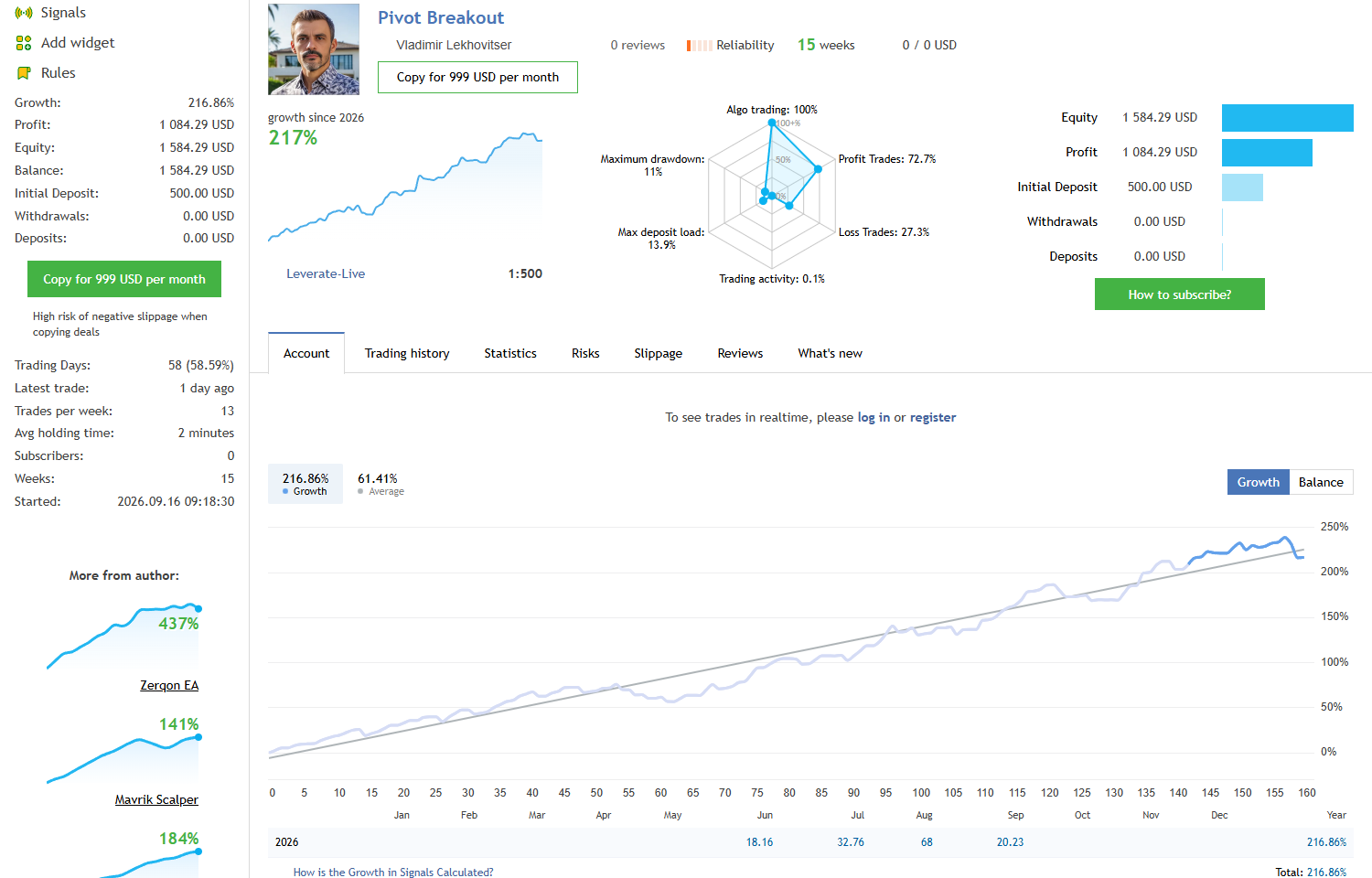
MQL5 labels the Pivot Breakout account a real account on Leverate-Live at 1:500 leverage. At the October 1 observation, it showed 216.86% growth, 161 trades and a 2.44 profit factor. Its initial deposit was 500 USD, with no subsequent deposits or withdrawals shown; balance and equity were both 1,584.29 USD at that moment.
The page displays 15 weeks of account history but states that public monitoring started September 16, 2026 at 09:18:30. That start was nine days before the public product release. Imported historical trades should not be treated as 15 weeks of continuous public observation of the retail build. The public record does not establish the exact build and settings used for every earlier trade.
- Trade sample
- 161 trades; 117 profitable and 44 losing. Both long and short XAUUSD trades appear.
- Profit factor
- 2.44 at the dated check.
- Relative balance drawdown
- 10.98% (96.66 USD shown).
- Relative equity drawdown
- 4.38% (72.68 USD shown).
- Maximal balance drawdown
- 113.24 USD (6.68%)—a different measure from relative balance drawdown.
- Holding time / deposit load
- Two-minute average holding time; 13.88% maximum deposit load.
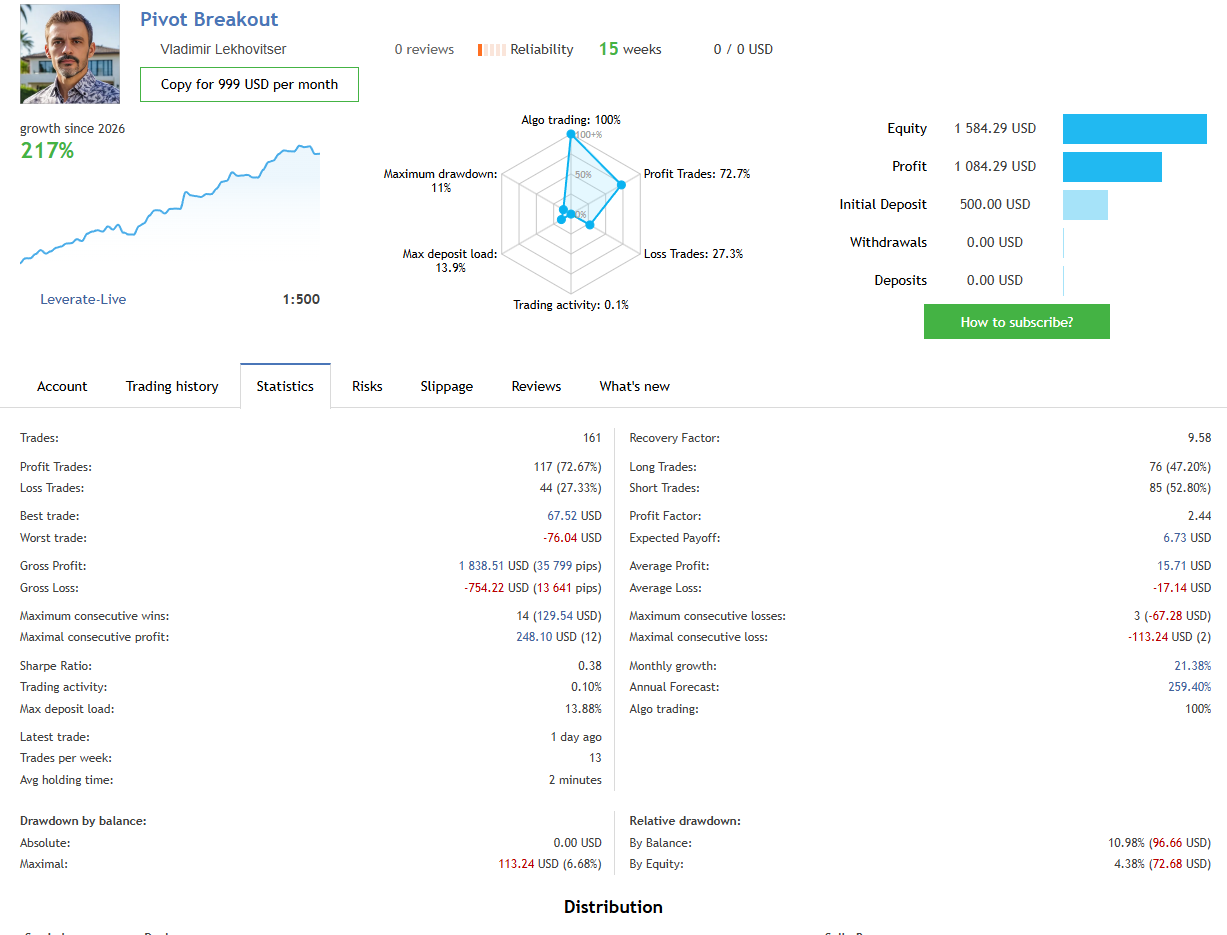
We retain MQL5’s separate balance and equity labels rather than combining the different drawdown statistics into one “maximum risk” figure. None is a limit on future losses. Equal balance and equity at the capture only means there was no floating difference then; it does not describe every point in the account history.
MQL5 warns of high risk of negative slippage when copying deals. That is a warning about copying this account, not a controlled test of the standalone EA. The two-minute average holding time nevertheless makes spread, fill speed and exit execution relevant to a broker-specific evaluation. The account’s growth cannot simply be transferred to another terminal or broker.
Two original backtests with different sizing
The original reports both cover January 1, 2025–September 24, 2026 on XAUUSD M30, using a 1,000 USD initial deposit and 1:500 leverage. They select Every tick modeling and ideal execution with no delay. This is not the same as an independently reproduced real-tick forward test.
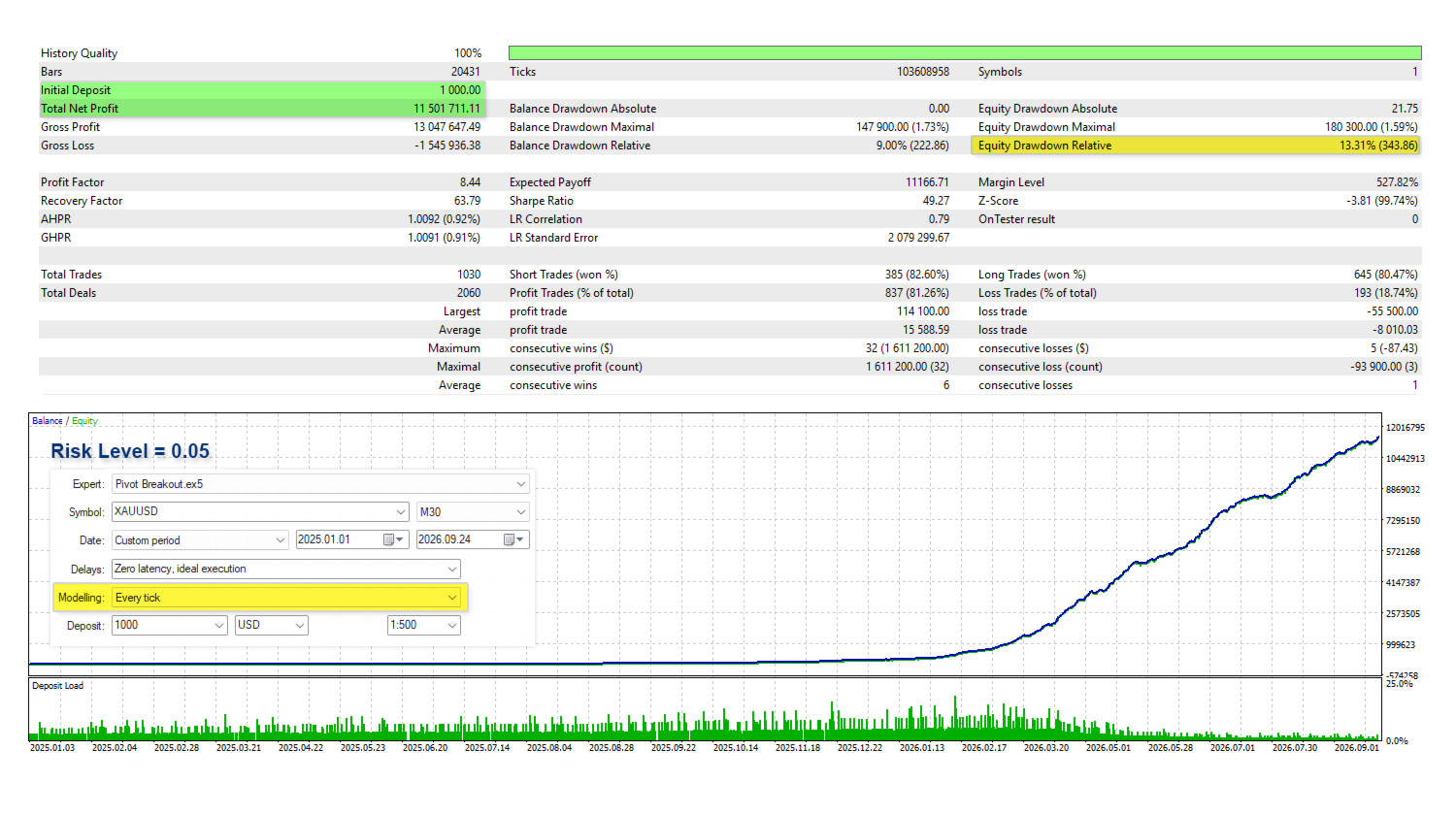
The variable-lot report uses Risk Level 0.05, which is higher than the listing’s 0.04 signal setting. It records 1,030 trades, profit factor 8.44 and 13.31% relative equity drawdown. Growing position size changes the result and risk path; its large ending result is not a fixed-lot expectation or a forecast.
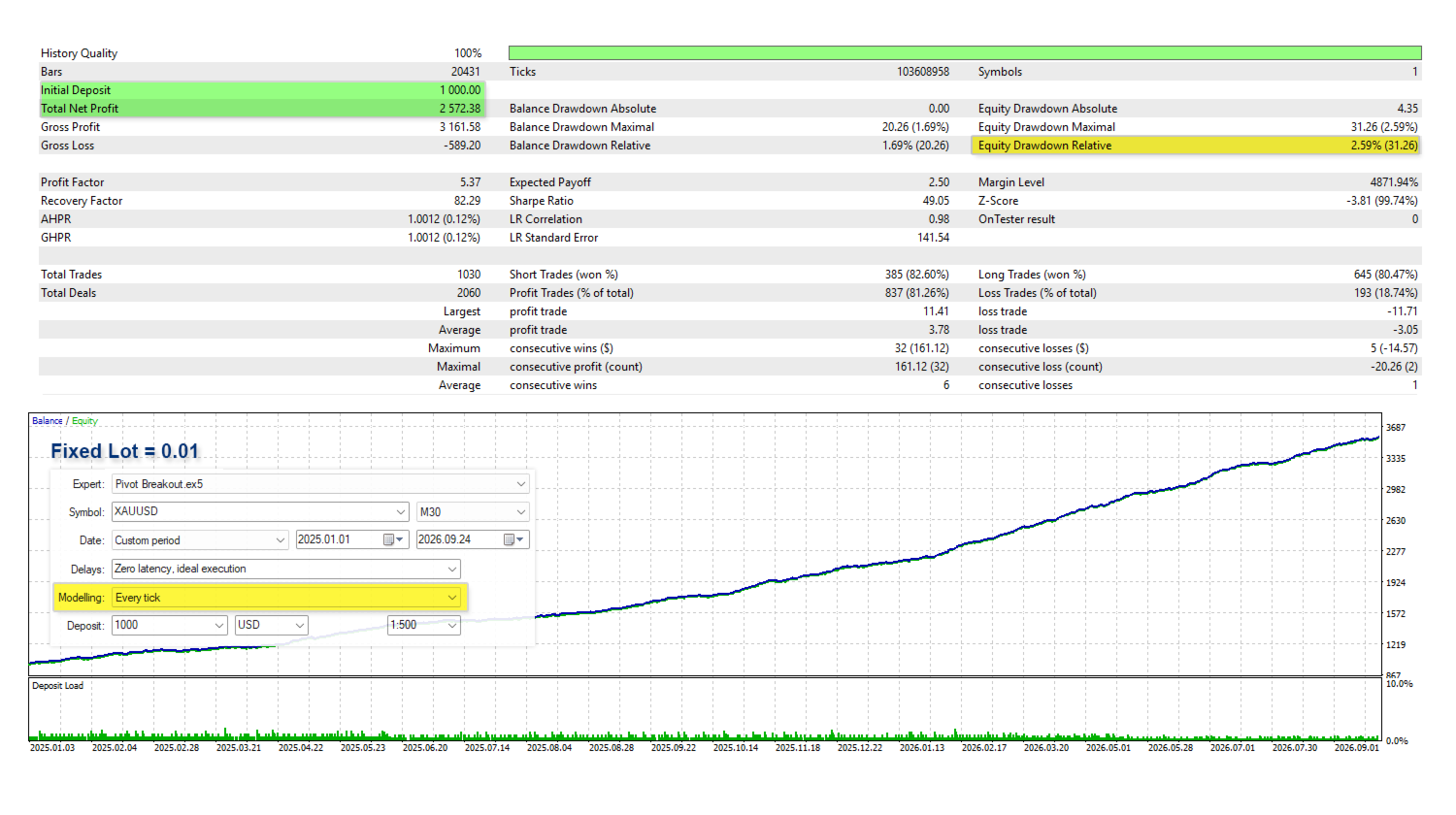
The fixed 0.01-lot report uses the same period and 1,030-trade count. It records profit factor 5.37 and 2.59% relative equity drawdown. It is useful as a separate sizing example, but a small fixed lot and favorable simulated execution can produce a small drawdown percentage that is not transferable to a larger lot or another broker.
The period ends one day before the public listing date, so neither screenshot establishes a long retail forward record. Re-test the unchanged defaults with your intended costs and execution assumptions, preserve the inputs, and reserve data not used to choose the configuration. A developer report alone does not demonstrate that several enabled strategies diversify one another.
Account loss protection: the shared guides disagree
The linked family FAQ and PrizmaL risk-protection guide describe daily-loss and total-drawdown controls, but disagree about what happens at a limit. The FAQ says that with CloseAllTradesOnLimit set to false, new entries stop while existing trades remain. The separate protection guide says false closes the EA’s own trades, while true can close all account positions, including manual trades and other EAs, and remove pending orders.
The FAQ also distinguishes a daily restart from a total-drawdown stop requiring intervention, while the protection guide broadly describes automatic resumption after the daily reset even though the total limit does not reset daily. These documents predate Pivot Breakout. We cannot establish the supplied build’s exact behavior from those conflicting descriptions.
If the controls are present, test them on demo: establish the reference balance, include floating loss, check the reset time, observe which positions close and whether trading resumes. Keep other strategies isolated while doing so. Do not rely on a generic “prop firm protection” label as a guarantee of compliance with a firm’s account rules.
Customer feedback and evidence scope
No public product reviews or posted buyer comments appeared for Pivot Breakout at this check. The linked signal also had no reviews. The developer’s aggregate ratings or feedback on other EAs are separate from this product; they are not Pivot Breakout verified-purchase ratings.
The listing supplies a live account link, original reports and a shared manual, which make the offer easier to investigate. Its recent release, newer public monitoring start, simulated execution and manual inconsistencies still limit the conclusions that can be drawn. The older signal image in the developer gallery shows a different dated snapshot and is not presented here as the current result.
Related EAs from the same author
Mavrik Scalper EA MT5 is the direct gold comparison: it operates on M5 with a different entry model and has its own signal, lot-sizing and backtest review. Pivot Breakout’s distinguishing feature is its M30 rule-based pivot framework and six component switches.
Zerqon EA MT5 and Loophole EA MT5 are also retained in the CheaperForex catalog after their MQL5 sales listings were removed. Loophole’s NZDCAD averaging strategy differs materially from this gold breakout design. Those older products’ results should not be used as validation of Pivot Breakout, and removal from sale alone does not establish why a listing ended.
Before putting the breakout strategy into use
Start by recording the default strategy switches, risk mode, lot output and server time on a demo hedging account. Measure stopped-trade cash exposure with several concurrent positions, observe pending-order behavior and verify news pauses. Compare actual fills with the ideal-execution reports before increasing position size.
Pivot Breakout offers a clear alternative to the author’s neural-network gold systems. The strongest buying case is its understandable entry concept and configurable components. The public evidence supports further evaluation, with broker execution and the actual loss-control behavior still requiring attention.
Explore Pivot Breakout EA MT5 and current pricing
Primary sources, checked October 1, 2026: Pivot Breakout listing and original gallery; dated public signal; shared settings FAQ; risk-protection guide.