
Scalping XAUUSD M1 EA MT5 trades gold’s short-term price impulses through Buy Stop and Sell Stop orders. Pablo Redondo Perez’s overview combines tick and continuation checks with EMA 9/21, Parabolic SAR and volatility filtering, then manages trades using monetary targets/cuts and optional adverse re-entry.
Our assessment: its appeal is a clearly disclosed gold M1 setup with several entry filters and a detailed test-input list. It may suit traders willing to examine execution and basket exposure on their own broker. The main consideration is fixed-volume re-entry after an adverse move: it does not progressively double lots, but it still increases total exposure, while several optional safeguards are inactive in the published test.
View Scalping XAUUSD M1 EA MT5 features and pricing

This source-based review was prepared October 13, 2026. The current listing displayed version 4.10; its overview calls the system XAU Scalper V4. The published input list is presented as the configuration used for the displayed historical test. We have not independently traded this EA or reproduced its results.
Impulse continuation on gold’s M1 chart
The EA looks at tick activity, movement speed and current volatility, then seeks continuation of a detected impulse. The published configuration uses a two-second signal window, a six-second confirmation window, minimum impulse 40 points and minimum confirmation 20 points. These are disclosed settings; the overview does not provide the complete executable entry formula.
EMA 9/21 and slope, Parabolic SAR and slope, ATR and recent-range checks, tick activity, current-candle confirmation and spread protection are enabled in the example. The separate candle-size and volatility-deviation filters are disabled. It is inaccurate to say every named filter is active merely because the EA provides it.
Stop entries and execution conditions
The example sets a ten-point pending offset, twenty-second pending lifetime and one pending order at a time, with cancellation on an opposite signal enabled. Distance-from-extreme and spread conditions can also reject an entry. Such checks describe eligibility, not guaranteed fills at the planned price.
The developer recommends low spread and stable execution, with a VPS for uninterrupted operation. The trading session shown is 08:00–18:00 broker server time on weekdays. Gold contract specifications, available tick history, commissions, latency and real fills can change outcomes even when the same inputs are used.
What fixed-volume re-entry changes
InpAllowAdverseReentry is true in the displayed test. If price moves against the existing basket, another same-direction position can be added using the same configured volume. The example uses a forty-point adverse step and ten-second minimum re-entry interval.
This avoids progressive lot escalation, but not increasing exposure. At the disclosed 0.5 volume, five simultaneously open positions would total 2.5 lots. That arithmetic is not a recommended account size or a maximum-loss estimate: gold contract details, exit behavior and execution determine the monetary exposure.
Published controls versus active settings
| Control group | Disclosed test configuration |
|---|---|
| Position size and count | Fixed initial volume 0.5; maximum positions 5; Buy and Sell enabled. |
| Monetary exits | Target 20.5 and loss parameter 25 per position, in deposit-currency units; adaptive loss cut enabled. |
| Signal and time exits | Opposite-signal loss closing enabled; minimum ten seconds before signal exit; basket holding input 180 minutes. |
| Hidden basket trailing | Disabled, despite start/distance values being present. |
| Equity and daily limits | Equity protection 0.0; daily entry, losing-exit and monetary-loss values zero. |
| News protection | Disabled. |
Monetary settings use the account’s deposit currency, not universally US dollars. Their existence does not establish broker-held price stops, a fixed percentage risk or exact realized exits. Five position-level controls do not guarantee a portfolio loss ceiling. Test basket behavior during fast adverse gold moves, including re-entry and opposite-signal exits.
The original Spanish test report, explained in English
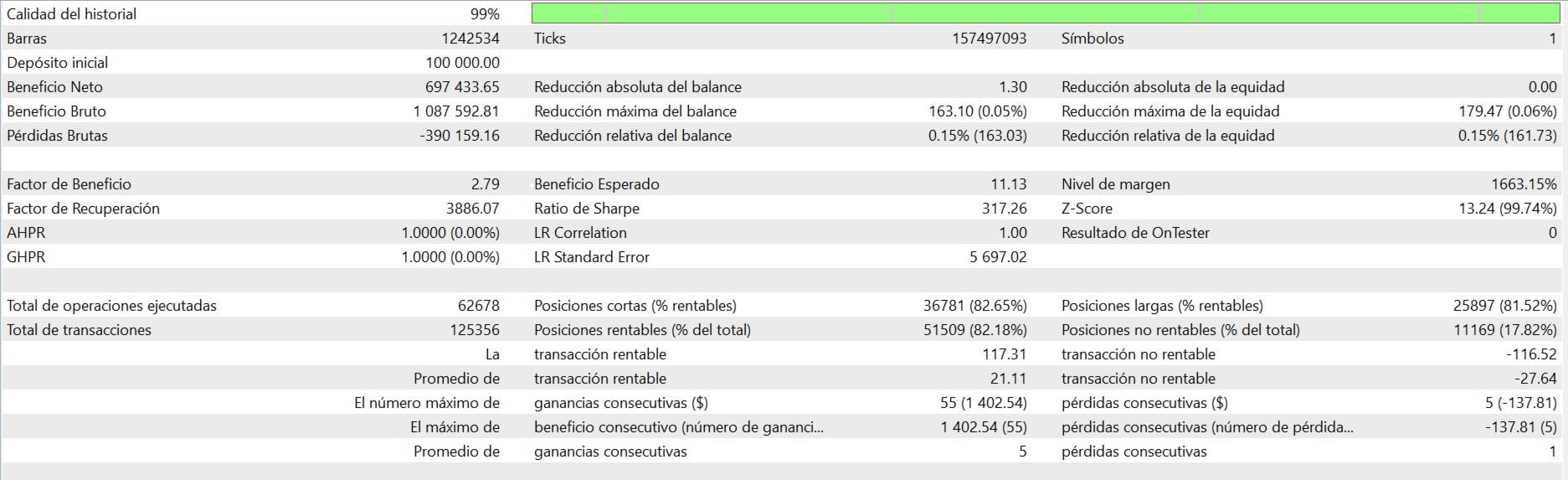
The report displays an initial deposit of 100,000, net profit of 697,433.65, profit factor 2.79 and 62,678 trades, with 82.18% profitable trades. These are historical tester statistics, not independently verified live returns. The displayed 99% history quality does not establish a particular tick-testing model or reproduce real execution.
Relative balance and equity drawdown are both displayed as 0.15%, with amounts of 163.03 and 161.73 respectively. The separate maximal figures are balance 163.10 (0.05%) and equity 179.47 (0.06%). These are different measurements. Small percentages alongside a 100,000 test deposit cannot be transferred unchanged to a smaller account using the same volume.
The report’s average losing trade is 27.64, and its largest loss is 116.52, compared with the overview’s loss input of 25 per position. The cropped evidence does not let us reconcile the exact test configuration, execution or costs. This is a reason to avoid presenting the input as a guaranteed realized-loss ceiling.
Balance, equity and deposit load
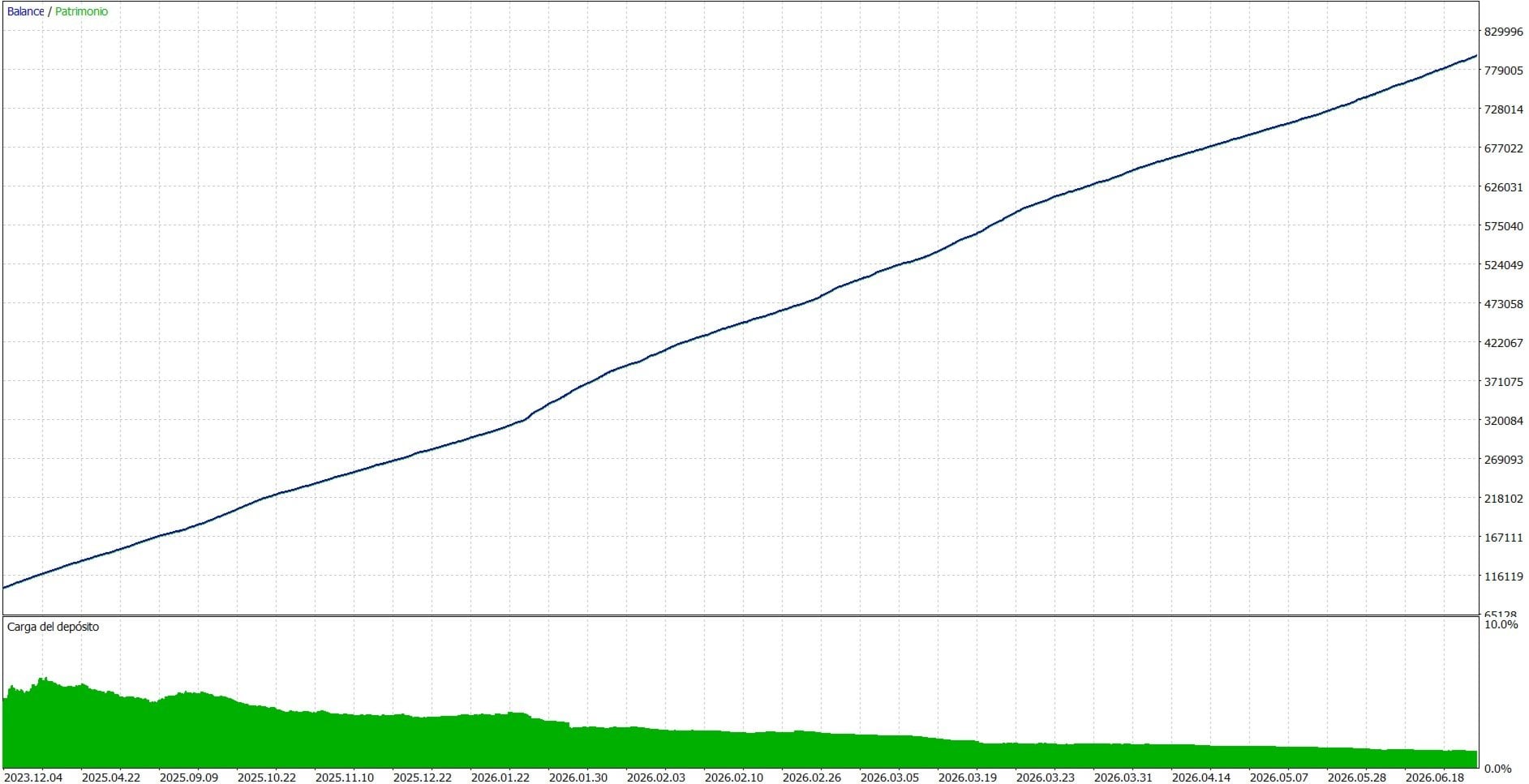
The curve rises strongly, with balance and equity appearing close together and deposit load shown below. That is useful visual context, but it does not measure future execution or guarantee similar behavior with different capital, spreads and gold specifications. Reproducing the configuration on the intended broker is more informative than using the curve’s appearance as a risk estimate.
Public source and customer-feedback scope
The developer’s seller profile listed two products and no published signals. The checked listing provided no linked public manual, preset or monitored signal, and no release-history tab was available. Its public Comments panel was empty, and no product customer reviews were present. We therefore make no live-account or third-party customer-rating claim.
Verify it yourself
Read the official Scalping Xauusd M1 overview and Pablo Redondo Perez’s seller profile. Use the supplied build’s actual controls and your broker’s environment to assess operation; this is source analysis, not an independently verified trading test.