
Available from CheaperForex
Ethereum Beast EA MT5 trades ETH breakouts through pending entries split into separately managed legs. Each leg has defined SL/TP and break-even management. The distinctive controls are venue-aware sets, trading-cost checks, a leg cap, entry spacing and local chart diagnostics.
Our assessment: it suits traders who want to inspect ETH execution and manage exposure across several breakout legs. The main considerations are aggregate position risk, the difference between historical test grades and future losses, and the separate setup responsibilities of the optional Binance connector. Sources were checked 31 October 2026; this is a source-based review, not an independently reproduced test or firsthand terminal assessment.

How the breakout legs are managed
Arnold Bobrinskii describes a system that waits for entry conditions and places pending stop orders, with protective SL/TP intended for each leg. Favorable movement can move the stop to break-even plus a small amount; the design combines earlier protected exits with legs targeting a larger move. Exchange fill confirmation and protection recovery still depend on the connector’s operating state.
The no-grid, no-martingale and no-averaging statements are developer descriptions, not our inspection of the executable. Separate stops do not make simultaneous exposure disappear. If several entries fill during the same ETH move, a reversal, gap or execution problem can affect several legs together.
Four sets do not mean four independent strategies
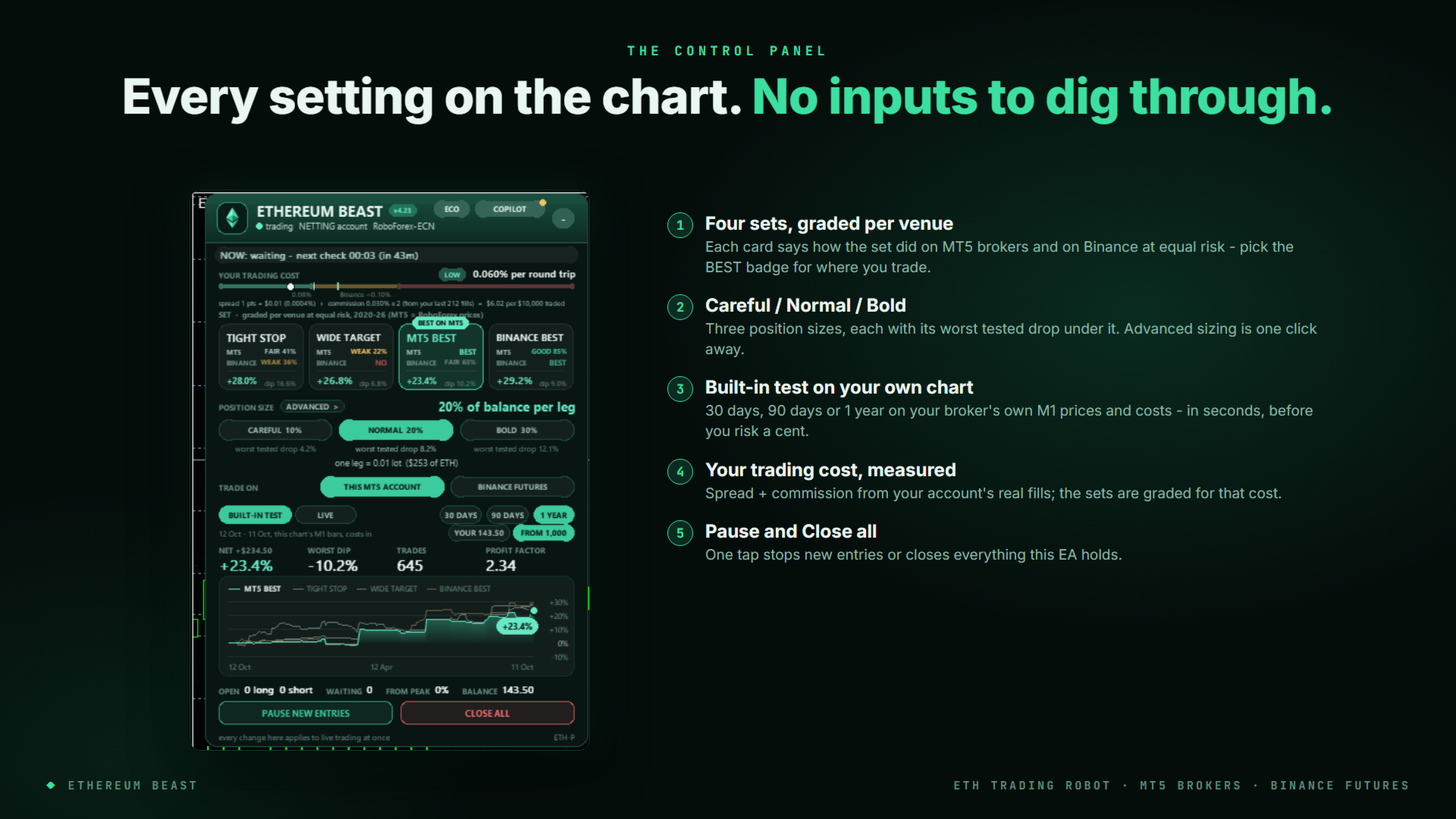
AUTO chooses a venue-oriented set. MT5 BEST retains part of a move for a farther target; BINANCE BEST favors quicker break-even management; TIGHT STOP is aimed at lower-cost brokers; WIDE TARGET is aimed at higher-cost execution and is restricted to MT5 hedging accounts. These are developer set descriptions, not independently verified performance rankings.
The panel also limits how many legs from a set may participate. Spacing places nearby breakout entries at small intervals rather than all at one price. It may reduce the number caught by one sharp spike, but a move through every level can still fill the group.
The trailing-lock option treats the first leg on a side differently from later additions: the first can retain its target while later legs follow favorable movement more closely. The current overview describes AUTO as enabled for Binance and disabled for broker execution. Changing that behavior changes the exit sample rather than merely changing the display.
Broker execution and the optional connector are different routes
Standard mode trades the broker’s ETH symbol through MT5 pending orders without an exchange API key. The developer lists hedging/netting compatibility and broker-held protective orders, but per-leg bookkeeping should not be assumed to provide identical physical stop behavior on both account types. WIDE TARGET is specifically restricted to hedging accounts; netting execution has not been independently tested here.
Optional Binance USD-M futures mode uses the customer’s own account, one-way position mode and futures-trading API permission with withdrawals disabled. The specified WebRequest destination is the Binance futures API. The source describes exchange-side conditional entries and reduce-only protective exits per leg, with an ETHUSDT chart/feed prepared by the connector.
This does not supply exchange access, account approval or API credentials. Fees, funding, contract rules, margin and connectivity differ from broker execution. The overview still labels other exchanges as forthcoming, but the dated 4.35 release note from 28 October lists Bybit USDT perpetuals, OKX USDT swaps and Hyperliquid as beta connectors. That is developer-reported beta support, not independently tested equivalence to the primary broker or Binance routes.
The public record is a young MT5 broker account
The developer-linked signal 2395471 was checked on 31 October 2026. It is an MT5 account at RoboForex-ECN with 1:500 leverage, trading ETHUSD. This is broker-account evidence, not a record of Binance or the newly added beta connectors.
- Cashflows and growth
- 127.88% growth; $53.47 initial deposit plus $68.38 profit equals $121.85 balance/equity. No added deposits or withdrawals.
- Trade sample
- 41 ETHUSD trades: 36 winners and five losers; profit factor 5.22.
- Relative drawdown
- Balance: 20.63% ($12.04). Equity: 22.90% ($19.94).
- Maximal balance DD
- $12.44 (21.32%), separately from the relative fields.
- History labels
- Six weeks displayed; the source’s Started field is 13 October 2026 at 20:17:23. Its activity tooltip reports 12 days of monitoring.
The source warns that the account is new and that unusually high recent growth implies high risk. A 14 October event-log entry said one day accounted for 80% of growth at that point, highlighting historical concentration. A six-week account-history label does not establish six weeks of continuous public monitoring or one unchanged current build. The history predates retail publication and the 4.35 update.
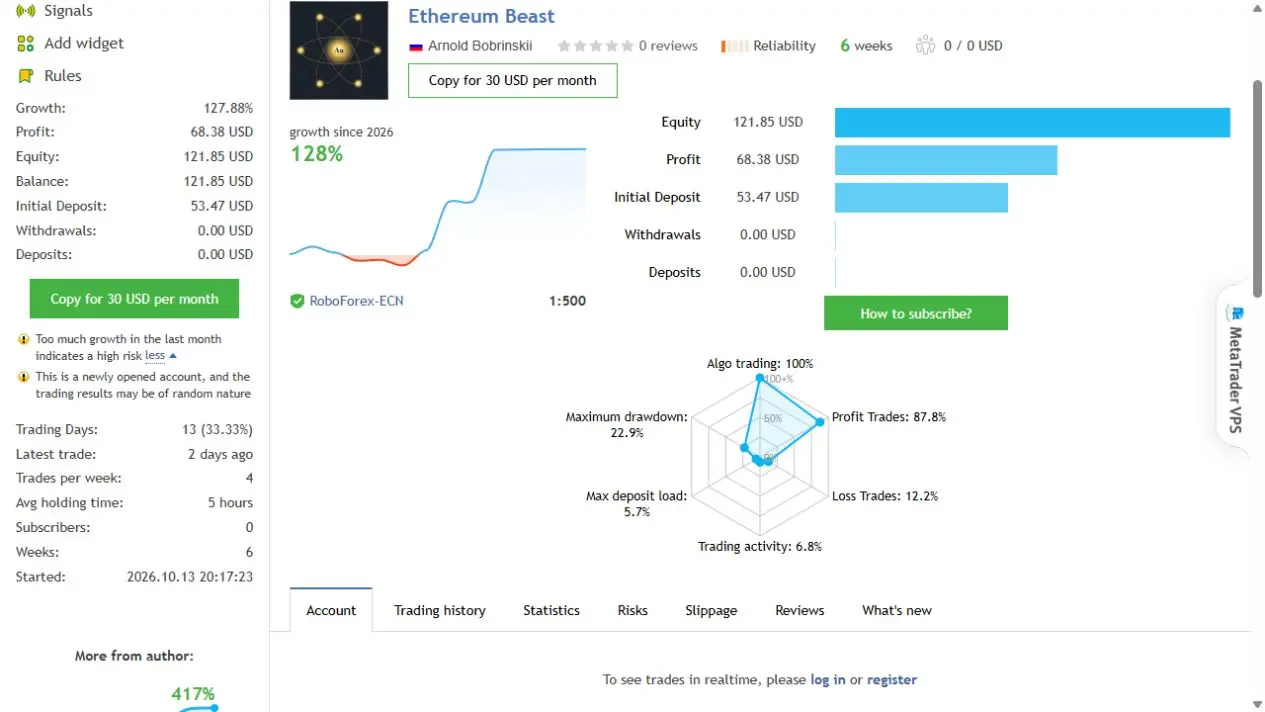
The tiny initial balance does not validate a universal minimum deposit or low-risk configuration. The developer’s 20 October study describes this signal as running above default risk. In a 14 October public reply, the author said the settings had been sent privately; exact current parameters are not established here. The observed 22.90% relative equity drawdown must not be compared with the panel’s historical 10% calibration as if settings were identical, and neither figure guarantees a future loss cap.
Read the risk labels as historical measurements
The source grades its sets using a common worst-tested-drop reference over historical data and venue costs. The displayed 10% figure is not a future drawdown cap or protection order. The built-in chart test uses broker M1 history and measured trading cost; it is a useful comparison tool, not a prospective or independently reproduced trading record.
The developer’s 20 October portfolio study combines Ethereum Beast with Gold Beaver in retrospective 2020–2026 MT5 tests. It reports M1 data, spread/commission/swap costs, a $10,000 start and a 100-lot order cap. ETH sizing was 38% of balance per position, versus the stated 20% default. Its −0.07 correlation and approximately 15% tester drawdown are historical results; daily-sampled charts show about 13%, a different sampling method. They do not guarantee future independence or portfolio risk.
The overview quotes minimum-balance examples at a 20%-per-leg size setting: about $1,300 with a 0.1 ETH minimum lot, or about $150 on Binance. This is not established as a 20% stop-loss risk measure or a safe starting-balance recommendation. Minimum order size can force actual allocation above the requested setting, while multiple legs add aggregate exposure.
Local diagnostics still need an operating terminal
The on-chart copilot reads the EA’s own setup and trading state. It can explain why filters block entry, show proposed orders and report status. This is not evidence of an external language model or a separate paid AI dependency. The source’s local-readout description should not be confused with a promise that exchange mode sends no network traffic.
The position check compares broker/exchange holdings with the EA’s book, while restart handling rebuilds that book and reports intervening closures. These are reconciliation features, not guarantees that every disruption is resolved. Keep the terminal running on a stable connection or VPS; remotely held protective orders do not replace continuous operation for new entries and active management.
Release changes and early buyer feedback
The listing was published on 14 October 2026. Version 4.35, dated 28 October, adds the beta connectors, immediate panel/copilot changes, chart-specific settings and revised Binance fill handling; its note says the MT5 broker trading rules are unchanged. These operational changes should not be mistaken for demonstrated performance gains.
The earlier 4.32 note describes repeated fill checks and an orphan guard intended to adopt an unbooked Binance position within a minute. This qualifies any assumption that every failure is protected instantaneously. An earlier roadmap mentioned an ONNX model as future work; the current release does not establish that a trained AI module has shipped.
betokasu, 23 October 2026: the sole written buyer review praises the developer’s responsiveness after installing the EA the previous day and says performance remains to be seen. It is early setup feedback, not a measured return record, and predates the 4.35 update.
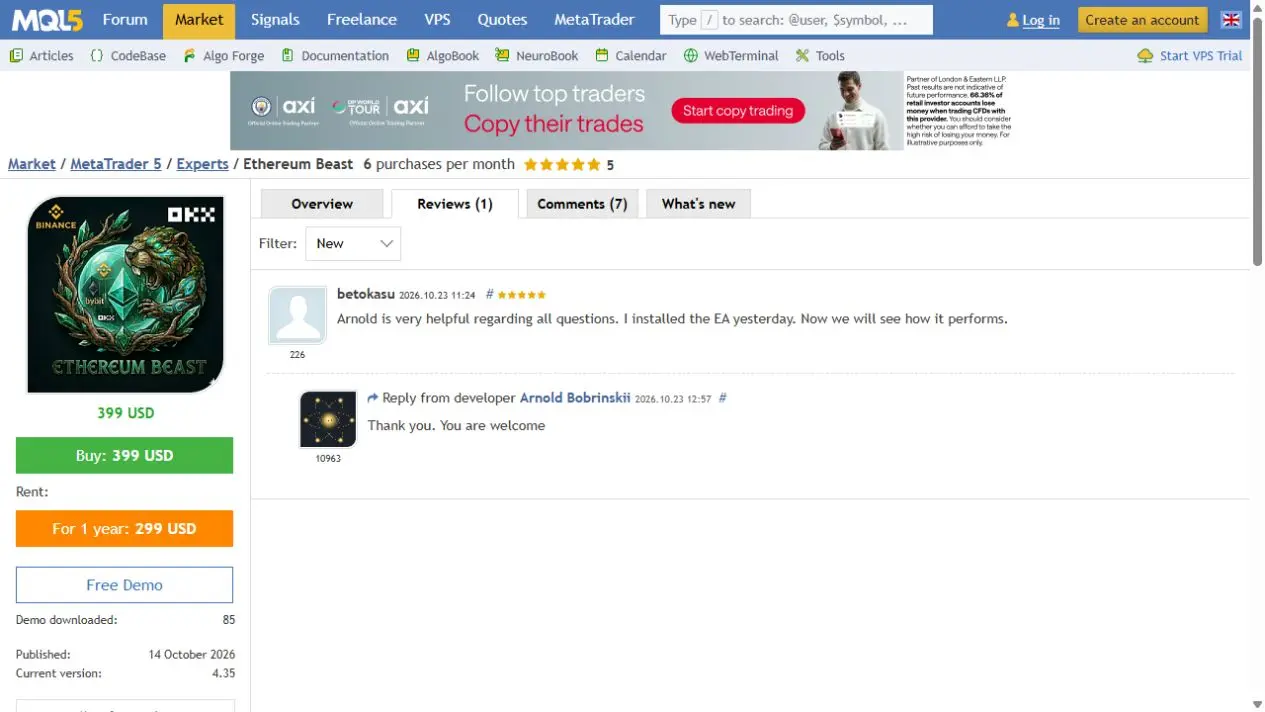
MQL5 customer opinion is separate from CheaperForex verified-purchase feedback and does not independently verify the trading claims.
Other products from this developer
See our Bober Crypto review, Bober Lazer review and Gold Beaver review. Their results are separate evidence and should not be transferred to Ethereum Beast.
Verify it yourself
Read the current developer listing, the release notes and the linked public signal. Compare platform, trade history, costs, cashflows and drawdown with the dated evidence. Historical results do not guarantee future performance.
Choose Ethereum Beast EA MT5 from CheaperForex