
Ultimate Breakout System EA MT5 is a configurable portfolio framework built around support/resistance, volatility and opening-range breakouts. Its strength is the ability to organise several tested configurations from one chart. Its main demand is configuration discipline: a large preset library is not the same as a validated portfolio.
View Ultimate Breakout System EA MT5 features and current pricing
Ready to Buy Ultimate Breakout System EA MT5?
$479.99 with crypto · $599.99 by card
✅ Build a Breakout Portfolio
✅ Check the current offer and the platform requirements before purchase.
Official version · Instant download · Free lifetime updates · 7-day money-back guarantee
Our assessment: CheaperForex supplies a standalone file, with free lifetime updates. We examine the public portfolio record, external-file setup and customer evidence without treating one account as proof of every preset.

Current product check — 24 September 2026
Review the current external-file and AutoLoader requirements when configuring the supplied build. The public 44-strategy portfolio is one evolving combination, not independent validation of every downloadable preset.
What does Ultimate Breakout System actually do?
UBS is a toolkit for building breakout strategies, rather than a fixed gold-only robot. The current documentation offers support/resistance, volatility and opening-range entry models. The practical difference is how each defines the level or range that price must escape before a trade can begin.
- Support/resistance breakout
- Uses price levels and configurable entry conditions; the release notes also describe a break-and-retest option.
- Volatility breakout
- Looks for a move beyond a defined consolidation or volatility setup.
- Opening-range breakout
- Uses a selected time window to form the range. Broker time and session settings therefore deserve particular attention.
- Trade management
- Stops, targets, trailing choices and trading windows let different presets behave differently. The product name alone does not tell you the risk of a configuration.
The official UBS listing is the source for current capabilities. The public V7.0 manual is an earlier document; consult the current release notes alongside it. Later notes include fixes to AutoLoader’s P&L display and opening-range parameters, so build compatibility matters.
The preset library is a starting point
The current listing advertises 300+ strategies. The developer’s archive contains a substantial collection of set files, including portfolio and optimisation configurations. A large file count does not establish that every setup is independent, equally robust or suitable for your broker.
Use the developer’s public manual and presets to understand what you are changing. Test beyond the period used to choose parameters, include realistic costs and compare nearby settings. A strategy that works only at one finely tuned combination deserves extra scrutiny.
OneChartSetup: the useful feature with an important caveat
AutoLoader runs compatible presets together from a single chart and supports portfolio backtesting. The manual requires separate magic numbers, exact ForceSymbol values and explicit timeframes, with the files in Common/Files/Sets. These are trading-configuration requirements, not information you must send us to place an order.
The developer’s portfolio setup discussion explains the 44-strategy example. The same discussion section warns that MQL5’s built-in VPS does not transfer the external files needed by AutoLoader. Use a full Windows environment for this workflow, and test any alternative deployment arrangement before relying on it.
Its historical drawdown-based sizing can help balance strategies, but a calculated risk per strategy is not a hard cap. Correlation, a new market regime and execution differences can push combined losses beyond the backtest.
Public signal at 12 September: growth and losing periods
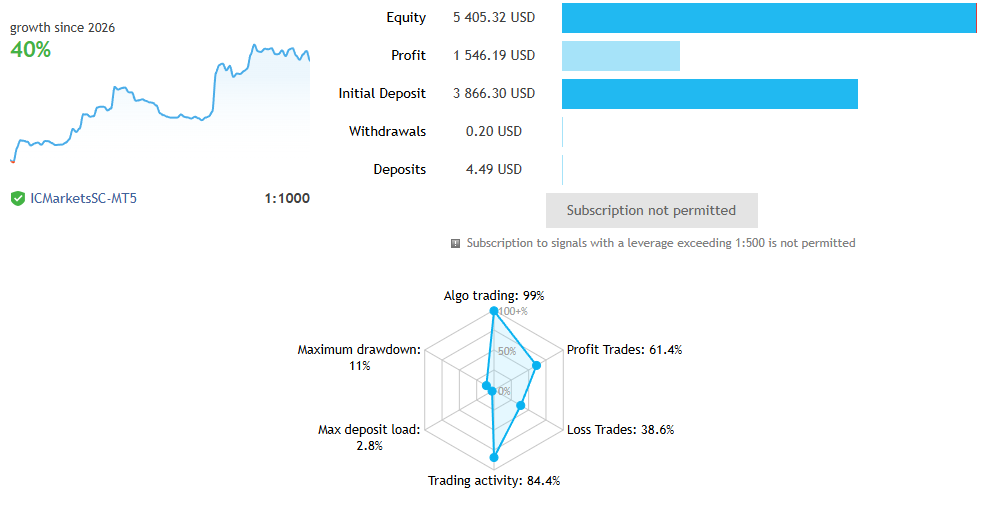
The Ultimate Breakout System 44 strategies signal was labelled a real MT5 account on ICMarketsSC-MT5. At capture it showed 40.16% growth, 1,145 trades and a 1.32 profit factor. The account’s displayed start was 16 May 2026. A monitoring-duration tooltip showed roughly 85 days, shorter than its displayed 18-week history.
- Balance drawdown
- MQL5 reported 11.00% maximum relative balance drawdown.
- Equity drawdown
- The separate maximum relative equity figure was 3.63%. These are distinct reported measures; quoting only the smaller number would give an incomplete risk picture.
- Losing months
- July showed −8.06%; September was approximately −1.9% at this partial-month snapshot.
- Leverage and copying
- The account used 1:1000 leverage. MQL5 blocked signal subscriptions because that exceeds its 1:500 threshold. Viewing the record is different from being able to subscribe.
The developer expanded this portfolio from 30 to 44 strategies in July. Its full history therefore is not a continuous test of an unchanged 44-strategy configuration. The results are encouraging enough to investigate, but several months of history and a modest profit factor do not establish resilience across many market regimes. Leverage is not a recommendation for your own account.
What do MQL5 customers say?
The MQL5 customer reviews include substantial praise for the developer’s support, configurable settings and portfolio tools. Yong Ket Hoong describes presets as a starting point across several markets; evefern explicitly says it was too early to judge profitability. Those are useful distinctions between liking the software and establishing trading performance.
A newer review from Celal Yazici questions the price-to-value ratio and stresses that breakout entries do not always work. That is a relevant counterweight to extremely enthusiastic comments. Customer experiences depend on the settings, broker and period traded; neither praise nor criticism substitutes for an account record. Access to private developer communities mentioned by reviewers should not be assumed to be part of a different seller’s offer.
UBS or a more focused EA?
Choose UBS for its ability to configure and combine breakout ideas. If you mainly want to assess a gold-specific system, The Gold Reaper MT5 from the same developer is a relevant comparison. Sharing a developer does not make their results interchangeable.
UBS is most useful when you are willing to backtest, verify symbol mappings and monitor combined exposure. It is a weaker fit if you want to run every preset immediately or expect custom settings to guarantee prop-firm approval. Each firm’s current rules still apply.
Our verdict
Ultimate Breakout System offers meaningful flexibility: three documented entry models, detailed exit controls and a practical portfolio workflow. Its case rests on those tools and the evidence for selected configurations, not on the size of the library alone. Start with a manageable portfolio, validate it on your broker and judge drawdowns alongside growth.
View Ultimate Breakout System MT5 & pricing →