
Zxcvbnm MT5 trades gold, EURUSD and GBPUSD with a compiled machine-learning entry model, tight fixed exits and a spread gate. It is the shorter-horizon member of Inrexea’s new pair of systems. The appeal is a limited set of controls and a clear rule against averaging into losing trades. Its main practical consideration is execution: small targets leave less room for spread and slippage.
Our assessment: the design is straightforward to understand, but the public record is far too young for a strong performance recommendation. The standalone file also needs to be distinguished from the developer’s connected Database edition. We reviewed the listing, screenshots, comments and public accounts; we have not independently traded or reproduced the EA.
View product details and current pricing.

Evidence checked 13 September 2026. Current standalone listing: v1.10.
Three markets, one position per market
The official Zxcvbnm listing identifies XAUUSD as the busiest instrument, with EURUSD and GBPUSD watched by the same model. You attach the EA once to any chart; it uses its own data rather than the attached chart’s timeframe. Individual markets can be disabled, which is useful when assessing execution or limiting exposure.
The developer describes fixed take profit and stop loss, managed on each tick, plus a broker-side safety stop. There is no grid, martingale or averaging in the stated design. A losing position is meant to exit rather than be defended with more orders. That controls the structure of risk, but does not establish that entries have a profitable edge.
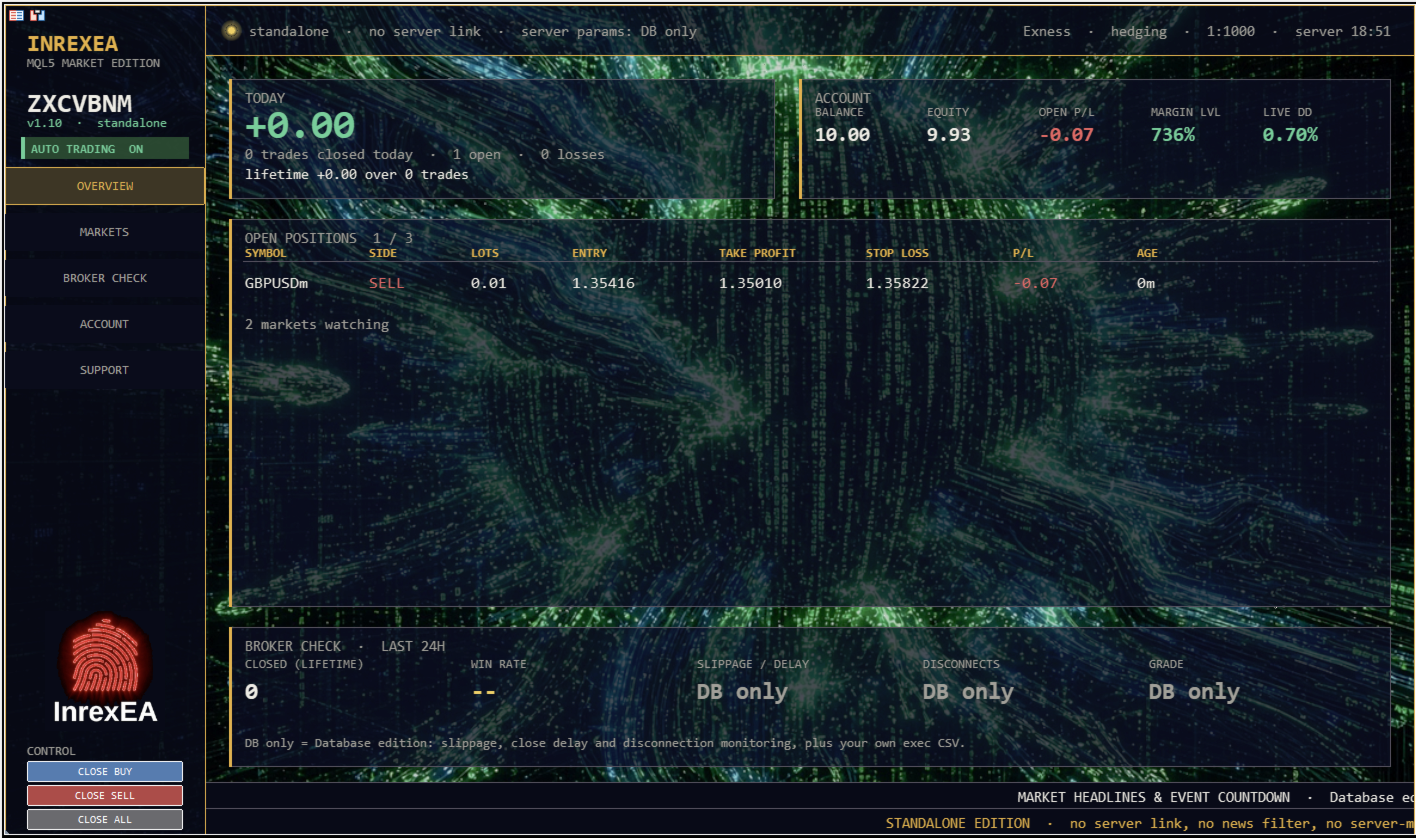
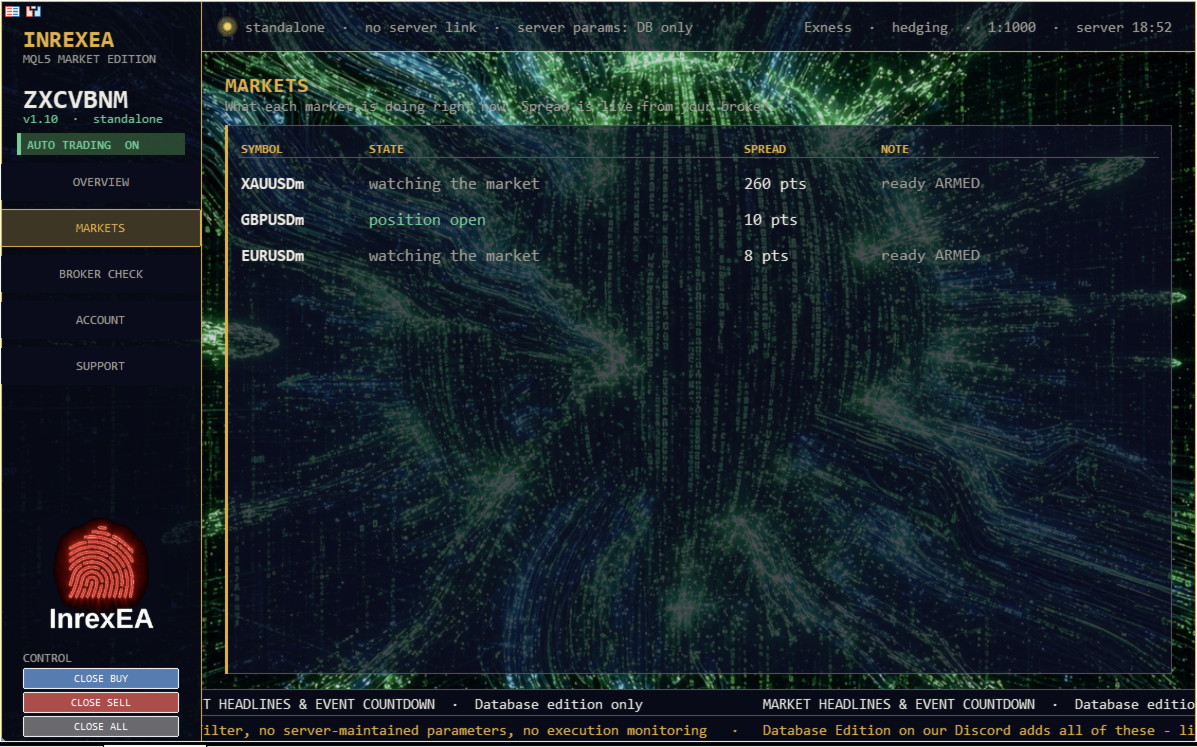
The original standalone dashboard shows positions, account values and instrument status. Its zero-result example is a software illustration, not proof of performance. The market screen also makes the instrument-level spread readings visible, which fits the product’s execution-sensitive design.
Why the spread gate matters
Zxcvbnm’s built-in gate skips entries when the current spread is above its allowed limit. With tight targets, trading costs can absorb a meaningful share of the intended move. A rejected entry may therefore be normal behaviour rather than an installation fault.


You can set risk per trade and enable markets, but cannot freely optimise the standalone stop and target distances. The default is stated as 1% of balance. If three positions were open at that setting, their combined intended stop risk would be greater than one trade’s 1%; realised losses can also be affected by gaps and execution. Broker minimum lots can push the actual percentage above a small requested value, so check the journal.
A stable VPS helps keep tick-based management running. It cannot guarantee a particular fill or remove broker-side delay. On a netting account, take particular care when several systems trade the same symbol: positions are combined at account level, so a magic number alone should not be assumed to isolate every interaction.
Standalone and Database are different editions
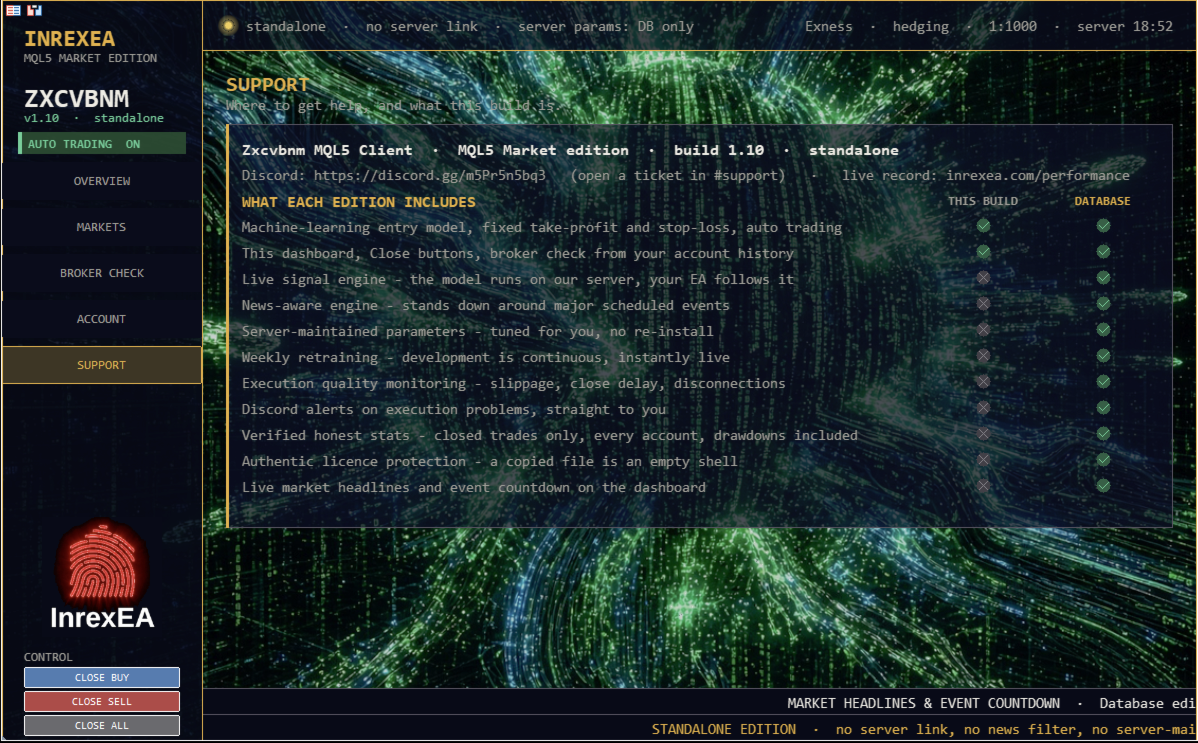
The developer’s comparison screen is particularly useful. Standalone v1.10 includes the compiled model, fixed exits, dashboard and local broker check. It explicitly excludes the live server-side engine, connected news awareness, server-maintained parameters, weekly retraining and remote execution monitoring. Those are Database features.
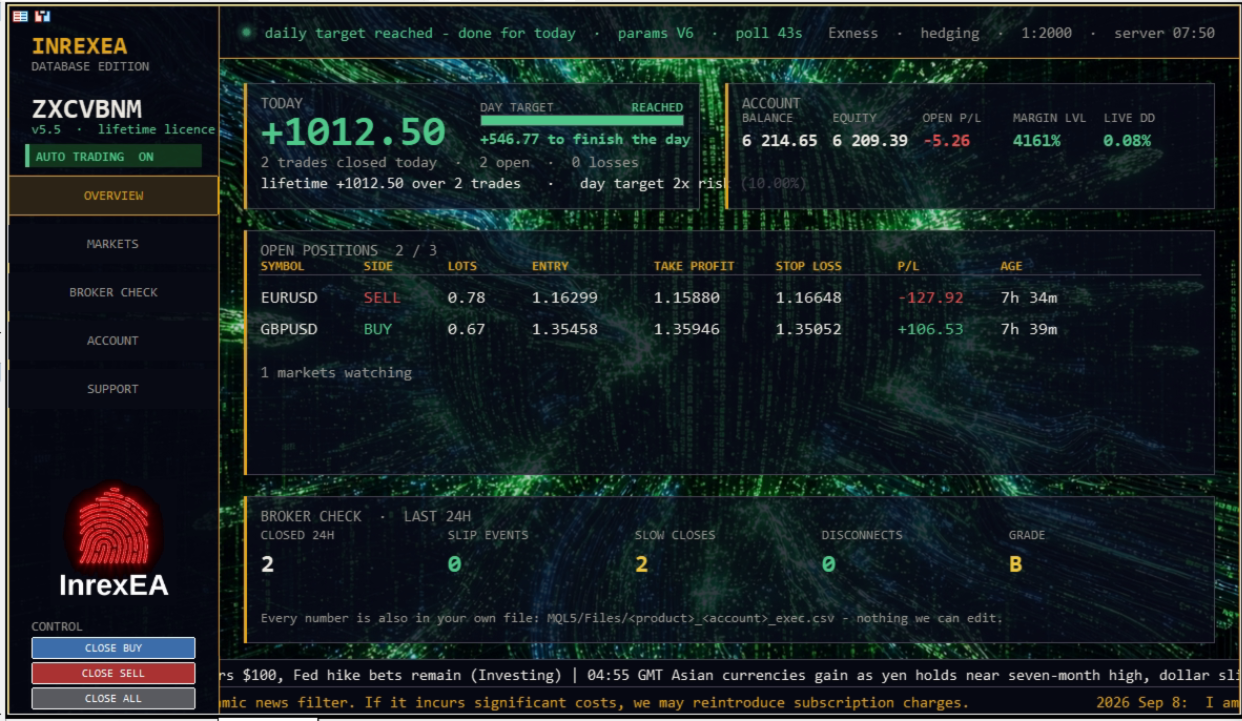
The additional dashboard above is a developer Database-edition example. Its result figures and connected functions should not be attributed to the file sold here. In the developer’s product comments, the author discusses Database v5.6, dynamic targets and market headlines. That is not a release note saying the standalone v1.10 file has those capabilities. The full guide is supplied privately; we did not find a public manual to inspect.
The Exness signal: small loss, very short history
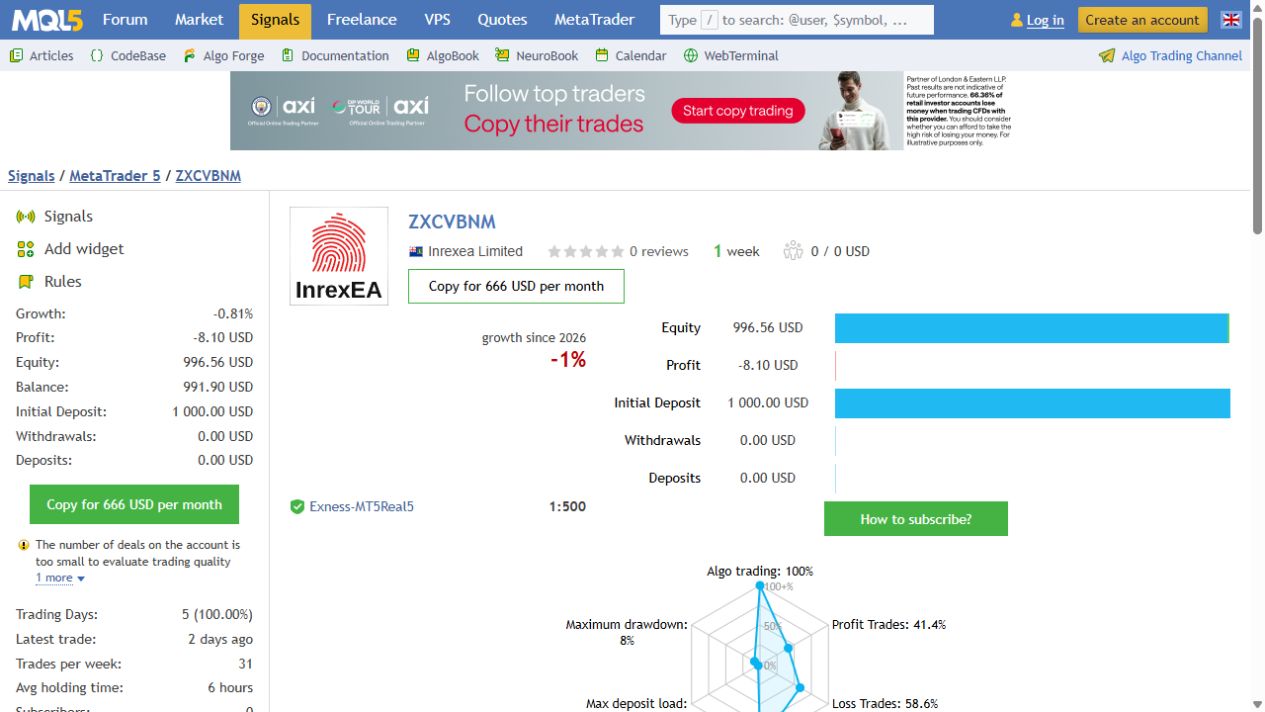
The listing links to the MQL5 Zxcvbnm signal, identified as a real account on Exness-MT5Real5 with 1:500 leverage. At our check, its $1,000 initial deposit had become a $991.90 balance, with $996.56 equity. There were no additional deposits or withdrawals shown.
- Growth / net profit
- −0.81% / −$8.10.
- Closed trades
- 29: 12 winners and 17 losers; profit factor 0.95.
- Trade distribution
- 21 gold trades, four GBPUSD and four EURUSD.
- Drawdown
- 8.01% relative balance drawdown; 0.59% reported relative equity drawdown.
- History context
- Five trading days; monitoring start shown as 11 September 2026. Average holding time six hours.
The six-hour average is worth comparing with the short-horizon description: “quick” should not be understood as every trade closing in seconds. More importantly, the very brief monitoring period and larger balance drawdown mean the lower recorded equity figure should not be used as a complete risk ceiling. Imported trade history and a continuously monitored equity history are not the same evidence.
The developer’s performance page separately labels its Zxcvbnm card “DB Live #1” and reports results on a different update schedule. Its displayed figures were not identical to MQL5’s snapshot. We therefore retain the source and date of each claim instead of merging them into a single record. Neither page establishes an exact standalone-build match.
MQL5 flags both the small number of deals and the newly opened account. A 29-trade loss does not prove the system cannot work, but it plainly does not support a claim of established profitability either. A longer, clearly identified standalone record would be much more useful.
The nine-month developer backtest
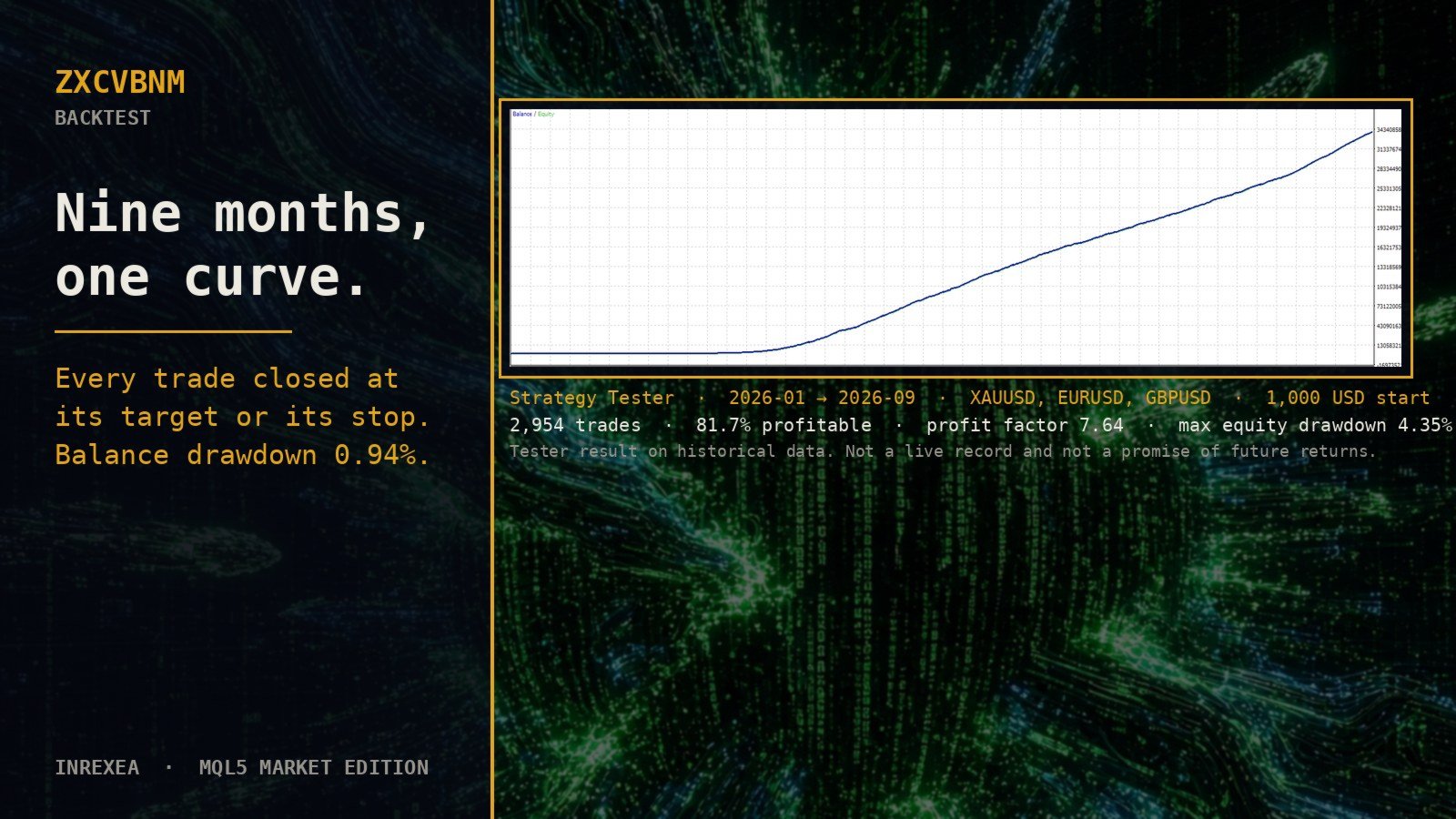
The graphic covers January–September 2026 and reports 2,954 trades, 81.7% profitable trades and a 7.64 profit factor from a stated $1,000 start. It prints 0.94% balance drawdown prominently, while the smaller text states 4.35% maximum equity drawdown. Both figures matter; presenting only the smaller one understates the test’s reported floating risk.
These are developer-supplied historical results, not an independent rerun. Their large difference from the very short live sample is a reason to investigate data, settings, execution assumptions and edition identity, not a reason to project the test curve forward. The linked developer’s explanation of backtesting itself argues against treating historical curves as promises and discusses execution and overfitting. That caution should be applied to this graphic too.
What does the MQL5 review actually say?

The sole visible rating entry, by ViktorN N on 9 September 2026, contains no written comment. The developer replies with thanks and a support invitation. It would be inaccurate to turn that into a testimonial about profits, reliability or customer service. The original MQL5 review is shown above so readers can see the limited evidence for themselves.
Zxcvbnm versus Qwertyuiop and My Last Strategy
Qwertyuiop MT5 adds silver and Bitcoin and uses price-percentage exit distances. Its broader market list is the more relevant comparison if you want multiple asset classes in one interface. Read the Qwertyuiop review for its separate signal and risk discussion.
We also sell My Last Strategy MT5 from Inrexea. That uses a grid-based framework, making it structurally different from Zxcvbnm’s stated no-averaging approach. Our My Last Strategy review covers its own evidence. Developer identity does not make these records interchangeable.
Verdict
Zxcvbnm offers a focused three-market design and useful execution visibility. It may appeal to traders who prefer fixed exits over basket recovery and are willing to assess broker conditions carefully. The present evidence remains preliminary: a small losing live sample, one rating without commentary and an unverified historical test. The standalone/Database distinction is essential to making an informed comparison.