
Qwertyuiop MT5 watches gold, silver, EURUSD, GBPUSD and Bitcoin from a single chart, with machine-learning entries and fixed exits. Its defining feature is breadth: five independently selectable markets under one risk-sizing interface, with no averaging or martingale in the developer’s stated design.
Our assessment: the one-chart workflow and explicit exit rules are useful features, but five instruments do not automatically create a balanced portfolio. The public live record is young and appears alongside Database-edition material, so it is not proof of the standalone file’s performance. This review examines public sources rather than claiming an independent trading test.
View product details and current pricing.
Sources checked 13 September 2026. The current standalone listing is v1.10.
What the five-market design changes
The official Qwertyuiop listing describes XAUUSD as the model’s main area of activity, with XAGUSD, EURUSD, GBPUSD and BTCUSD watched through the same framework. This is not a requirement to trade all five. Disable instruments your broker does not offer or those you do not want in the account.

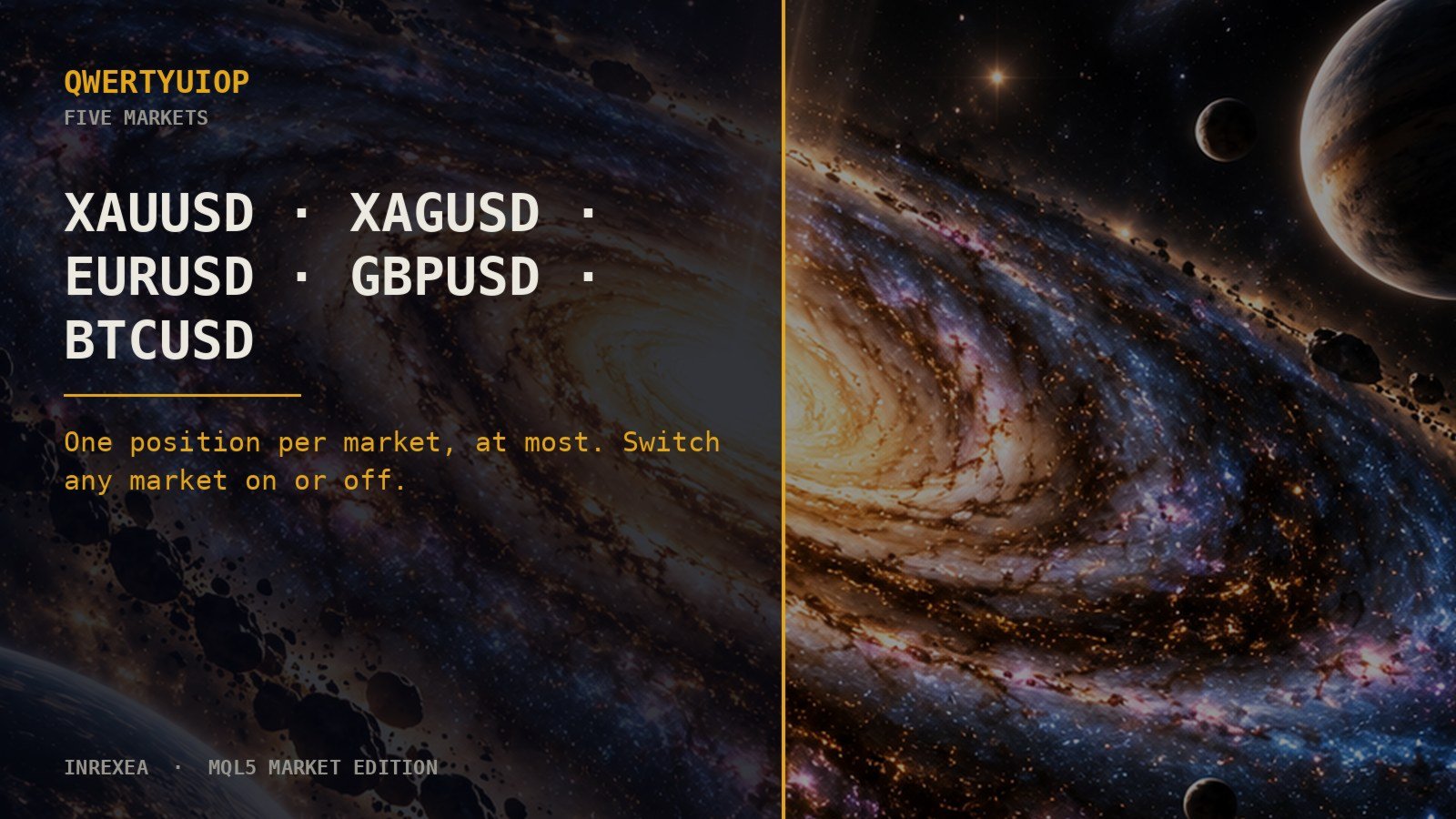
The compiled entry model runs locally. The chart symbol and timeframe are not the strategy selector: attach the EA once, choose the markets and set risk. Automatic prefix/suffix handling is stated, but contract sizes, minimum lots and trading sessions still need checking on your own broker.
The broader instrument list can offer more opportunities, but several markets may respond to the same macroeconomic event. Gold and silver often share drivers, while currency and cryptocurrency exposure adds its own risks. One position per market is a position limit, not a guarantee of diversification.
Fixed exits versus fixed account risk


Qwertyuiop defines take-profit and stop-loss distances as percentages of price. That is distinct from the percentage of your account risked through lot sizing. The build fixes the exits; you select the balance-risk percentage, whose stated default is 1% per trade.
For example, five simultaneous trades each sized for roughly 1% intended stop risk would represent roughly 5% combined nominal exposure before differences in fills and account values. A broker-side safety stop is useful protection, but does not guarantee execution at its requested price during gaps or thin liquidity. The absence of martingale removes one escalation mechanism, not the possibility of a large cumulative drawdown.
The developer specifies at least $1,000 and suggests 1:100 or higher leverage. Minimum lots can cause actual risk to exceed a small selected percentage; the EA is said to print that true percentage in its journal. Inspect it rather than assuming the input was achievable.
The dashboard and recent-trade broker check
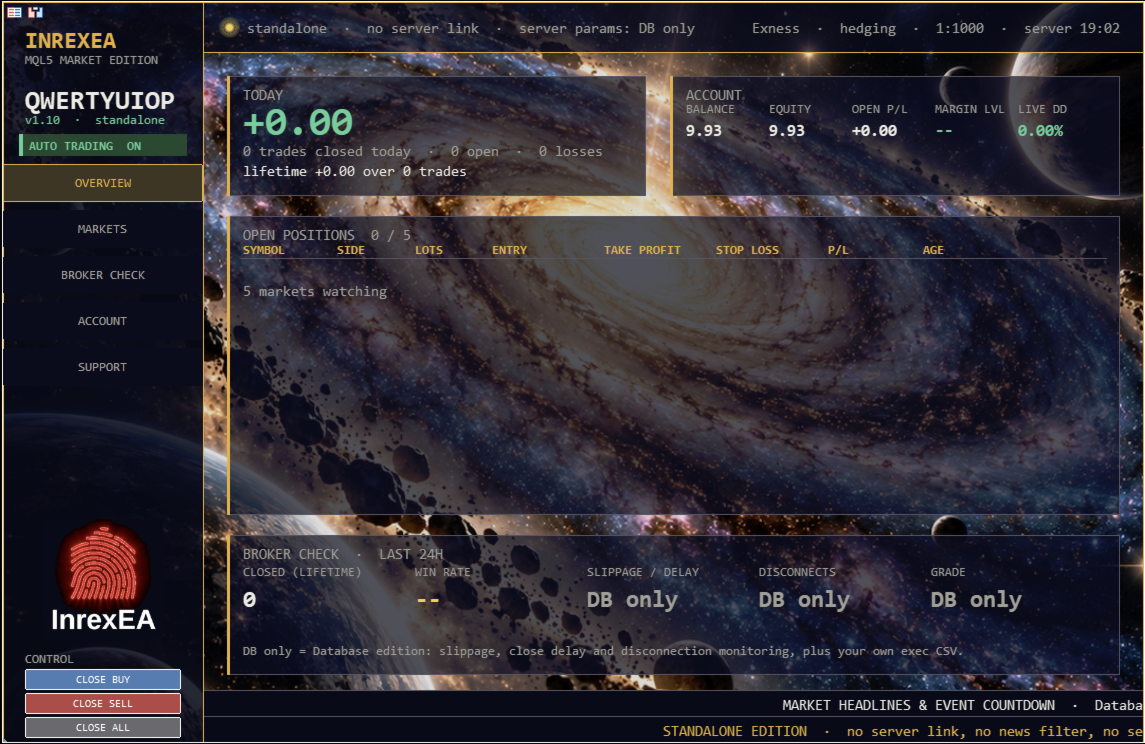
The standalone overview displays account values, open positions, exact exits and market status in place of a normal chart. The original screenshot is a zero-result demonstration, not an account-performance claim. Close controls are visible, which makes it important to understand how manual intervention interacts with the automated strategy.

The broker-check feature reviews the last ten closed trades, including requested versus filled price and closing behaviour. That can help investigate execution, but ten observations do not establish a broker’s long-term quality. It is also different from the Database edition’s remote monitoring and alerts.
Which features belong to the standalone file?
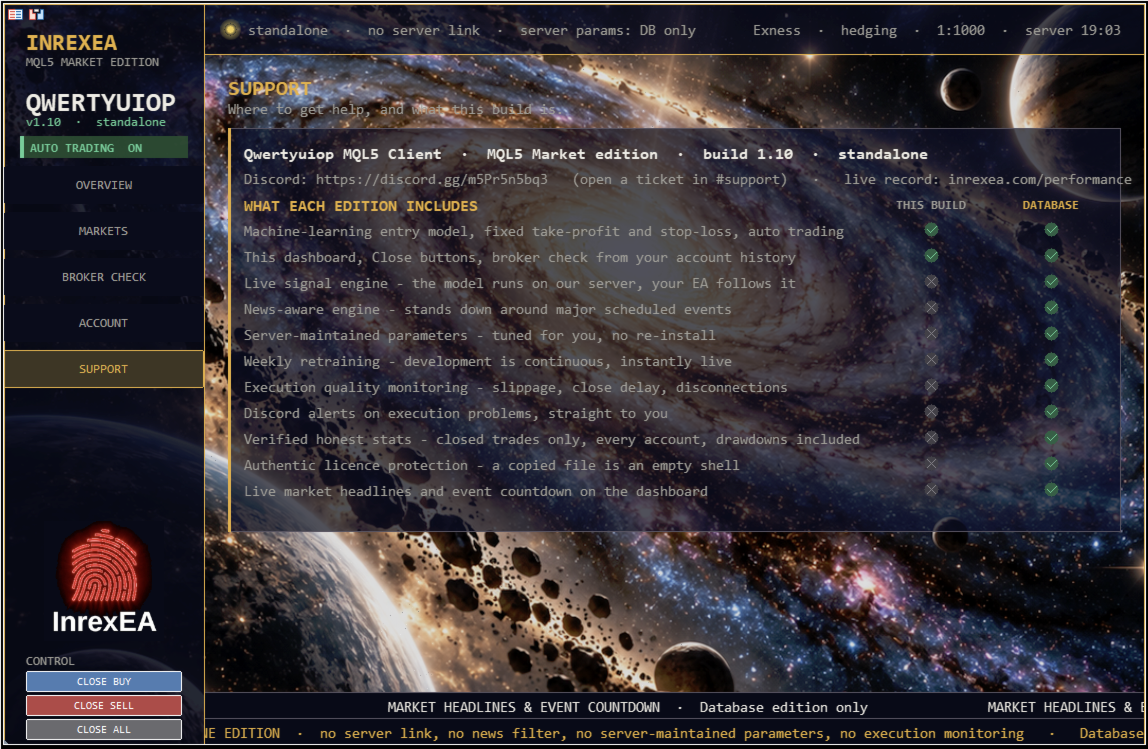
This developer comparison makes the distinction explicit. The standalone v1.10 file includes the locally compiled model, fixed exits, dashboard and local account-history checks. Live server models, weekly retraining, connected news awareness, server-maintained parameters and remote execution monitoring are listed under Database.
The developer’s product comments discuss Database v5.6 with dynamic targets and live headlines. They should not be read as standalone v1.10 release notes. Access to that separate service is conditional even in the developer’s listing and is not included in this offer. We also found a buyer asking for the guide and a developer reply directing them to a private message; no public full manual was available to verify.
The linked Exness account
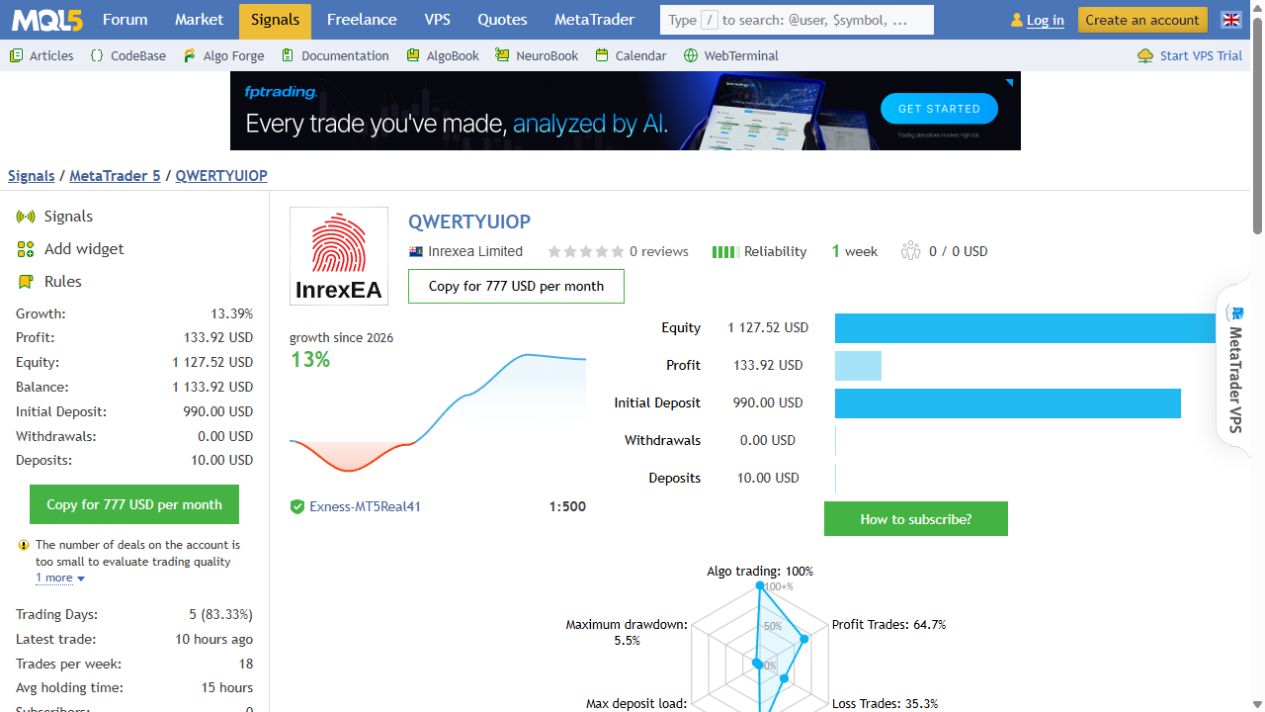
The MQL5 Qwertyuiop signal is identified as a real account on Exness-MT5Real41 with 1:500 leverage. At our 13 September check it showed positive growth, but only 17 closed trades. The developer’s own performance page labels the matching Qwertyuiop record “DB Live #1”; we therefore do not present it as independently verified standalone performance.
- Growth / profit
- 13.39% / $133.92.
- Funding and value
- $990 initial deposit plus $10 additional deposit; $1,133.92 balance and $1,127.52 equity.
- Closed trades
- 17 trades: 11 winners, six losers; profit factor 2.74.
- Drawdown figures
- 5.54% relative balance drawdown; 1.06% reported relative equity drawdown.
- Sample and duration
- Five trading days, a displayed monitoring start of 11 September 2026, and a 15-hour average holding time.
Equity was $6.40 below balance at the snapshot, so the account still had net floating loss despite positive closed profit. Its largest closed loss was $48.36 versus a largest win of $51.00. Those observations are more informative than treating the opening growth percentage as a monthly expectation.
The smaller reported equity drawdown should not replace the larger balance-history drawdown. With monitoring only recently started, historical closed trades and the available equity observations cover different evidence. MQL5 itself warns that the account is new and the deal count too small to evaluate trading quality.
The developer’s performance page records chart points only when all positions are closed, while separately reporting floating P/L and using irregular update intervals. That methodology is useful context, but its drawdown display is not interchangeable with MQL5’s. We have not merged the statistics or assumed the positive start establishes a durable advantage.
What the developer backtest shows
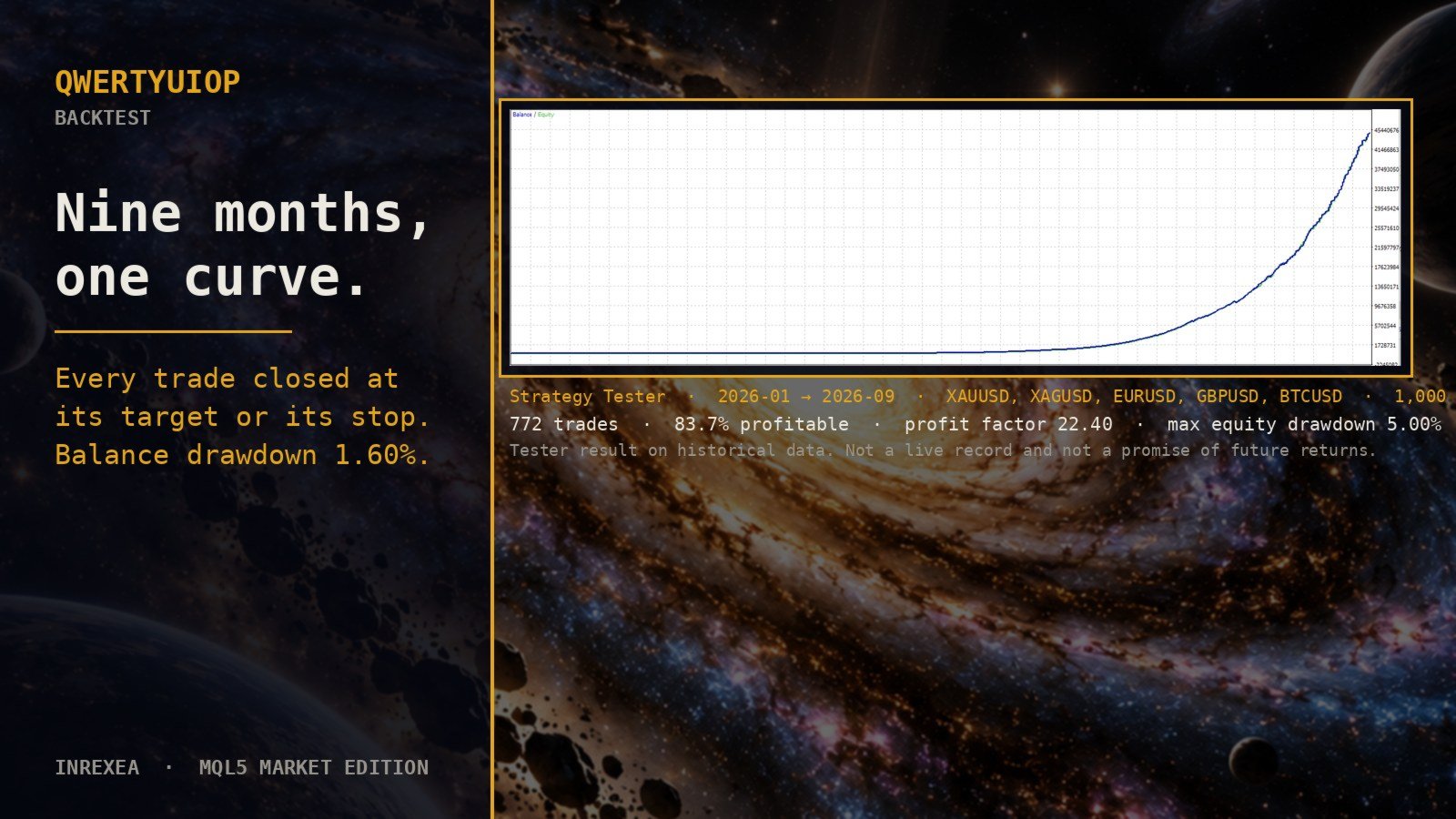
The supplied January–September 2026 graphic reports 772 trades, an 83.7% profitable-trade rate and a 22.40 profit factor. It prominently quotes 1.60% balance drawdown, with 5.00% maximum equity drawdown in the smaller text. Those are developer test figures, not a live track record or a test we reproduced.
A profit factor that high requires careful validation of execution assumptions, model selection and out-of-sample behaviour. The linked developer’s explanation of backtesting argues that tester curves can mislead because of execution differences and overfitting. That argument does not validate this particular chart; it reinforces the need for stronger forward evidence. Seventeen live trades cannot resolve the gap between a smooth historical test and future results.
Customer feedback is currently minimal
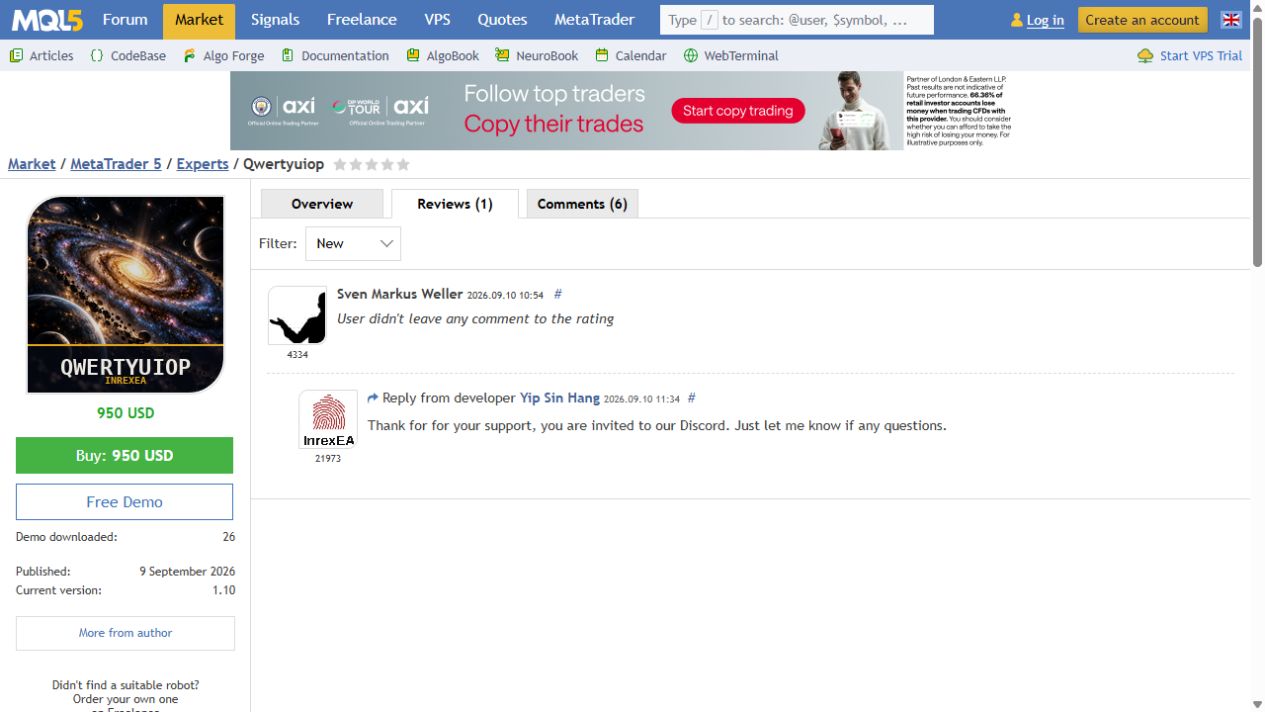
The one visible MQL5 rating entry is from Sven Markus Weller, dated 10 September 2026, and has no written comment. The developer replies with thanks and a support invitation. There is no detailed customer performance account to analyse. The original MQL5 review is included so the absence of written evidence is clear; it has not been imported as a CheaperForex purchase rating.
Compare Zxcvbnm and My Last Strategy
Zxcvbnm MT5 watches three markets rather than five and is explicitly positioned for shorter-horizon trades with a spread gate. Its separate review examines a different signal. Qwertyuiop is the broader instrument choice, not automatically the better-performing one.
My Last Strategy MT5 is also from Inrexea, but its grid-based framework has different position-management behaviour. Our My Last Strategy review covers that product. Neither its history nor the developer’s other account results should be substituted for Qwertyuiop’s own record.
Verdict
Qwertyuiop’s strengths are its unified five-market interface, individually switchable symbols and predefined exit structure. The open question is performance of the actual standalone build under real broker conditions. Its linked account has started positively, but the sample is tiny and the Database-edition connection matters. Assess total exposure and the edition you are buying before drawing conclusions from either the live snapshot or the backtest.