
XT Bitcoin Robot EA Review (MT4 + MT5): An Honest Look at MQL Tools’ BTCUSD H1 Bitcoin System
Last updated: August 2026
XT Bitcoin Robot is a fully automated BTCUSD (Bitcoin) Expert Advisor from MQL Tools, the Spanish developer behind a large and long-running catalogue of MetaTrader systems. It trades Bitcoin on the H1 timeframe and is available in two separate builds, one for MetaTrader 5 and one for MetaTrader 4. This review covers both.
It is a brand-new release — published in August 2026, with no marketplace reviews and no public MQL5 live signal at the time of writing. That is the central fact a buyer needs, and we are putting it in the third sentence rather than the fine print. What you are evaluating is a feature set, a backtest, and a developer’s reputation. Those are not worthless, but they are not a track record either.
We rate XT Bitcoin Robot 4 out of 5. The positive lean rests on a genuinely protective design — a take profit and stop loss on every position, an account-level maximum drawdown cap, a working news filter, and an ADX entry filter — combined with a developer whose catalogue has accumulated a substantial and broadly positive review base over many years across dozens of products. What holds it back is the complete absence of product-specific evidence and a backtest whose headline figures cannot be taken at face value.
⚠️ Looking for an XT Bitcoin Robot “free download”? Don’t.
Every legitimate marketplace EA ships with built-in DRM or licensing. There is no working cracked file in existence — so a “free” copy is always one of two things:
- malware, or
- bait for a Telegram payment scam where you pay and get nothing.
The only safe routes are the MQL5 marketplace or a reputable reseller. CheaperForex offers both builds at a lower price than the marketplace — see the MT5 product page or the MT4 product page.
The Developer: MQL Tools

MQL Tools is a Spain-based development company with a catalogue running to dozens of Expert Advisors, indicators and utilities, built up over many years and citing seventeen years of programming experience. Their aggregate marketplace rating sits in the low-to-mid four range across well over a thousand individual ratings — a volume of feedback that very few EA developers accumulate, and which makes that average considerably more informative than a five-star score from a handful of reviews.
Several of their systems are established products in their own right with substantial independent review bases behind them, and we carry a number of them: Scalping Robot Pro for XAUUSD scalping, Big Forex Players, AI Prop Firms for funded-account traders, and DAX Robot for the Germany 40 index.
This matters for XT Bitcoin Robot in a specific and limited way. A developer with dozens of products and years of accumulated feedback has real reputational exposure in a new release, and a track record of continuing to support and update what they ship. That is a legitimate reason to give a brand-new product a fair hearing. It is not, however, evidence that this particular system works — inherited credibility and a proven strategy are different things, and buyers should keep them separate.
What It Actually Does
The strategy specifics are not published in detail, but the risk architecture is, and that is the more useful half. The components:
- Take profit and stop loss on every position. No trade is left open-ended. The developer sets these at tested defaults and states they do not need changing, which also means you should not widen them casually.
- Maximum drawdown percentage cap. An account-level limit rather than a per-trade one — the closest thing here to a circuit breaker, and the setting most worth configuring deliberately.
- News filter. New positions are blocked for 60 minutes before and 60 minutes after high-impact economic releases. The window is adjustable and you can select which currency’s calendar drives it.
- ADX entry filter. Entries require measurable directional strength rather than firing on any signal, which should reduce trades taken in aimless conditions.
- Optional daily profit target. Stops trading once a chosen daily gain is banked — a discipline mechanism more than a risk control, but a useful one.
- Configurable schedule. Any weekday can be included or excluded and trading hours set freely, or the robot can run continuously.
Taken together this is a conventional, comprehensible protective stack. There is no grid language, no martingale language, and no averaging described anywhere in the documentation — and the always-attached stop loss is inconsistent with those approaches. That is a meaningful point in its favour for a Bitcoin system, since crypto’s volatility punishes recovery-based strategies especially hard.
The Panel — Useful, Not Decorative
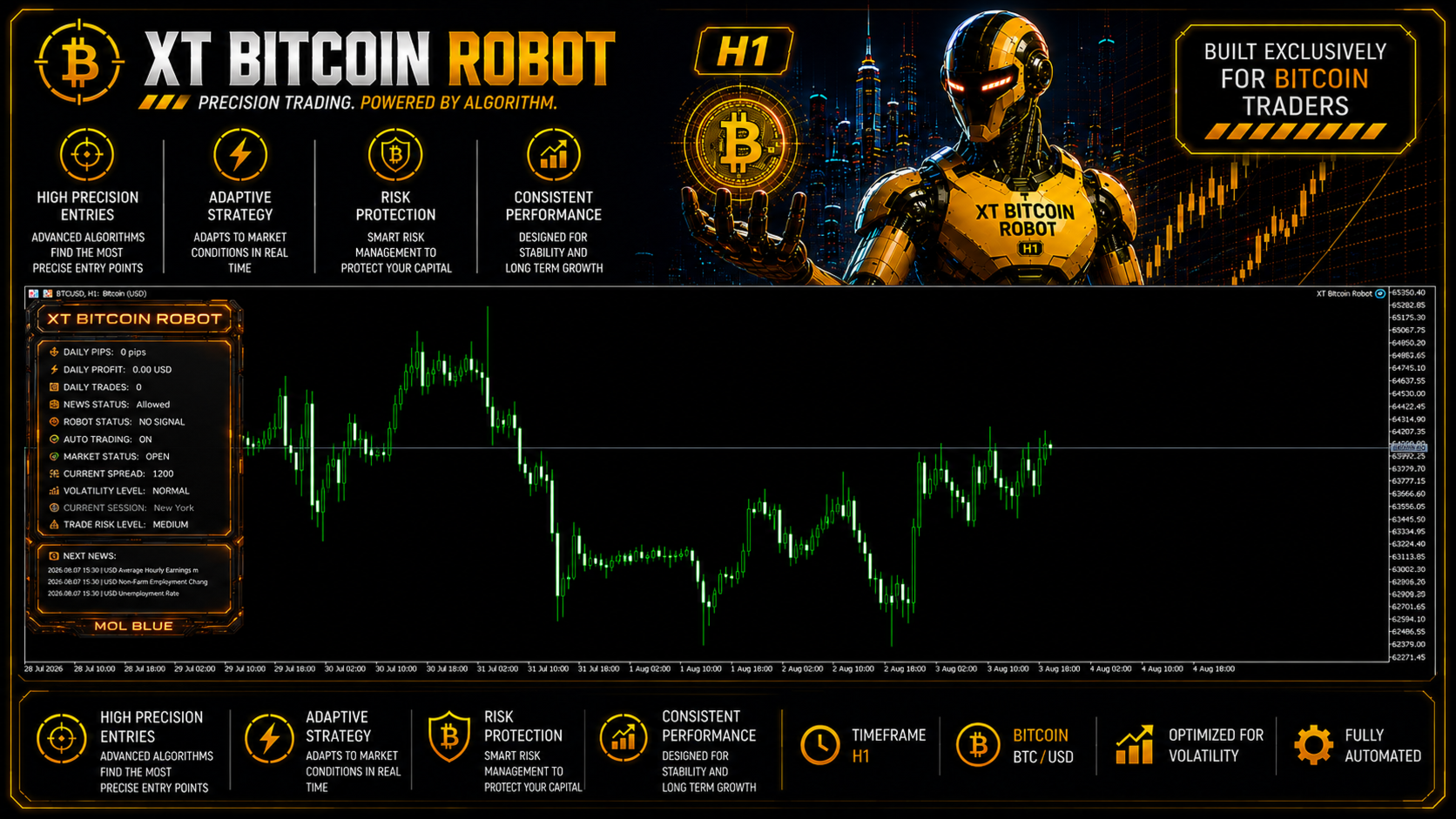
The chart panel reports the day’s pips, profit and trade count, the news filter’s current state, robot and auto-trading status, market status, live spread, volatility level, active session and selected trade risk level, with upcoming news releases listed beneath. Manual close buttons are included.
Two things make this more than cosmetic. First, seeing the news filter’s state means you can verify it is working rather than trusting a bullet point. Second, the live spread readout is genuinely valuable on Bitcoin: in the developer’s own screenshot the spread reads 1200 points, which is an order of magnitude beyond a typical forex pair. On an instrument where spread varies enormously between brokers and sessions, having that figure on screen next to the robot’s status is practical information — and a reminder that broker choice will materially affect your results here.
The Backtest — Read the Drawdown, Not the Profit
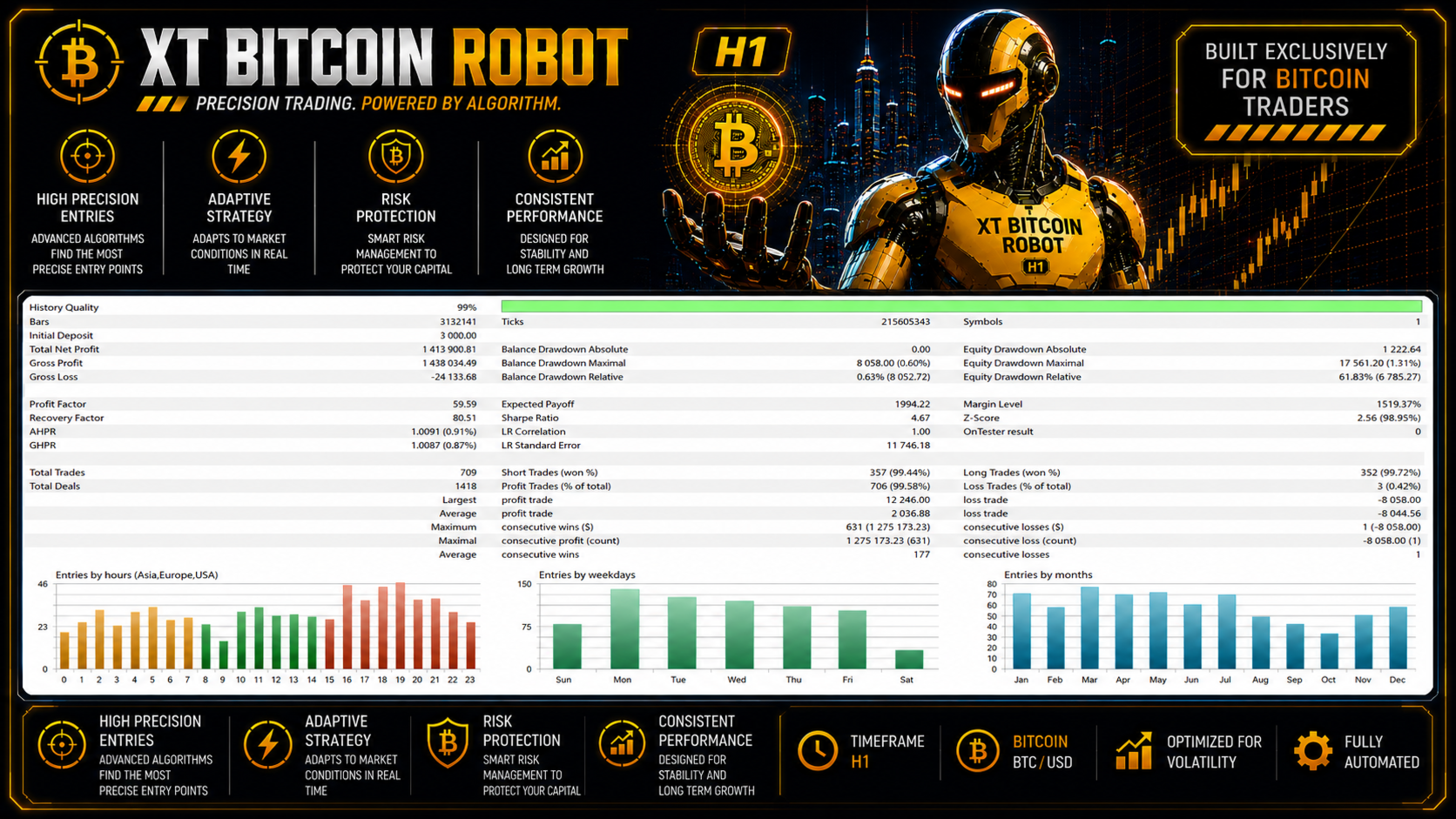
The published backtest runs at 99% history quality from a $3,000 starting deposit across 709 trades, and we are going to be straightforward about it.
The headline figures are not credible as expectations. The test records 706 winning trades against 3 losing ones — a 99.58% win rate — with a profit factor near 60 and a peak run of 631 consecutive winners. No strategy trades Bitcoin for years and loses three times. Figures like these are the signature of a system tuned tightly to the period it was tested on, and we will not present them as an indication of what your account will do, because they are not.
The distribution tells you how it achieves that. Average winning trade around $2,037; average losing trade around $8,045. The losers are roughly four times the size of the winners. That is the classic profile of a system that banks modest gains readily and holds losing positions for a long time before finally conceding — which is how a win rate reaches 99% without the strategy necessarily having any edge. The stop loss does eventually cut those trades, which is why there are only three of them and why total gross loss stays small in the test. But it also means a loss, when it comes, is a big one relative to the wins that preceded it.
Here is the number that actually matters, and most buyers will scroll past it. The report shows a maximum balance drawdown of 0.60% and a maximum equity drawdown of 1.31% — both reassuringly tiny, and both measured against the enormous balance the test had compounded to by the end. But the same report records a relative equity drawdown of 61.83%. That is the deepest percentage drawdown the account experienced at any point, and it occurred earlier in the test when the balance was still small. In plain terms: at some stage this system took the account down roughly 62% on floating equity before recovering.
That figure, not the profit total, is the one to size your account around. It tells you the strategy is capable of holding a position deeply underwater, and that a trader who had started at the wrong moment would have watched most of their capital disappear on screen before any recovery arrived. Whether you could sit through that is a real question, and it is the honest answer to “how risky is this?”
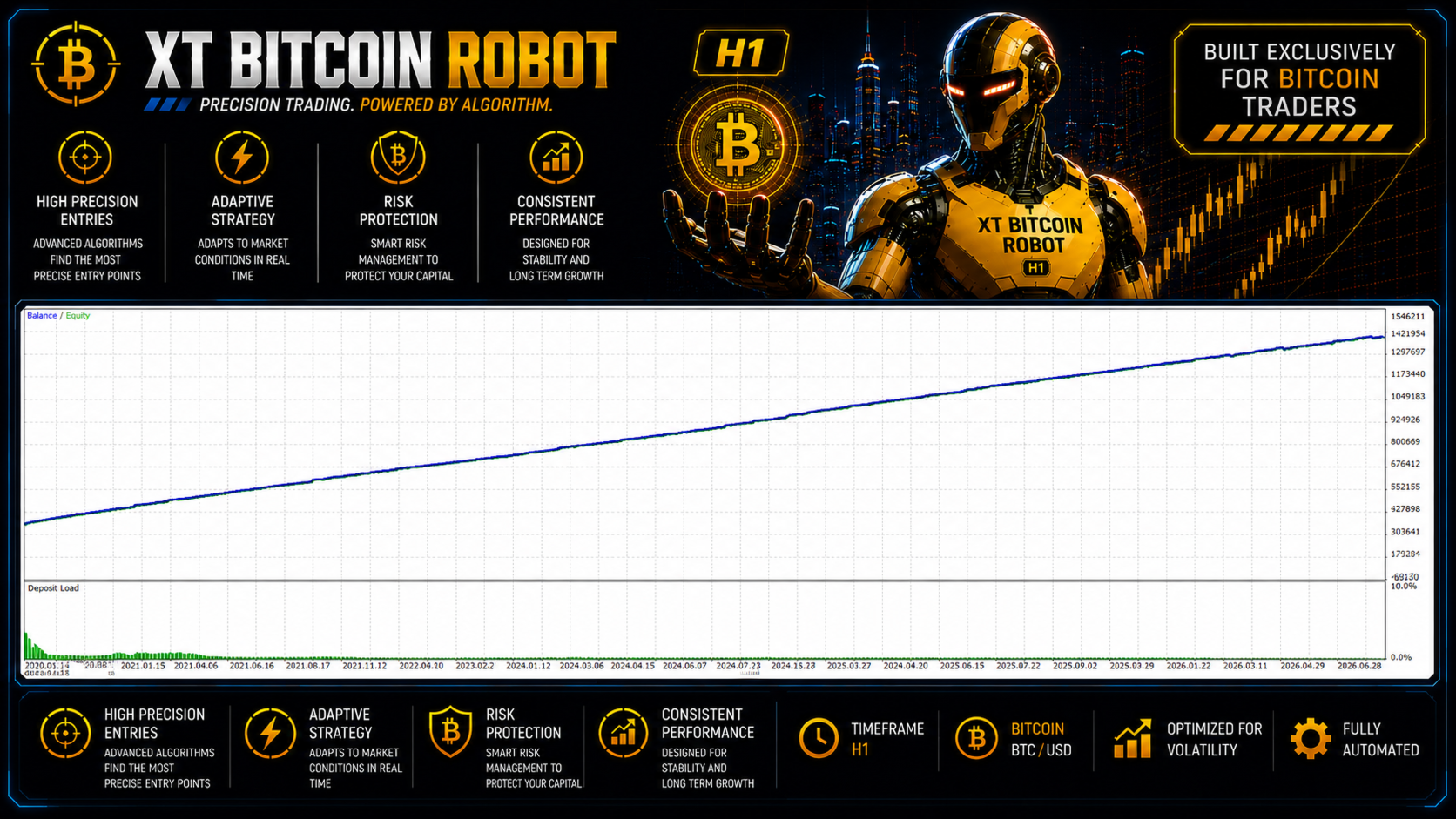
The growth curve covers roughly 2020 to mid-2026 and rises in an almost perfectly straight diagonal. It is worth being blunt about what a line like that signifies. Bitcoin over that period went through a mania, a brutal collapse, a long dead zone and a fresh surge. A strategy trading it that produces a straight line has not found a way to be indifferent to those regimes; it has almost certainly been fitted to them. Read the curve as a picture of the tested settings, not a forecast — and note that the deposit load band stays very low throughout, which at least corroborates the single-position, defined-risk structure described in the documentation.
No Live Track Record — What That Means
There is no public MQL5 live signal for this product, and no marketplace reviews yet, because it was published in August 2026. This is the biggest gap in the case for buying it, and it is worth spelling out precisely what is missing.
A backtest cannot show you slippage, real spread costs on a wide-spread instrument like Bitcoin, execution quality during volatile releases, weekend gap behaviour, or how a strategy copes when live conditions diverge from the period it was optimised on. Those are exactly the variables that separate a promising tester result from a working system, and on crypto they matter more than on most instruments.
The developer does publish results on their own website, and their established products have accumulated genuine independent feedback over time. But for this specific robot, on this specific instrument, there is currently nothing a prospective buyer can independently verify. The practical consequence: you are the verification. Demo it on your intended broker, then run a small live account, and judge it on your own record over a meaningful stretch. With any brand-new EA that is good practice; here it is the only evidence that will exist for a while.
MT4 or MT5 — Which Build?
Both editions run the same BTCUSD H1 strategy with the same protective stack. The differences are practical rather than strategic:
The MT5 build installs through the MetaTrader 5 marketplace, which means activation is handled by the platform and future updates arrive directly in the terminal. If you already run MT5, this is the smoother option, and MT5’s newer architecture is generally better suited to crypto symbols and multi-asset accounts.
The MT4 build is a separate executable compiled for MetaTrader 4, supplied as a standalone file. Its value is straightforward: if your broker, your existing setup or your habits keep you on MT4, you get Bitcoin automation without migrating platforms — and credible crypto systems remain comparatively scarce on MT4.
The honest guidance: pick the platform you actually trade on. There is no strategic advantage to either build, and no reason to switch platforms for this product. If you are genuinely undecided and starting fresh, MT5 is the more future-proof choice for crypto.
Who XT Bitcoin Robot Is For
It might be a fit if you:
- Want automated Bitcoin exposure with defined per-trade risk rather than a recovery-based crypto system
- Value a working news filter and an account-level drawdown cap, and will configure the latter deliberately
- Are comfortable being an early buyer on a product whose evidence is a feature set and a developer’s reputation rather than a live record
- Trade with a genuinely low-spread Bitcoin broker and run a reliable VPS
- Could tolerate a deep floating drawdown without abandoning the system, given what the backtest records
- Prefer near-zero configuration and are happy leaving tested defaults alone
Look elsewhere or wait if you:
- Require a public live signal or an established review base before buying — this product has neither yet
- Would read a 99.58% backtest win rate as an indication of future performance
- Could not sit through the roughly 62% relative equity drawdown the test records
- Trade Bitcoin on a wide-spread account, which will materially erode results
- Want a long, independently verified crypto track record — consider one of the developer’s established products such as Scalping Robot Pro or Big Forex Players instead
Our Verdict
We rate XT Bitcoin Robot 4 out of 5.
What earns the positive lean is a sensibly built protective stack and a developer with genuine standing. Every position carries a take profit and a stop loss; there is an account-level drawdown cap; the news filter works and its state is visible on the chart; entries are filtered through ADX. Nothing in the documentation describes grid or martingale mechanics, and the always-present stop loss is inconsistent with them — which matters more on Bitcoin than almost anywhere else, because crypto volatility destroys recovery systems. Behind it sits a developer with dozens of products and a four-plus aggregate rating across well over a thousand ratings, several of whose systems have earned their own independent followings.
What holds it at four is that there is no evidence about this robot specifically. No live signal, no reviews, published days ago. And the backtest, read carefully, argues for caution rather than confidence: a 99.58% win rate with losers four times the size of winners describes a system that holds losing trades a long time, and the report’s own relative equity drawdown of roughly 62% shows where that leads. A straight-line curve through Bitcoin’s wildest six years is a fitted curve, not a robust one.
Practical recommendation: if the protective feature set and the developer’s catalogue are what persuade you, buy it as an experiment rather than a solution. Set the maximum drawdown cap conservatively and treat it as your real defence. Use a low-spread Bitcoin broker and a reliable VPS. Demo first, then run the smallest live position size that is meaningful to you, and give it several weeks — through at least one bad stretch — before deciding whether it deserves more capital. Buying through CheaperForex at a lower price than the marketplace keeps the cost of that experiment down, which is the sensible way to approach any product whose track record has yet to exist.
How to Get XT Bitcoin Robot Safely
Two legitimate sources, and only two.
The MQL5 marketplace — direct from the developer. Here is the official MT5 listing and here is the MT4 listing. Both offer a free demo you can run in the strategy tester.
CheaperForex — the same EAs at a lower price. MT5 product page · MT4 product page.
Anywhere else offering it free or via a Telegram seller is a trap — there is no working cracked file, only malware or pay-and-vanish scams.
Frequently Asked Questions
Is XT Bitcoin Robot legit, or a scam?
Legitimate. It is a published MQL5 marketplace product from MQL Tools, an established Spanish developer with dozens of products and well over a thousand accumulated marketplace ratings. The scams are the “free download” sites and Telegram sellers offering cracked copies that cannot exist — every legitimate marketplace EA is licence-protected, so a free copy is either malware or a payment scam. Legitimate does not mean proven, though: this specific robot has no live track record yet.
Does it use a grid or martingale?
Nothing in the developer’s documentation describes grid, martingale or averaging behaviour, and every position is opened with both a take profit and a stop loss attached — which is inconsistent with those approaches. The backtest’s consistently low deposit load supports that reading. We would still verify it on demo yourself, since the strategy internals are not published in detail.
What is the real risk figure in the backtest?
The relative equity drawdown of roughly 62%, not the 0.60% balance drawdown or 1.31% equity drawdown that appear more prominently. Those small percentages are measured against the large balance the test had compounded to; the 62% figure is the deepest percentage drawdown the account actually experienced, earlier in the test. Size your account around that number.
Why is the backtest win rate so high?
Because losing positions are held for a long time before the stop finally cuts them. The report shows 706 wins against 3 losses, but the average loss is around four times the average win. A win rate near 99% achieved that way reflects trade management rather than predictive edge, and it will not carry over to live trading. Treat the tested figures as an artefact of optimisation, not a forecast.
Is there a live signal I can check?
Not at the time of writing. The product was published in August 2026 and has no public MQL5 signal and no marketplace reviews. That is the main gap in the case for buying it, since a backtest cannot show slippage, real Bitcoin spread costs, execution during news, or weekend gap behaviour. In practice you are the verification: demo it, then run a small live account and judge it on your own record.
Should I buy the MT4 or MT5 version?
Whichever platform you already trade on — the strategy and protections are the same in both. The MT5 build installs through the MetaTrader 5 marketplace with updates arriving in the terminal; the MT4 build is a standalone file for MetaTrader 4 users who do not want to migrate. If you are starting fresh, MT5 is the more future-proof choice for crypto.
What broker and setup does it need?
A broker offering BTCUSD with genuinely competitive spreads — this matters more than usual, since Bitcoin spreads are wide and directly erode returns. A $1,000 minimum deposit, a 0.01 minimum lot, and leverage from 1:20 to 1:1000 are supported, across Raw, Hedging, Zero, Cent, Micro, Standard, Premium and ECN account types. A low-latency VPS is strongly recommended, since crypto trades continuously.
What else does this developer make?
MQL Tools has a broad catalogue, and we carry several of their established systems: Scalping Robot Pro for XAUUSD, Big Forex Players, AI Prop Firms for funded-account traders, and DAX Robot for the Germany 40 index. Several have substantially longer review histories than XT Bitcoin Robot, which is worth knowing if a proven record is what you are after.