Last updated: August 2026
Quantum Titan is a XAUUSD (Gold) Expert Advisor for MetaTrader 5 from Bogdan Ion Puscasu, and the newest addition to the Quantum range. It reached the MQL5 marketplace in August 2026 after a period of private trading on the developer’s own capital, and it arrives with something most new EAs cannot offer: a substantial, clean, real-money track record that predates its public release.
That is the crux of this review. The live account was opened with €50,000 — the largest initial capital commitment behind any Quantum release — and has run for roughly 22 weeks with zero deposits and zero withdrawals. When a signal has no account flows, its growth figure means exactly what it appears to mean, and a surprising number of marketplace signals do not clear that bar. This one does.
We rate Quantum Titan 4.5 out of 5. The upper-half score reflects a genuinely selective architecture backed by observable data, defined per-trade risk with no grid mechanics, an undistorted live record on a serious account size, and the strongest developer credentials on the MQL5 marketplace. What we hold back accounts for a young and thin trade sample, returns concentrated in two strong months, a backtest whose real risk figure is buried beneath a friendlier headline, and a no-martingale statement that is qualified rather than absolute.
⚠️ Looking for a Quantum Titan EA “free download”? Don’t.
Every legitimate marketplace EA ships with built-in DRM or licensing. There is no working cracked file in existence — so a “free” copy is always one of two things:
- malware, or
- bait for a Telegram payment scam where you pay and get nothing.
The only safe routes are the MQL5 marketplace or a reputable reseller. CheaperForex offers Quantum Titan at a significant discount versus the marketplace price — see the product page here.
The Developer: Bogdan Ion Puscasu

Bogdan Ion Puscasu runs Incredible Traders from Romania and has built what is, by volume of verified feedback, the most successful Expert Advisor catalogue on MQL5. His developer rating sits at 4.8 across more than 2,600 individual marketplace ratings — a combination of scale and score that no other EA developer on the platform matches. Products such as Quantum Queen, Quantum Emperor and Quantum King each carry hundreds of reviews in their own right.
For a product with no reviews of its own, that catalogue is the trust anchor. A developer with thousands of customers and a decade-plus of published work has considerable reputational exposure in a new release, and a demonstrated history of supporting products through updates over time.
In the interest of a complete picture, we have noted in our other Quantum reviews that live signals have historically been withdrawn from some products in this catalogue when performance turned unfavourable. That is a fair transparency concern and it is worth restating here, because Titan’s entire case currently rests on one live account. We would rather a reader hear that from us than discover it later. It does not undermine the account’s genuine figures — but it is a reason to bookmark the signal and check it yourself over the coming months rather than treating a snapshot as permanent.
How Quantum Titan Trades
The strategy is described in more operational detail than most listings offer, and the design has a clear philosophy behind it.
Selective entry. Titan monitors gold continuously but does not remain permanently exposed. It waits for a specific set of predefined conditions to align and enters only when they do. The developer is explicit that some trading days will produce no positions at all, and frames this as intentional rather than a shortcoming. This is genuinely unusual — most EAs quietly optimise for activity, because a system that rarely trades is harder to sell.
Defined risk from the outset. Every position opens with a predefined stop loss attached. Risk is set at entry rather than managed reactively afterwards.
Independent position management. Each trade is evaluated and managed separately. There is no basket construction, no adding to losers, and no recovery cycle spanning multiple positions.
No grid — and a carefully worded martingale statement. The developer states that Titan does not use a grid strategy, and does not use martingale in its recommended default configuration. We would draw your attention to that qualifier rather than glossing over it. It is not a red flag — plenty of EAs expose optional aggressive modes — but it does mean the no-martingale assurance describes the default setup rather than every configuration available to you. Stay on the recommended defaults unless you fully understand what a change does.
Active trade management. Once open, positions are managed by trailing stop and profit-protection logic that secures gains as momentum develops. When an expected move fails to materialise, the system is designed to reduce exposure rather than sit in the market hoping. Hold times are short — the developer’s own materials cite an average measured in minutes.
Configurable risk. Eight preset automatic risk levels and multiple money-management methods, plus account-level maximum drawdown protection. For most buyers the drawdown protection setting is the single most important configuration decision.
Does the Live Data Support the “Selective” Claim?
This is the right question to ask of any EA marketed on selectivity, because it is an easy claim to make and a hard one to fake once a signal is public. Here the numbers back it up.
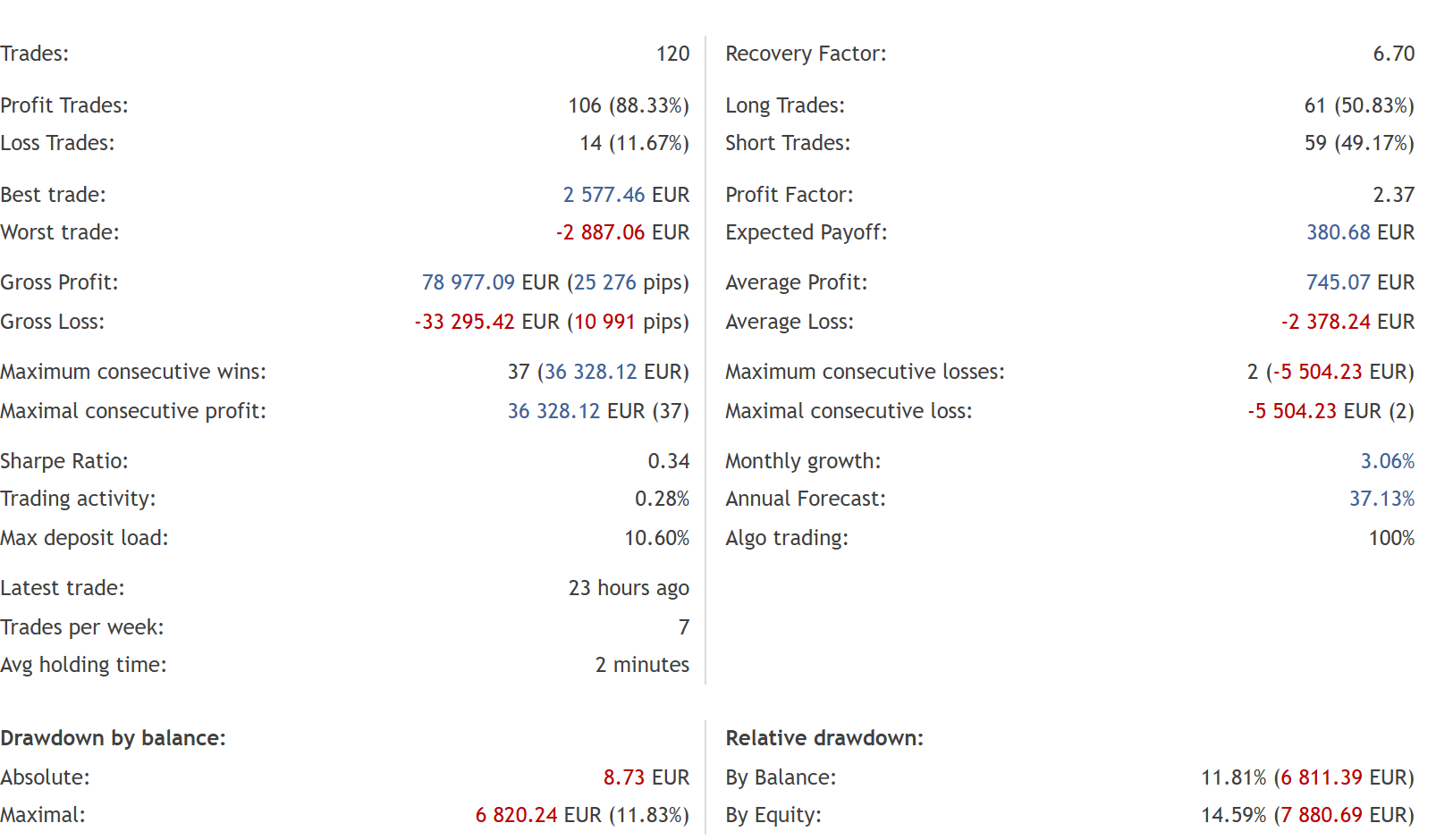
Trading activity: 0.3%. This metric measures the proportion of time the account has positions open. At 0.3%, Titan is out of the market essentially all of the time. For comparison, EAs that describe themselves as selective frequently show figures in the 5–15% range, and always-on systems run far higher.
Roughly 79 trades in about 22 weeks. That works out to fewer than four trades a week. Combined with short hold times, the picture is of a system that waits, acts briefly, and withdraws.
Maximum deposit load: 10.6%. Only around a tenth of usable margin was committed at peak exposure. That is consistent with independent, modestly-sized positions rather than accumulated baskets, and it corroborates the no-grid claim from a direction independent of the developer’s own description.
Three separate metrics pointing the same way is meaningful. The architecture described in the listing and the behaviour visible in the live account agree with each other, which is not something we can say about every product we review.

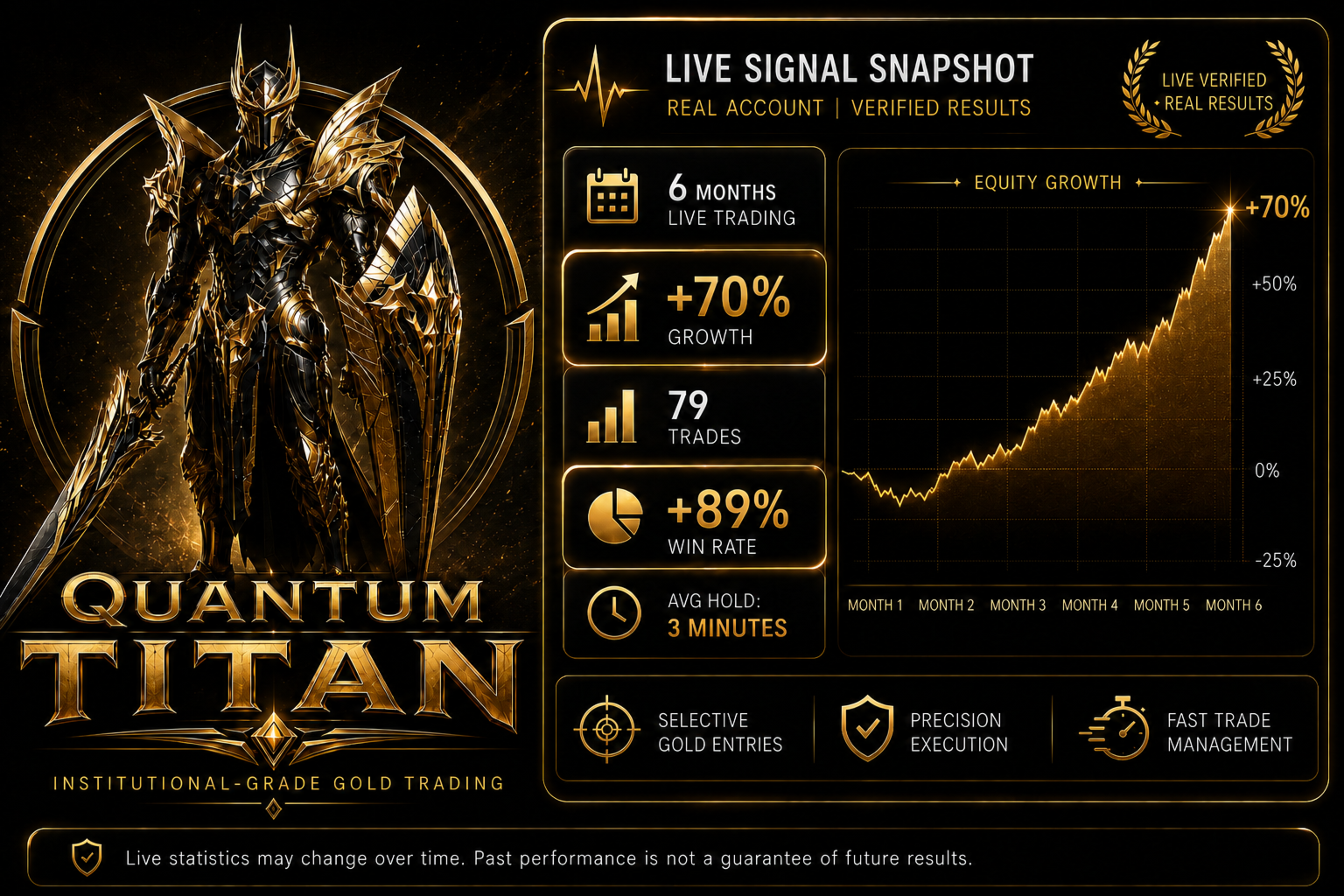
The developer’s own summary graphic cites six months live, roughly 70% growth, 79 trades, an 89% win rate and an average hold time of about three minutes. We checked these against the signal page, and unlike a good deal of EA marketing they reconcile — the growth, win rate and trade count all match. The short average hold is the detail worth dwelling on: combined with 0.3% trading activity, it describes a system that enters, resolves the position quickly, and returns to waiting. Note the graphic carries its own disclaimer that live statistics change over time, which is a fair caveat and one we would echo.
The Live Signal — Reading It Properly

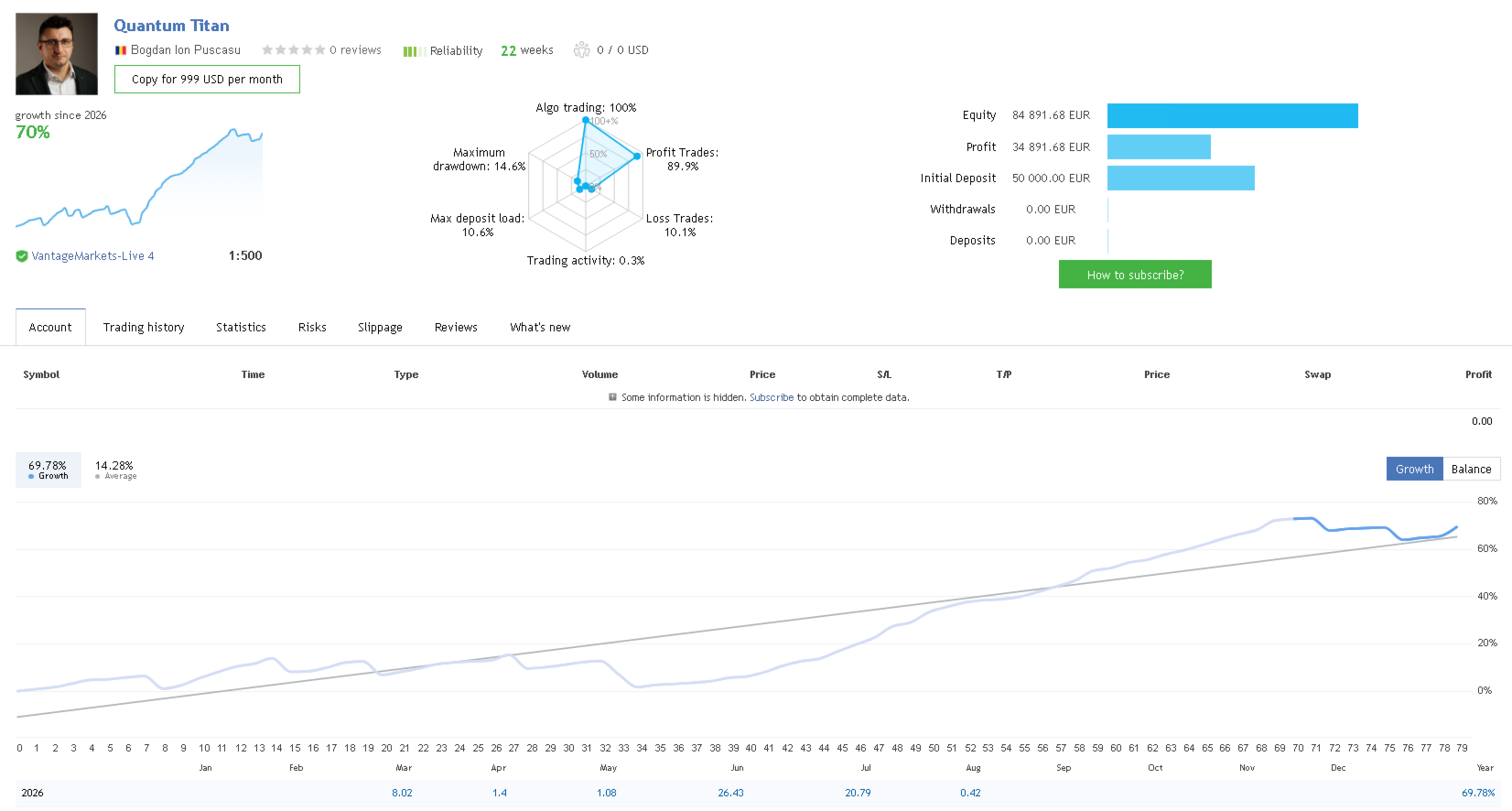
The public live signal runs on a Vantage Markets account at 1:500 leverage.
What is genuinely strong here. The account opened at €50,000 and stands at roughly €84,892, for about €34,892 of profit — with zero deposits and zero withdrawals throughout. That last detail is what separates this from a large share of marketplace signals, where headline growth is inflated by repeatedly topping up a small starting balance. Nothing needs unpicking: the roughly 69.78% growth is a real return on real capital that was there from the start. The account size matters too. A €50,000 account faces realistic execution, spreads and slippage in a way a €100 demonstration account does not.
The supporting metrics are healthy. An 89.9% win rate comes with a genuine 10.1% loss rate rather than an implausible near-perfect figure. Maximum drawdown of 14.6% is reasonable for the return produced.
Now the part most buyers will miss. The monthly breakdown shows the gains are concentrated, not steady. Across 2026: March contributed roughly 8%, April about 1.4%, May around 1.1%, June about 26.4%, July about 20.8%, and August has opened close to flat at around 0.4%. In other words, June and July together account for roughly 47 of the 70 percentage points. The other months, collectively, produced about 11%.
That is not damning — plenty of legitimate strategies earn in bursts, and a selective system that trades rarely will naturally have uneven months. But it does mean you should not model this as “roughly 12% per month.” A more honest reading is that Titan produced modest returns for several months, caught two exceptional ones, and has started the current month quietly. Whether the strong months reflect a repeatable edge or a favourable gold environment is the open question, and 22 weeks is not long enough to answer it.
The sample size point. Around 79 trades is a small dataset for drawing statistical conclusions, regardless of the calendar span. A selective EA inherently accumulates evidence slowly, which is the flip side of low market exposure. Treat this as a promising and clean start rather than a proven long-term record.
The Backtest — Two Drawdown Figures, and Only One Matters

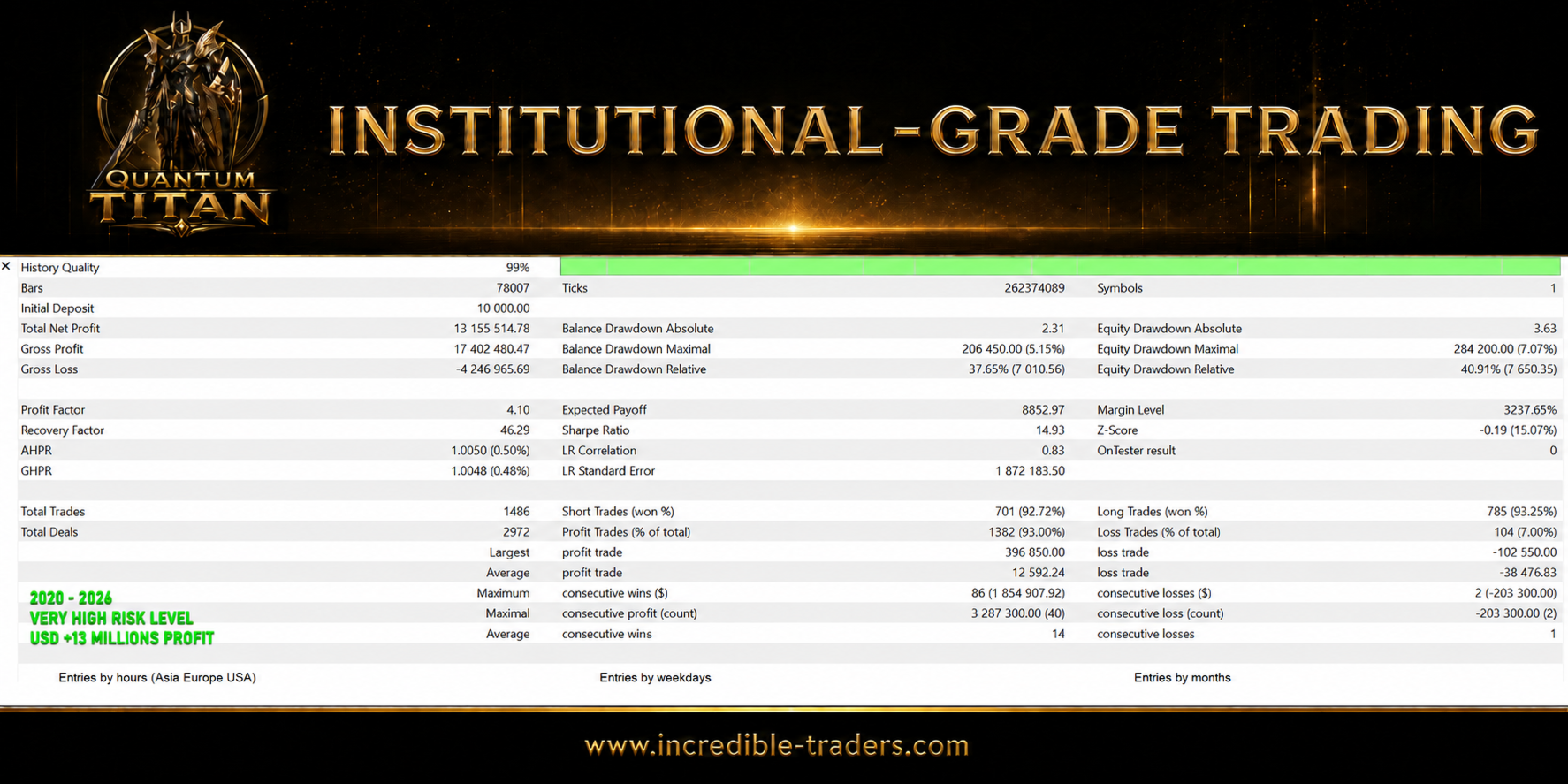
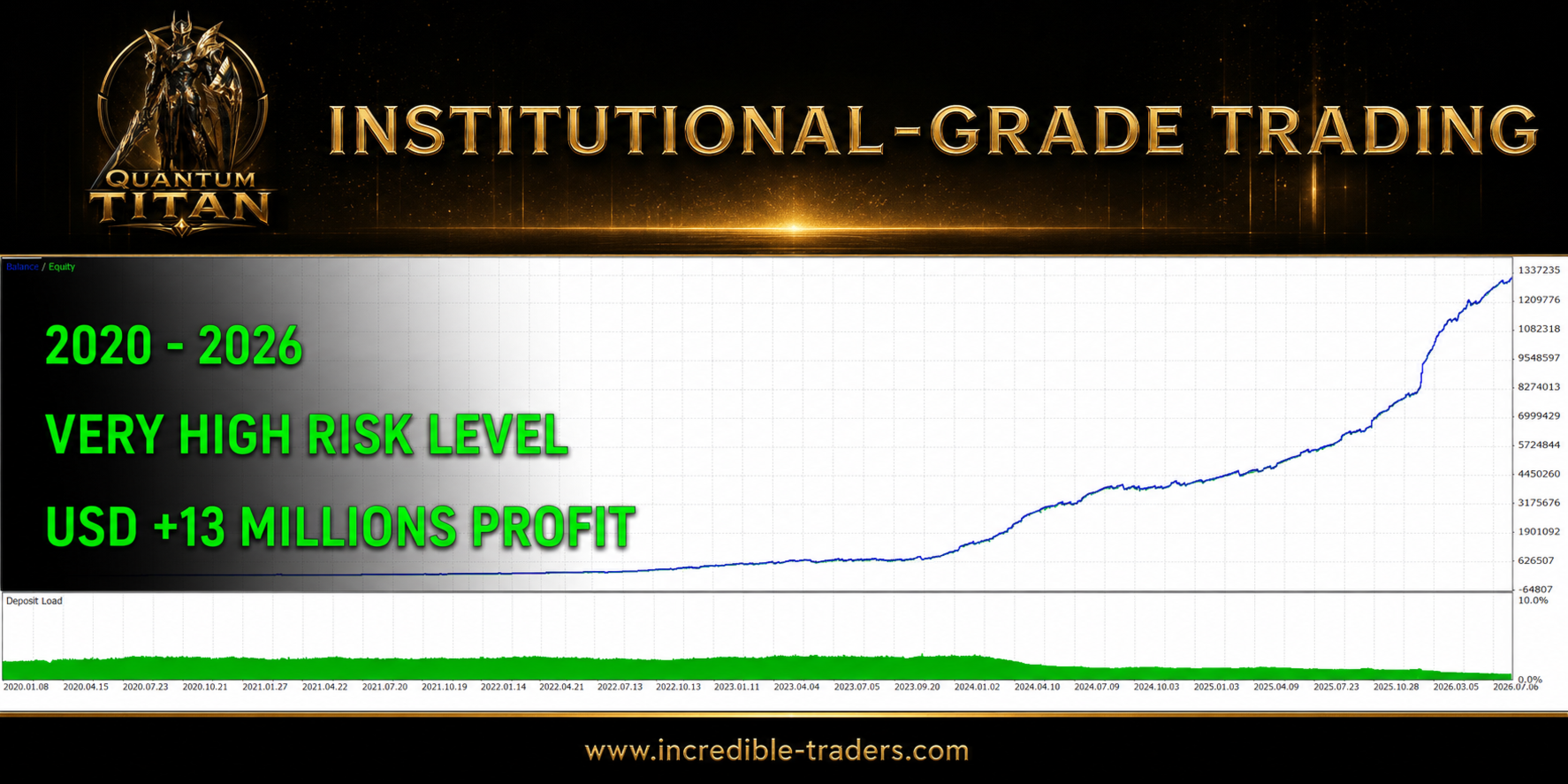
The backtest covers 2020 to 2026 at 99% history quality from a $10,000 deposit, and the developer labels it plainly as a very high risk configuration. Across 1,486 trades it records a 93% win rate and a profit factor of 4.10.
The headline total is compounding, not prediction. The multi-million-dollar result comes from compounding an aggressive risk setting across six years. It illustrates what the maximum-aggression configuration does in a simulation; it is not a forecast, and no sensible buyer should run that setting.
The drawdown figure that matters. The report shows a maximum equity drawdown of 7.07% — reassuringly small, and measured against the enormous balance the test had compounded to by its later years. The same report also records a relative equity drawdown of 40.91%. That is the deepest percentage drawdown the account actually experienced, and it happened earlier when the balance was still modest. In practical terms: at the tested risk level, this strategy took the account down roughly 41% at one point. That figure, not the 7%, is what you should size around. The balance-side pair tells the same story — 5.15% headline against 37.65% relative.
The win/loss asymmetry. Average winning trade around $12,592; average losing trade around $38,477. Losers run roughly three times the size of winners. That is the trade-off behind a 93% win rate: the strategy is right frequently, and when it is wrong the loss is proportionally large. It is not inherently a flaw — many sound strategies have this shape — but it does mean a short run of losses hurts disproportionately, and it explains how a 41% drawdown becomes possible despite such a high hit rate.

The growth curve rises slowly for the first several years then steepens sharply, which is simply what compounding looks like when plotted on a linear axis — the later gains are larger in absolute terms because the balance is larger. It is not evidence that the strategy improved. The genuinely useful detail is the deposit load band along the bottom, which stays consistently low across the entire six-year test. That is independent corroboration of the low-exposure, independent-position design, and it is consistent with what the live account shows.
How Titan Compares to the Other Quantum Gold EAs
Bogdan’s catalogue now contains several gold systems, and they are not interchangeable. If you already own one, this is the section that matters.
- Quantum Queen — the flagship, and a grid system. Highest-rated EA on the marketplace by review volume, with a multi-year live record. Higher peak returns, grid drawdown behaviour. Our Quantum Queen review covers it in full.
- Quantum Queen X — the Queen successor with a custom mode for enabling or disabling individual strategies. See our Queen X review.
- Quantum Valkyrie — the non-grid gold alternative, and conceptually the closest sibling to Titan.
- Quantum Athena — the lighter, current-conditions variant of the Queen engine. Our Athena review has the detail.
- Quantum OmniGold — a fixed stop loss with staged take-profits and trend-based lot scaling. See the OmniGold review.
- Quantum Titan — the selective, minimal-exposure option, and the only one launched on a €50,000 account.
Beyond gold, the range covers other instruments: Quantum Emperor on GBPUSD, Quantum King on AUDCAD (see the King review), Quantum Bitcoin on BTCUSD (see the Bitcoin review), Quantum Baron on crude oil, and Quantum StarMan across multiple currency pairs.
A practical note on running several together. Two gold EAs on the same account creates correlated exposure — they can be in the same trade at the same time without either knowing about the other. If you already run Queen, Queen X, Athena, Valkyrie or OmniGold on gold, adding Titan to the same account increases combined risk in a way neither system accounts for. Separate accounts, or careful margin monitoring, is the sensible approach.
Setup Requirements
The developer’s specification is clear and worth following rather than improvising around:
- Symbol: XAUUSD (Gold), on MetaTrader 5
- Account type: Hedging
- Minimum deposit: $500, with $1,000 or higher recommended
- Leverage: 1:100 minimum, 1:500 recommended
- Brokers: VT Markets, TMGM and StarTrader are named, or any broker offering ECN, RAW or low-spread accounts
- VPS: Described as mandatory, not optional — a selective system that misses its narrow entry windows because the terminal was offline is not doing its job
- Configuration: Plug and play with optimised defaults; choose a money-management method and one of the eight risk levels
Given the backtest’s 41% relative drawdown at the very high risk setting, we would start well below the aggressive end of that risk scale and set the account-level drawdown protection deliberately rather than leaving it at whatever it defaults to.
Who Quantum Titan Is For
It might be a fit if you:
- Want a gold EA with genuinely low market exposure rather than one that is always in a position
- Prefer defined per-trade risk with no grid mechanics or basket recovery
- Value an undistorted live record on a substantial account over a large but inflated growth percentage
- Are comfortable with an EA that may go days without trading, and will not interpret quiet periods as a malfunction
- Trust the Quantum catalogue’s track record enough to be an early buyer on a product with no reviews of its own yet
- Will run a VPS, stay on recommended defaults, and set the drawdown protection conservatively
Look elsewhere or wait if you:
- Need an established review base or a multi-year record for this specific product — consider Quantum Queen, which has both
- Would read the live account’s ~70% as a repeatable monthly or quarterly rate — two months produced most of it
- Could not tolerate the roughly 41% relative drawdown the backtest records at its tested risk level
- Are uncomfortable that the no-martingale assurance applies to the default configuration rather than universally
- Already run another Quantum gold EA on the same account and would be doubling correlated exposure
- Trade only on MT4 — this is an MT5 product
Our Verdict
We rate Quantum Titan 4.5 out of 5.
The upper-half score is earned on evidence quality rather than marketing. The live account is the cleanest kind available: €50,000 of real capital, no deposits, no withdrawals, roughly 22 weeks of history, and a believable 89.9% win rate with genuine losses. The selective architecture is not just claimed but corroborated from three independent directions — 0.3% trading activity, around 79 trades, and a 10.6% maximum deposit load all describe the same low-exposure system. Every position carries a predefined stop loss, trades are managed independently, and there is no grid. Behind it sits the most-reviewed developer on the marketplace, with thousands of verified reviews across a catalogue built over more than a decade.
The half-point we hold back covers four things, none of which is a red flag but all of which a buyer should weigh. The trade sample is small — 79 trades cannot yet demonstrate behaviour across varied gold conditions. The returns are lumpy, with June and July contributing roughly two-thirds of the total while other months were near flat. The backtest’s genuine risk figure is a roughly 41% relative equity drawdown sitting behind a 7% headline, with losers averaging three times the size of winners. And the no-martingale statement is scoped to the recommended default configuration rather than stated absolutely.
Practical recommendation: this is one of the better-evidenced new gold EAs we have reviewed, and it deserves a fair look — but treat the live account as a promising start rather than a settled record. Run a VPS, stay on the developer’s recommended defaults, choose a conservative risk level rather than the aggressive end of the scale, and set the account-level drawdown protection deliberately. Demo first, then run a small live account and judge it on your own results across several months, including at least one quiet stretch. If you already run another Quantum gold system, use a separate account. Buying through CheaperForex at a significant discount keeps the cost of that evaluation modest, which is the sensible way to approach any product whose track record is real but still young.
How to Get Quantum Titan EA Safely
Two legitimate sources, and only two.
The MQL5 marketplace — direct from Bogdan Ion Puscasu’s developer page. Here is the official MT5 listing, which also offers a free demo you can run in the strategy tester.
CheaperForex — the same EA at a significant discount versus the marketplace price. Here is the product page.
Anywhere else offering it free or via a Telegram seller is a trap — there is no working cracked file, only malware or pay-and-vanish scams.
Frequently Asked Questions
Is Quantum Titan EA legit, or a scam?
Legitimate. It is a published MQL5 marketplace product from Bogdan Ion Puscasu, the most-reviewed EA developer on the platform with a 4.8 rating across more than 2,600 marketplace ratings, and it runs a public real-money live signal on a €50,000 account. The scams are the “free download” sites and Telegram sellers offering cracked copies that cannot exist — every legitimate marketplace EA is licence-protected, so a free copy is either malware or a payment scam. Legitimate does not mean proven, though: this specific product has no accumulated reviews yet.
Does Quantum Titan use a grid or martingale?
The developer states it does not use a grid strategy, and does not use martingale in its recommended default configuration. The live account supports the no-grid claim independently: a maximum deposit load of 10.6% is consistent with independent, modestly-sized positions rather than accumulated baskets. Note the martingale wording describes the default setup rather than every available configuration, so stay on the recommended defaults unless you understand exactly what you are changing.
How often does it actually trade?
Rarely, by design. The live account shows roughly 79 trades across about 22 weeks — fewer than four a week — with trading activity of 0.3%, meaning the system holds positions for a tiny fraction of the time. Hold durations are short. The developer is explicit that some days will produce no trades at all, and this is intentional: the strategy waits for qualifying conditions rather than trading to stay busy.
Is the live signal’s ~70% growth genuine?
Yes. The account opened at €50,000 with zero deposits and zero withdrawals throughout, so the growth reflects actual trading rather than added capital — which is more than can be said for many marketplace signals. The important caveat is distribution: June and July contributed roughly 47 of those 70 percentage points, while several other months were close to flat and the current month has opened quietly. Do not model it as a steady monthly rate.
What drawdown should I expect?
The live account has shown a maximum drawdown of 14.6% to date. The backtest is the more sobering reference: while it displays a 7.07% maximum equity drawdown, the same report records a relative equity drawdown of 40.91% — the deepest percentage drop actually experienced, earlier in the test when the balance was smaller. At the tested very high risk setting, roughly 41% is the honest figure to size around, and it is why we suggest a conservative risk level.
Why is the win rate so high if the losses are large?
The backtest shows a 93% win rate alongside an average loss roughly three times the average win. That combination is common in strategies that take profit readily and cut losses at a wider stop: you are right frequently, but each error costs more than a typical success gains. It is not inherently a flaw, but it does mean a short cluster of losses has an outsized effect, which is how a 41% drawdown becomes possible despite such a high hit rate.
Which Quantum EA should I choose for gold?
It depends what you want. Quantum Queen is the grid flagship with the longest record and the largest review base. Quantum Valkyrie is the non-grid alternative. Quantum Athena is the lighter current-conditions variant, and Quantum OmniGold uses a fixed stop with staged take-profits. Titan is the selective, minimal-exposure option. If you run more than one on gold, use separate accounts — correlated exposure is a real risk.
What broker, account and hosting do I need?
A hedging account with XAUUSD on MetaTrader 5, a $500 minimum deposit with $1,000 or more recommended, and leverage of at least 1:100 with 1:500 suggested. The developer names VT Markets, TMGM and StarTrader, or any ECN, RAW or low-spread account. A VPS is described as mandatory rather than advisable — a selective system that misses its narrow entry windows because the platform was offline defeats the purpose.
Why is it cheaper at CheaperForex?
The product is identical — the same EA, the same activation and the same future updates from the developer. You pay significantly less. Since this is a brand-new listing whose evidence rests on a single live account rather than an accumulated review base, testing on demo and validating on your own broker before scaling is essential, and paying less to run that evaluation is the practical approach.