
King of Gold UCB Agent EA MT5 is a gold-focused adaptive trading system that chooses between market entries and limit orders at volume-profile zones. Its contextual bandit models use closed-trade outcomes to adjust execution and trade profiles, while a visible status panel explains the current setup and sizing.
Our assessment: the distinctive appeal is the combination of adaptive decisions, persistent memory and detailed trade-management controls. The main considerations are how learning evolves on a particular account, the interaction of recovery and basket settings, and the quality of the broker’s market data. This review examines public documentation and available evidence checked 20 October 2026; it is not a firsthand trading test or a code audit.
View King of Gold UCB Agent EA MT5 features and pricing

What the adaptive system chooses
The developer describes several contextual multi-armed bandits working together. In practical terms, they compare available choices using trade outcomes in different market conditions. The execution component chooses a market order or a limit order at a volume-profile zone; the profile component chooses shorter, normal or longer stop-loss and take-profit profiles.
Additional analysis covers candle patterns, alignment across M1–H4 and multi-timeframe confluence. The EA also tracks session and time-of-day results. These are descriptions of the system’s intended behavior, not proof that its choices will stay profitable as conditions change.
One trading chart, with wider market context
The EA trades the symbol and timeframe of the chart where it is attached. It can analyze the other symbols visible in Market Watch, but that is not a promise to open a multi-symbol portfolio automatically. XAUUSD is the primary market; the listing also says the EA can be attached to crypto, indices, stocks or Forex.
The internal M1–H4 analysis should not be confused with a mandatory attachment timeframe. The latest public XAUUSD example, posted on 16 October for version 1.23, specifies M1. It is an example configuration rather than evidence that every symbol should use that period. No universal minimum balance is specified; contract size, margin, minimum volume and costs all matter.
The panel makes the process easier to inspect
Five named views organize the status information: King covers memory, learning and risk mode; Scout explains entries and skipped setups; Sizer covers volume choices; Zoner shows volume zones and waiting orders; Guard reports drawdown, margin, spread, news and recovery conditions.
The panel also describes states such as building a setup, managing trades or resting. This is useful operational feedback, but a favorable score or a confident status message is not an independently validated forecast.
Trade exits, basket controls and recovery
The published controls include stop loss and take profit on every trade, optional trailing stops, breakeven and adaptive stop loss. The developer states that these management functions remain active outside the configured trading hours. A pause in new entries therefore does not necessarily stop management of existing positions.
Basket features include profit-target closure, optional trailing closure and a volume-based exit when incoming activity turns strongly against a profitable basket. Daily profit and loss limits can use trailing giveback protection. Spread filters, trading days, hours and a cooldown after losses add further constraints.
Recovery and small-balance modes require careful configuration. Their names should not be interpreted as a maximum-loss guarantee. Review how they change sizing, the number of positions and total exposure before enabling them. The available overview does not justify marketing the EA as no-grid or no-martingale, or treating basket profits as evidence that floating losses cannot build.
What the latest public preset actually enables
The version 1.23 XAUUSD M1 example uses a RiskPercent input of 3, allows up to three open trades and seven pending orders per symbol, and enables basket auto-close with trailing. These are source values to examine, not a recommended risk setting or a portfolio-wide loss cap.
Its daily target, daily-loss limit, floating-loss inclusion, cooldown, individual trailing stop, breakeven and safe-balance mode are disabled. Recovery auto-close and assist entries are also off, even though a recovery multiplier field exists. The execution-bandit switch is off while limit orders and the profile bandit are enabled. Loading the file therefore does not activate every feature listed in the overview.
The file records StopLoss=900 and TakeProfit=2000 with InputsArePips=false. Check the units against the broker’s symbol specification; these numbers should not be copied as universal pip distances. The example predates version 1.24, so verify how its inputs load in the current build.
Market depth, volume profile and news
Order-book signals are used when the broker supplies depth-of-market data, with a volume-profile fallback when it does not. That fallback makes the dependency more flexible, but the inputs can differ between brokers. Check the data actually visible in the intended account rather than assuming every installation sees the same liquidity information.
The calendar features consider upcoming high-impact events and a bias from released news. The overview describes awareness, not a universal promise to close all positions or avoid every release. Inspect the relevant inputs and behavior during demo testing.
Learning memory changes how to evaluate results
The developer says learned information is saved to a file and restored after a restart. April’s version 1.3 notes explicitly describe training in the tester and loading knowledge from the same data file. A practical implication is that testing should document the starting memory state, configuration and period, as well as the final performance numbers. An already trained instance and a fresh instance may not begin from the same state.
The listing emphasizes forward operation while also recommending Strategy Tester checks on the broker’s own data. Both are useful for different questions: testing can expose order handling and loss behavior, while a demo run shows how the learning process develops under current execution conditions.
Recent changes and the current build
The current listing shows version 1.24, updated 20 October 2026, described as improvements to orders and the agent engine. Version 1.22 introduced the expanded status explanations and five named agent views. Version 1.21 documented an autonomous bandit engine with internal memory.
September’s version 1.14 changed how consecutive bars are interpreted: the developer added trend-aware continuation versus exhaustion handling, a higher-timeframe filter and optional pullback entries. Its published input values belong to that release note; they should not be assumed to be today’s defaults. The sequence of changes also means older screenshots and comments may describe a materially different configuration.
What the public evidence can establish
No public live-account signal was linked in the product listing, public comments or seller profile checked for this review. There is therefore no linked monitored return or drawdown series to quote. The archived gallery chart shows an earlier version 1.18 interface dated 8 October; it is not a current performance report or proof that the later learning engine produces a particular result.
What the available customer feedback says
The source contains five review entries. Four are ratings without written explanations. In the one written review, dated 11 October 2026, Mruczkowski praises frequent updates and says the EA is working correctly. That is useful feedback about operation and maintenance, but it supplies no account history, drawdown or independently checkable return.
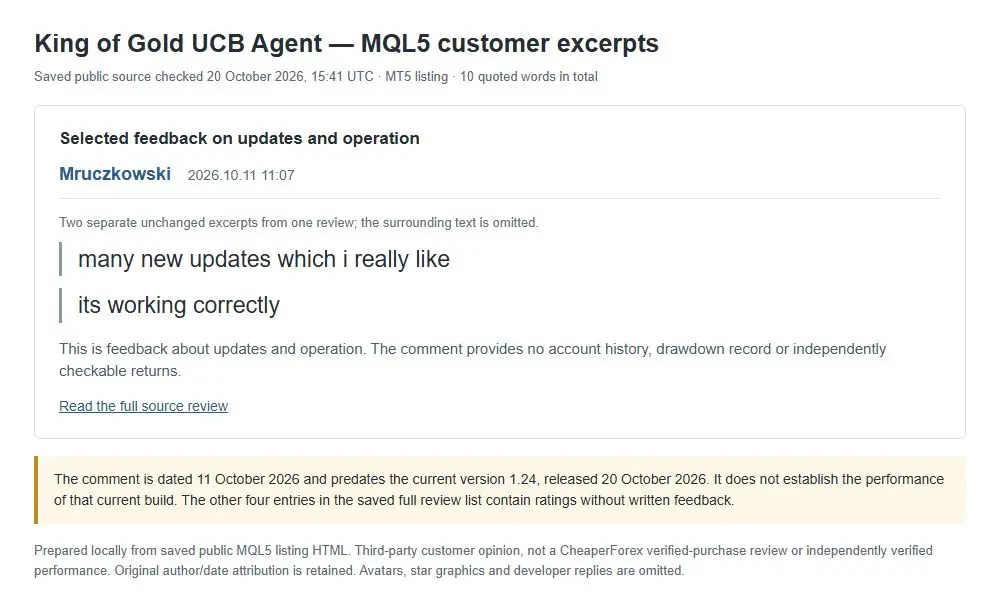
These are third-party opinions, not CheaperForex verified-purchase ratings. A small number of favorable entries cannot establish how the strategy behaves across brokers, risk settings and market regimes.
Practical setup checks
Start with the intended XAUUSD contract on demo, choose a controlled fixed-lot or risk-based setting, and observe open exposure as well as closed profit. Confirm what happens at a daily limit, after consecutive losses, around session boundaries and when a pending order is filled. The developer recommends an ECN or raw-spread account for gold, but actual spread, commission and execution still matter.
Telegram notifications are optional and require a user-created bot token and chat ID, plus WebRequest permission for api.telegram.org. Keep credentials private. Sound alerts and Journal telemetry provide additional ways to monitor operation without treating a notification as proof of successful execution.
Official product information · Developer release notes · Public product discussion