
- Official listing: BTC Master Pro on MQL5
- Public account: Developer’s BTC Master Pro monitoring account
BTC Master Pro is an H1 Bitcoin EA whose central design choice is an AI check before trade execution. Farzad Saadatinia combines that filter with strategy selection, lot-sizing modes and configurable trading sessions. The most revealing question is how its frequent profitable exits compare with the cost of losing trades.
Our assessment: the explicit sizing and scheduling controls make this a concrete system to evaluate. The public account is useful evidence, but its high win rate needs to be read alongside much larger average losses and a substantial historical balance drawdown. This review examines those trade-offs; we have not independently traded or backtested the executable.
View BTC Master Pro MT5 details and pricing

CheaperForex sells this EA. Source review and signal snapshot: 23 September 2026. Public materials comprise the developer’s listing, release notes, comments, historical reports and linked MQL5 monitoring account.
What the AI filter changes—and what is not demonstrated
The source describes OpenAI as an approval layer following the strategy’s entry logic. That distinction matters: a rejected entry changes which opportunities reach execution; it does not establish that every accepted trade has a reliable probability of profit.
The release history dates the AI addition to February 2026, alongside panel and input changes, followed by March refinements. The gallery’s older tests therefore cannot isolate the AI component’s contribution. A useful comparison would need the same market data, settings and cost assumptions with the filter enabled and disabled. The public material does not provide that controlled comparison.
Reading the current monitoring account
The linked MQL5 account uses VantageMarkets-Live 15, with 1:200 leverage. Monitoring began on 25 February 2026; the page displayed 32 weeks at our check. Its recorded trades were in BTCUSD. This is the developer’s account, not a CheaperForex test.
- Growth / net profit
- 168.50% / $627.59.
- Balance / equity
- $646.77 / $646.77 at capture.
- Trade record
- 812 trades; 738 profitable, a 90.88% win rate.
- Profit factor
- 1.50.
- Average win / loss
- $2.56 / −$17.05.
- Relative drawdown
- 25.50% by balance; separately displayed 5.93% by equity.
- Average holding time
- 53 minutes.
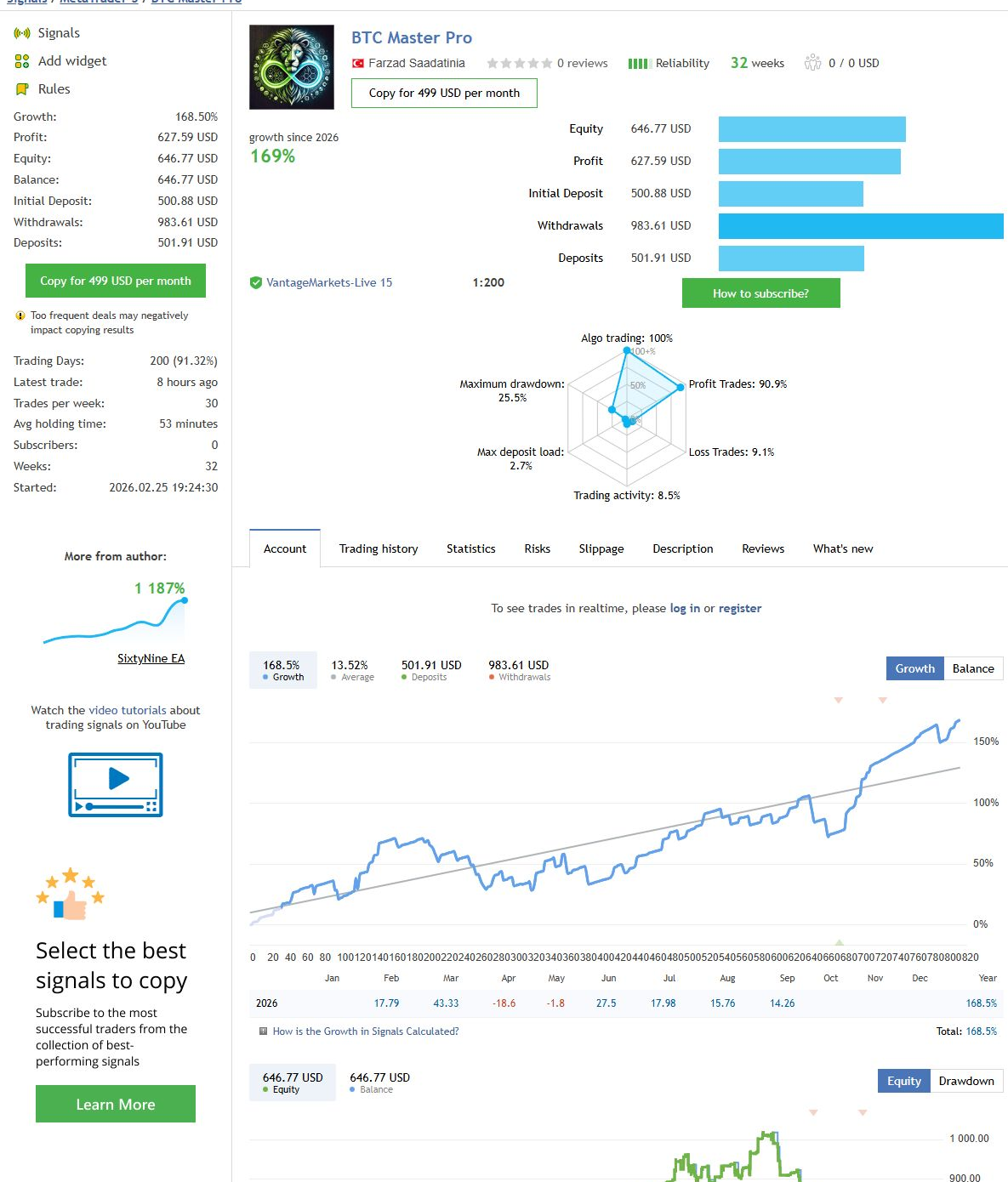
Cash flows also matter. The account began with $500.88 and shows another $501.91 deposited and $983.61 withdrawn. MQL5’s growth percentage is consequently not the same calculation as dividing net profit by the initial deposit. Nor does the equal balance/equity snapshot erase losses earlier in the record.
A high win rate can leave a narrow margin
Using the displayed averages, one losing trade offsets about 6.66 average winners. The approximate break-even win rate is 86.95%, calculated as 17.05 ÷ (17.05 + 2.56). These are observations about this sample, not fixed properties of the robot or a forecast.
That helps explain why a sequence of small wins can look reassuring while a handful of stops changes the overall result. A trader evaluating a similar configuration should compare loss size and losing sequences, not just count green trades. Execution differences become particularly relevant when many successful exits are small.
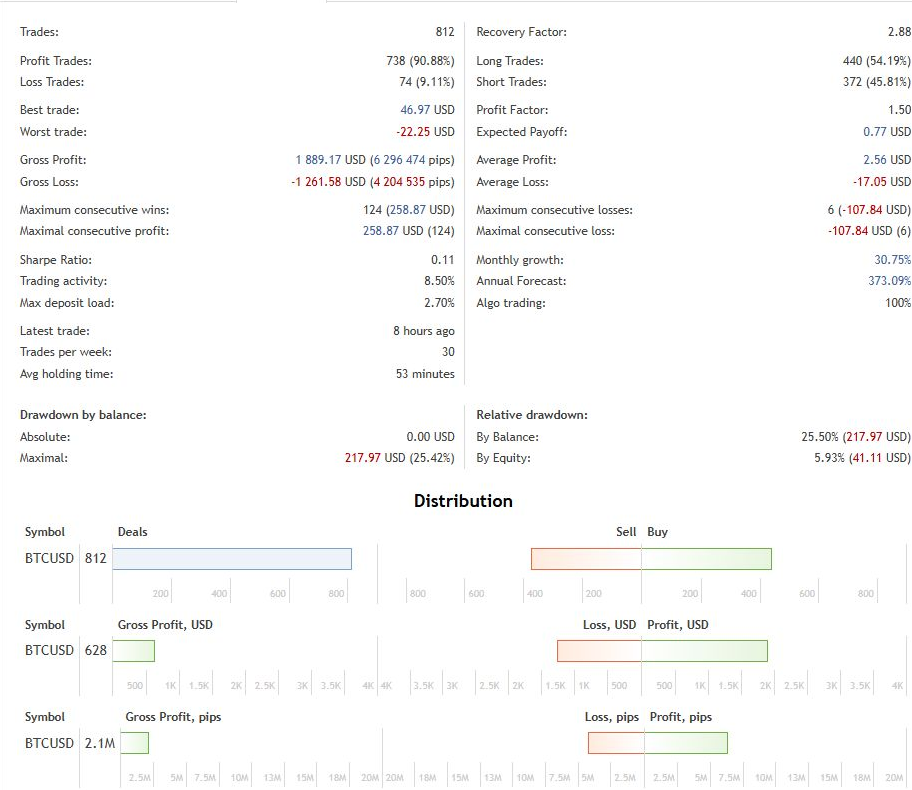
The monthly history includes −18.6% in April and −1.8% in May 2026, followed by other periods of recovery. September stood at +14.26% partway through the month. MQL5 also displayed a frequent-dealing warning about copying results. These observations qualify the growth headline: the path has included losing periods, and following the signal is a separate activity from running the standalone EA.
What the two historical backtests actually add
The developer supplies two report-and-curve pairs. Keeping each pair together makes it possible to inspect the scale of the simulation, the trajectory and the exposure display without treating the curve as a live statement.
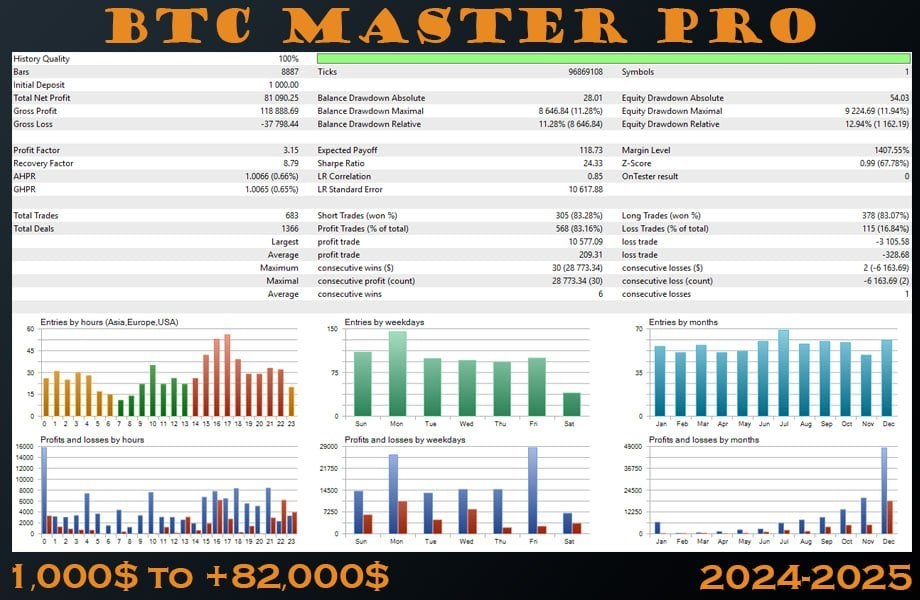
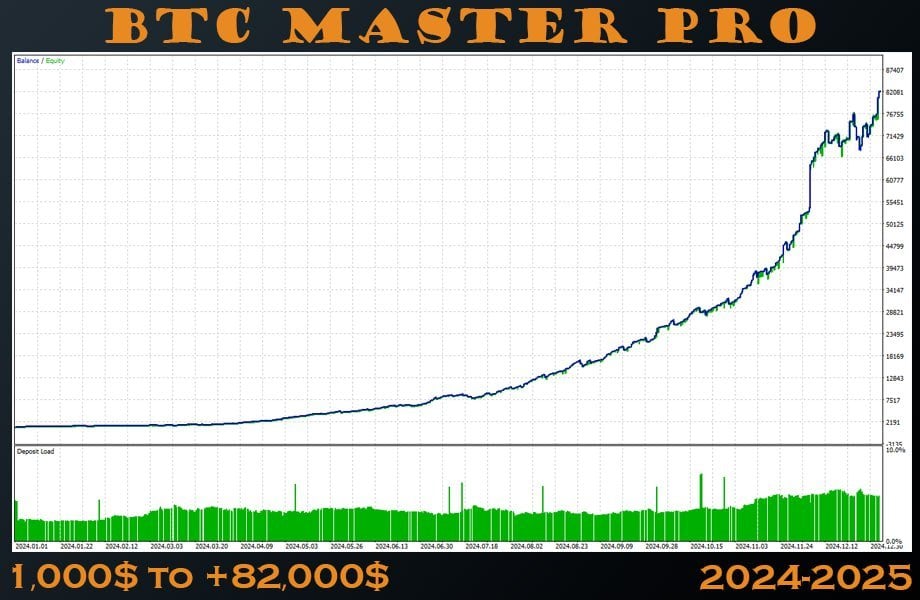
The shorter report displays 683 trades, a 3.15 profit factor and 12.94% relative equity drawdown. The longer report below spans a different labelled period and displays 2,960 trades, a 4.57 profit factor and 7.66% relative equity drawdown.
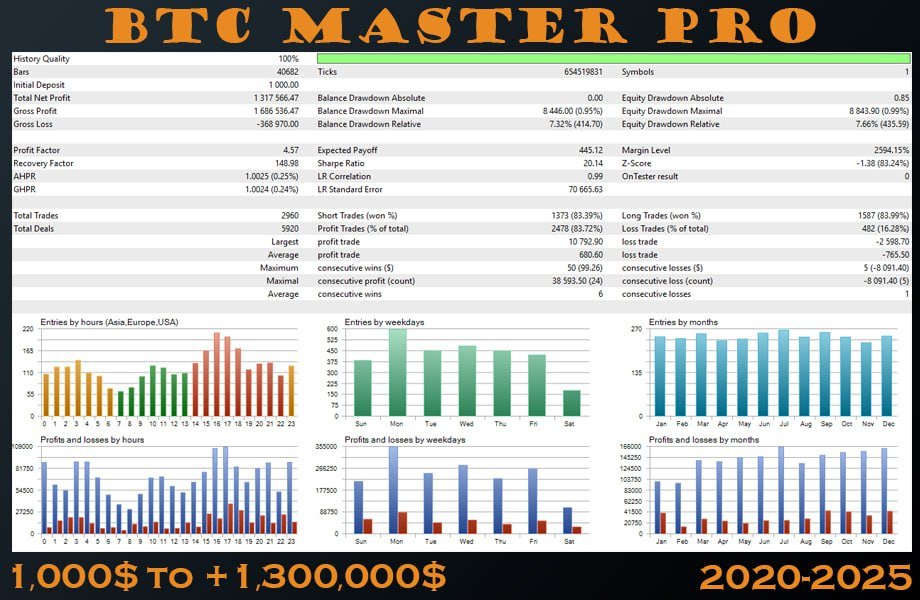
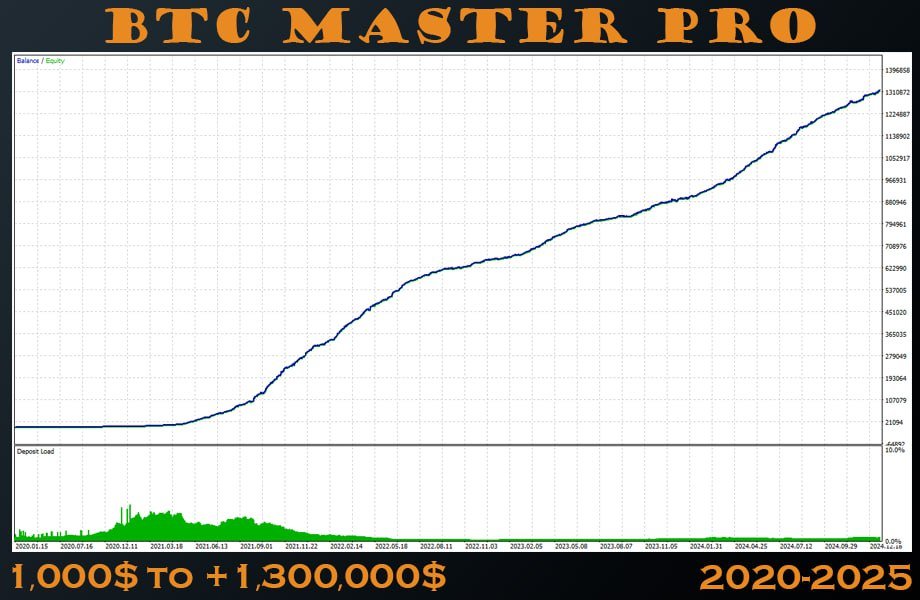
Both illustrated periods predate the announced AI release. Their results should not be combined with the monitored account as if they were one continuous track record. Differences in period, configuration and data make direct performance comparisons unreliable. In particular, a lower simulated drawdown does not establish a future loss ceiling.
Sizing, schedules and the scope of “one position”
In public operating comments, the developer distinguishes fixed lots, balance-proportional Auto Lots and stop-based risk-percentage sizing. Fixed volume does not keep percentage exposure constant as account equity changes; balance scaling does not necessarily equal a fixed loss percentage. This is a material configuration decision, not a cosmetic preference.
The current overview describes one-position logic. Older instructions also permit multiple strategy instances on separate charts with different magic numbers. Account exposure can therefore depend on deployment. Unique identifiers keep strategies distinct; they do not make simultaneous Bitcoin positions economically independent.
Day and hour filters provide another meaningful choice. A dated developer comment discusses Saturday stop-outs, but that historical observation is not proof that excluding Saturday will improve every current setup. Evaluate the schedule against your broker’s session and the chosen configuration, including losing periods.
Customer feedback is useful, but mixed
Positive MQL5 comments describe responsive support and satisfactory personal results. They can help assess customer experience, but do not disclose every account setting or establish an independently comparable return.

There are contrary experiences. In April 2025 Yuzuru Sanjo reported that four stops left little net profit; a January 2025 comment from Kwong Ho Lam reported losing the account’s money. The posts predate the current AI release and lack sufficient trade-level evidence to establish causes. They should nevertheless remain visible in a balanced assessment.

The release chronology and small review sample make “everyone gets the same result” an untenable conclusion. Read the full customer discussion alongside the current monitoring record, not as a substitute for it.
BTC Master Pro or SixtyNine?
SixtyNine EA MT5 is the same developer’s gold system, with six integrated strategy layers. BTC Master Pro focuses on Bitcoin and its execution filter. The sensible distinction is market, mechanism and settings—not which product has the more dramatic growth headline. Our SixtyNine review examines that product’s evidence separately.
For BTC Master Pro, a useful evaluation records the selected strategy, sizing method, schedule and broker contract before testing. Keep those choices unchanged long enough to observe both favorable and adverse sequences. Review open exposure and realised losses together. Adding the gold EA is a separate account-risk decision, not an automatic diversification benefit.