Get DowGold — Our #1 EA

Iron Stops EA MT5 Review | 100% SCAM

Last updated: August 2026

Iron Stops is an XAUUSD (Gold) Expert Advisor for MetaTrader 5 by Indonesian developer Fajar Dicky Firmansyah, published on the MQL5 marketplace on 14 August 2026. At the time of writing it is eleven days old, carries a 4.81 rating, and is selling at a rate the marketplace records as 188 purchases per month.

We do not stock it, and this review explains why. Before going further we should be clear about what this is and is not: we have not purchased or run Iron Stops. This is not a test report. It is an assessment of the evidence a prospective buyer can examine for themselves — the developer’s own listing, the live signal he links from it, and the reviews published beneath it. Everything cited here is public and checkable, and we would encourage you to check it rather than take our word for anything.

We rate Iron Stops 1 out of 5. That rating reflects the quality and coherence of the available evidence, not a claim about the developer’s intentions, which we are in no position to judge.

Four things drive that rating, and each is checkable in a few minutes: the “100K Real Signal” the product is marketed on is one week old and contains five trades; the $100,000 behind it appears to be virtual subscription capital rather than the developer’s own money; the backtest turning $1,000 into $40 million is captioned as having been achieved on a fixed 0.01 lot, which is arithmetically impossible; and a buyer has published a detailed technical audit alleging that backtest is contaminated by thousands of historical trade setups embedded in the compiled file.

⚠️ Before anything else

If you arrived here looking for a cracked or free copy of this or any other EA: there is no working cracked file for a licensed marketplace product. What is on offer at those sites is malware, or a Telegram seller who takes payment and vanishes. That holds regardless of what you conclude about the product itself.

Iron Stops EA MT5 logo — XAUUSD M30 gold Expert Advisor by Fajar Dicky Firmansyah, published on the MQL5 marketplace in August 2026

The “100K Real Signal” — What It Actually Shows

The listing headlines a link described as “100K Real Signal.” That framing does a lot of work, so it is worth opening the signal and reading what is on it.

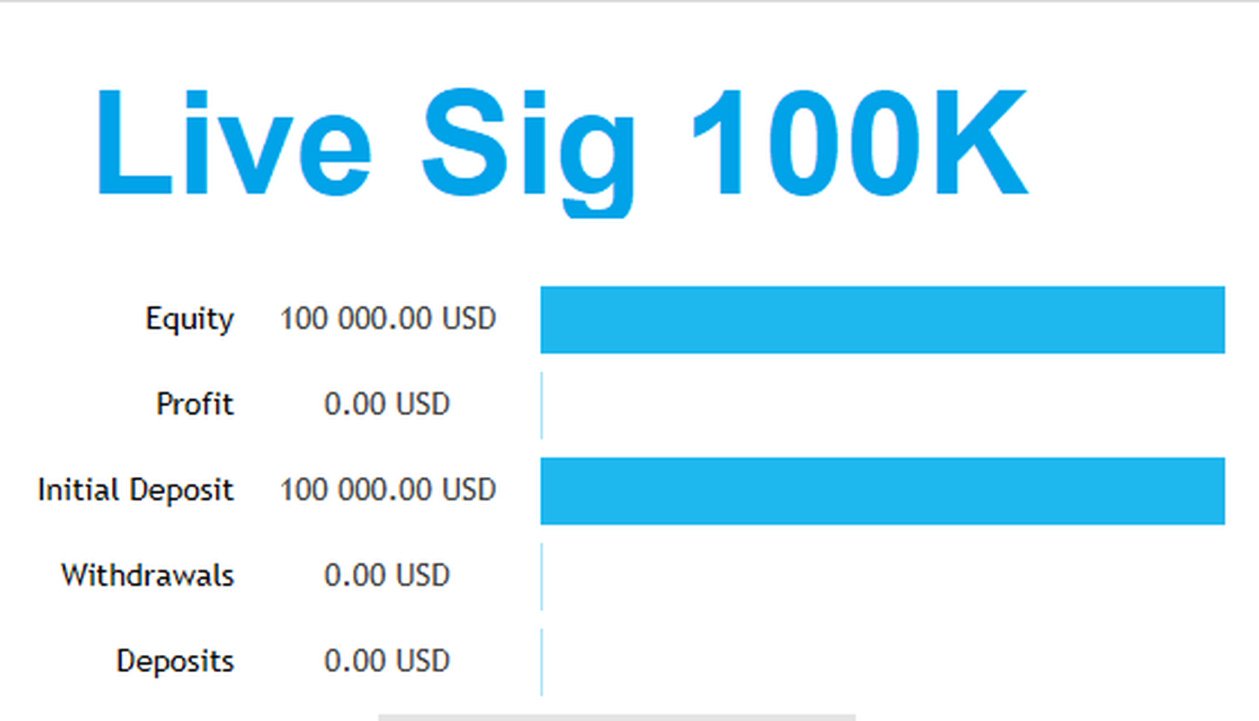
The account is on Darwinex at 1:200 leverage, opened 13 August 2026. As of writing it holds these figures:

Iron Stops EA live signal summary headed Live Sig 100K, showing equity of 100,000 USD, profit of 0.00 USD, an initial deposit of 100,000 USD, zero withdrawals and zero deposits
The signal that anchors the marketing: a $100,000 headline figure attached to an account barely off its starting balance.
  • Initial deposit: $100,000
  • Balance: $100,179.60
  • Growth: 0.18%
  • Total trades: 5
  • Profit factor: 1.17
  • Sharpe ratio: 0.08
  • Best trade: +$327.73
  • Worst trade: −$1,039.78
  • Subscribers: 0
  • Age: 1 week

Five trades. One week. A profit factor barely above break-even. And the single losing trade is more than three times the size of the best winning trade — which is exactly the trade shape that produces a high win rate right up until it doesn’t.

MQL5’s own automated systems have flagged the account four separate times, and those warnings sit on the signal page: that the number of deals is too small to evaluate trading quality; that this is a newly opened account and results may be of a random nature; that trading activity is low with only five trades detected in the last month; and that the share of trading days is too low.

The platform hosting the signal is telling you the signal proves nothing. We would put it more plainly: a $100,000 account balance is not evidence of anything except a $100,000 account balance. The number is large and impressive-looking, and it is doing rhetorical work that its five trades cannot support. A week-old account with a profit factor of 1.17 tells you the EA has opened some orders. That is genuinely all it tells you.

The developer is also offering copy-trade subscriptions to this signal at $900 per month. It currently has zero subscribers.

The $100,000 Is Not What It Appears to Be

The signal’s own description reads “100k Real money,” and the product listing calls it a “100K Real Signal.” Those words carry the weight of the entire sales pitch, so they deserve scrutiny.

The account is hosted on Darwinex. Darwinex operates a subscription product called Darwinex Zero, and understanding how it works changes what that $100,000 figure means.

Darwinex Zero is a monthly subscription service. Traders pay a fee and receive a trading account in order to build a public track record — the commercial model being that strong performers may later attract real investor capital allocated by Darwinex, from which they earn a share of the profits. Darwinex’s own description of these accounts is that they hold virtual funds and are hosted on a real server, simulating genuine market conditions including latency and market depth.

Read that carefully, because it is the crux. Virtual funds. Real server.

That combination is precisely why an MQL5 signal sourced from such an account can display a server name reading “Darwinex-Live” while the capital being traded is not the provider’s own money at risk. The server is real. The execution environment is real. The $100,000 is not.

Two further details are worth knowing. First, published pricing for Darwinex Zero puts a $100,000 account size at around $50 per month, falling to roughly $35 per month on an annual commitment. Second, $100,000 is a standard tier offered by the service, not an unusual sum someone had to accumulate.

So the headline number anchoring this product’s marketing — the one that makes a week-old, five-trade signal look institutional — is available to anybody for roughly the price of a streaming bundle.

We have checked this, and our conclusion is that the account behind the “100K Real Signal” is a Darwinex Zero virtual-capital account rather than $100,000 of the developer’s own money. We put that forward as our finding, and we would welcome correction: the developer could settle the question immediately by publishing evidence of real capital deployment. Until he does, we do not think the phrase “100k Real money” is supported.

To be precise and fair on one point, because it matters: Darwinex themselves draw a distinction between their virtual accounts and ordinary demo accounts, and they are entitled to. Darwinex Zero is a legitimate, FCA-regulated product with a genuine purpose, and there is nothing improper about a developer using one to build a track record — plenty do, openly and honestly. The issue here is not the use of Darwinex Zero. The issue is describing the resulting account as “100k Real money” in order to sell an Expert Advisor.

The Backtest: $1,000 Into $40 Million

Everything the product is selling rests on its backtest, so let us look at it directly.

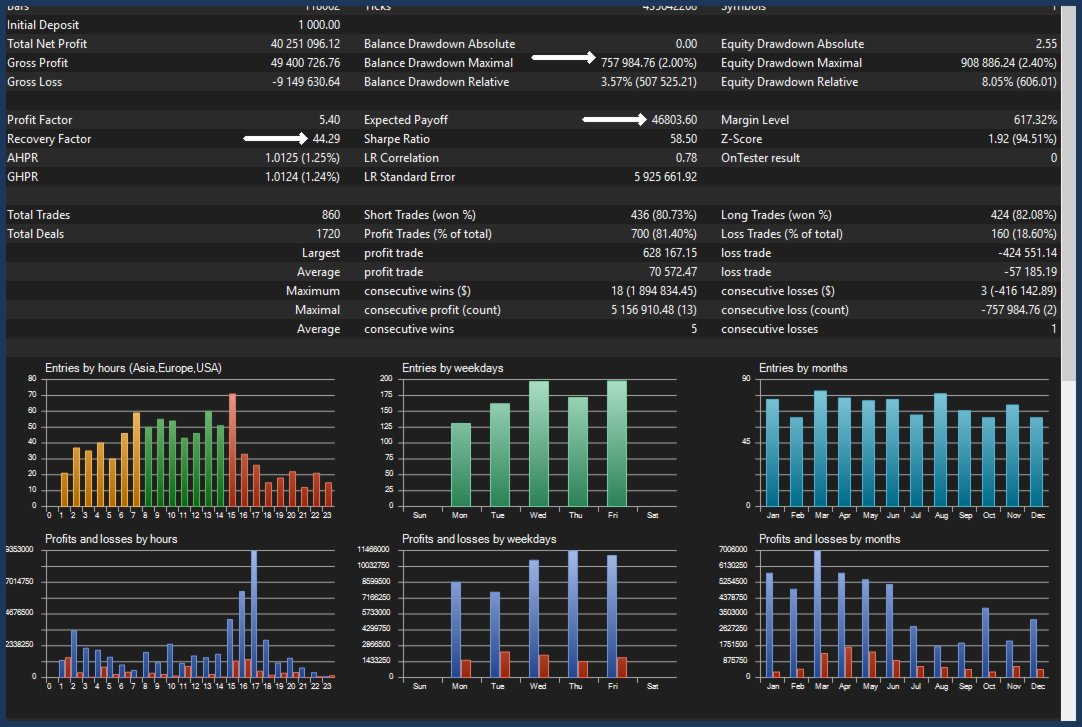
Iron Stops EA MT5 strategy tester report showing a 1,000 USD initial deposit producing 40,251,096 USD total net profit, a profit factor of 5.40, a recovery factor of 44.29, a Sharpe ratio of 58.50, an expected payoff of 46,803.60 USD per trade, 860 total trades with an 81.40 percent win rate, an average profit trade of 70,572 USD and an average loss trade of 57,185 USD
The published strategy tester report — read the expected payoff and the Sharpe ratio.

The headline figures:

  • Initial deposit: $1,000
  • Total net profit: $40,251,096.12
  • Profit factor: 5.40
  • Recovery factor: 44.29
  • Sharpe ratio: 58.50
  • Expected payoff: $46,803.60 per trade
  • Total trades: 860, of which 81.40% profitable
  • Average profit trade: $70,572.47 · Average loss trade: −$57,185.19

That is a return of roughly 40,251 times the starting capital. Take a moment with the Sharpe ratio too: 58.50. For context, the most celebrated quantitative funds in the world operate at a Sharpe of roughly 2 to 3 over the long run. A figure in the fifties is not an exceptional result; it is a number that should prompt you to question the test that produced it.

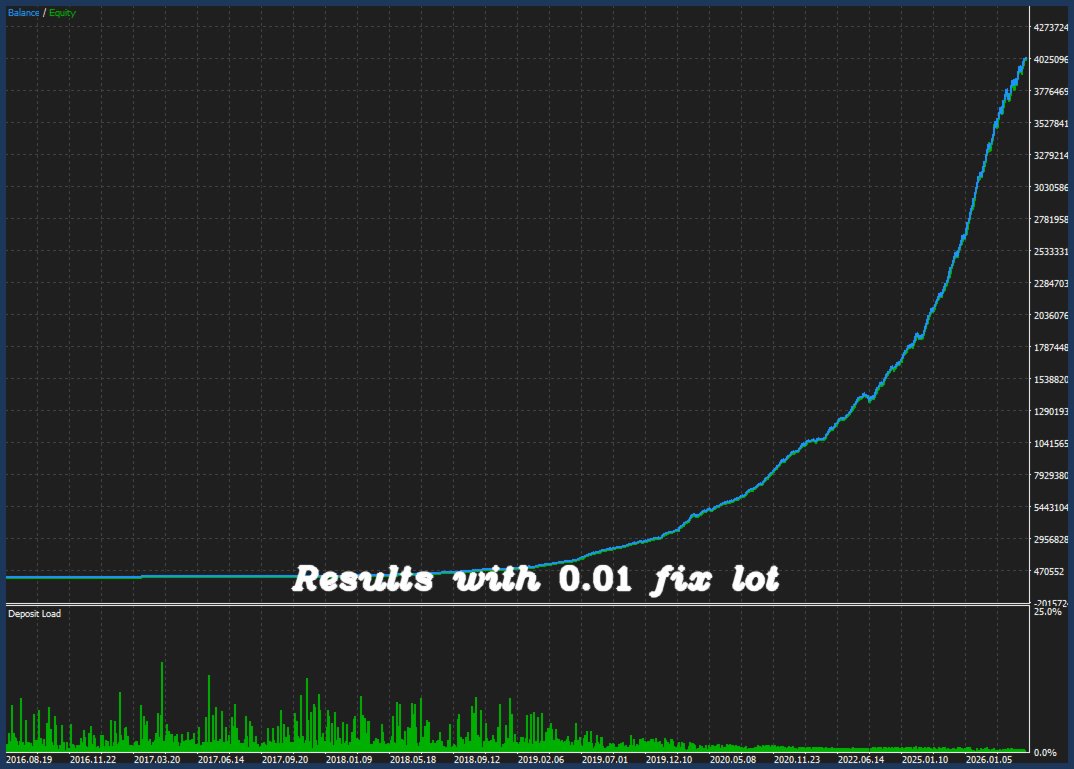
But the genuinely revealing part is the second chart.

Iron Stops EA MT5 backtest equity curve labelled Results with 0.01 fix lot, running from August 2016 to 2026 and rising in a steep exponential curve to over four million, with a deposit load histogram along the bottom
Labelled “Results with 0.01 fix lot” — and that label is the problem.

This curve is captioned, in the developer’s own words, as the results achieved with a fixed 0.01 lot. That claim does not survive contact with arithmetic, and you do not need to take our word for it — the check takes thirty seconds.

First, the shape. A genuinely fixed lot size produces a roughly linear equity curve. Every trade risks and earns the same nominal amount regardless of how large the account has grown, so the balance climbs in a straight line. Exponential growth is only possible when position size scales with the account. The curve above is unmistakably exponential — flat for years, then accelerating vertically. A fixed lot cannot compound. The chart’s shape contradicts its own caption.

Second, the magnitude. On XAUUSD, one standard lot is 100 troy ounces, so 0.01 lot is a single ounce. A $1 move in the gold price produces $1 of profit or loss on that position. The report’s own expected payoff is $46,803.60 per trade. To earn that on a single ounce of gold, the price would have to move $46,803 in the EA’s favour on the average trade — roughly twelve times the entire current price of gold, over and over, 860 times.

Third, the trade averages. The report shows an average winning trade of $70,572 against a starting deposit of $1,000. A single average trade is therefore worth seventy times the entire account it began with. That is only achievable through aggressive compounding of position size — which is, again, the precise opposite of a fixed lot.

We are not going to speculate about how the caption came to be attached to that chart. What we can say plainly is that a prospective buyer reading “results with 0.01 fix lot” would reasonably conclude the strategy generates these returns at minimum position size and therefore minimum risk. That conclusion is not supported by the numbers on the report sitting beside it.

Set alongside the live signal — five trades, 0.18% growth, a profit factor of 1.17 — the gap between the tested claim and the observed reality is roughly the distance between $40 million and $180.

A Buyer Published a Technical Audit. It Is Serious.

This is the part of the story that changed our view from “thin evidence” to “do not touch,” and it is sitting in plain sight in the reviews section of the product’s own listing.

On 23 August 2026, a buyer posting as Bo Wen Che published a detailed technical audit of the compiled EA, in both Chinese and English. We are summarising his published claims here — we have not independently reproduced them, and they remain, at the time of writing, allegations rather than established findings.

His claim, in short, is that the EA’s advertised backtest performance is contaminated by historical answers embedded in the compiled file. Specifically, he reports recovering 3,991 embedded historical “Setup” templates from the EX5’s static and runtime data, spanning approximately June 2004 to July 2026. Each template, he states, contains a timestamp, a trade direction, five price values, tolerance data and risk-reward parameters.

He then matched those embedded records against the EA’s historical trading behaviour and reports: precision of 99.62%, recall of 80.17%, an F1 score of 88.84%, and risk-reward class agreement of 98.86%. His conclusion is that a large share of the backtest’s trades are not discovered from market data by a live strategy at all, but are directly explained by pre-stored historical setup information inside the file.

The most consequential part of his audit is the replay test. He reports replaying entirely different real historical price paths beyond the embedded templates’ cutoff, and finding that 14 fixed trading-time nodes appeared in 18 out of 18 different price paths, accounting for 252 of 271 trades — 92.99%. Prices affected direction and stop/target geometry, but the trading times themselves were, on his account, largely predetermined.

Across those replayed real-market paths, he reports the result was a 60.56% win rate and a profit factor of 0.9755.

A profit factor below 1.0 means the strategy loses money. The advertised historical profit factor for this product is approximately 6.

He states he has preserved the recovered template data, the trade-by-trade matching, the EX5 hash, runtime evidence and the replay results, and has requested an independent review by MetaQuotes of the source code submitted to the Market.

The developer’s published reply to that audit, in full, was: “Hello thank you so much for your nice review.”

We are not going to characterise what that response means. We will simply note that a detailed, methodologically specific allegation that a product’s headline performance figures are contaminated is the kind of thing a developer with a clean answer would want to answer. Elsewhere on the same page, replying to a positive review, the developer wrote that “there are people who trying to destroy my EA’s reputation but they cant destroy a stable iron.”

To be scrupulously fair: this audit is one buyer’s work, it has not been independently verified as far as we can establish, and MetaQuotes has not published any finding. It is possible it is wrong. But it is specific, it is falsifiable, it comes with retained evidence, and it has gone unanswered on the merits. Anyone considering spending money here should read it in full on the listing and weigh it themselves.

What the 4.81 Rating Is Actually Measuring

A 4.81 average across 31 reviews looks like a strong endorsement. Read the reviews individually and something different emerges.

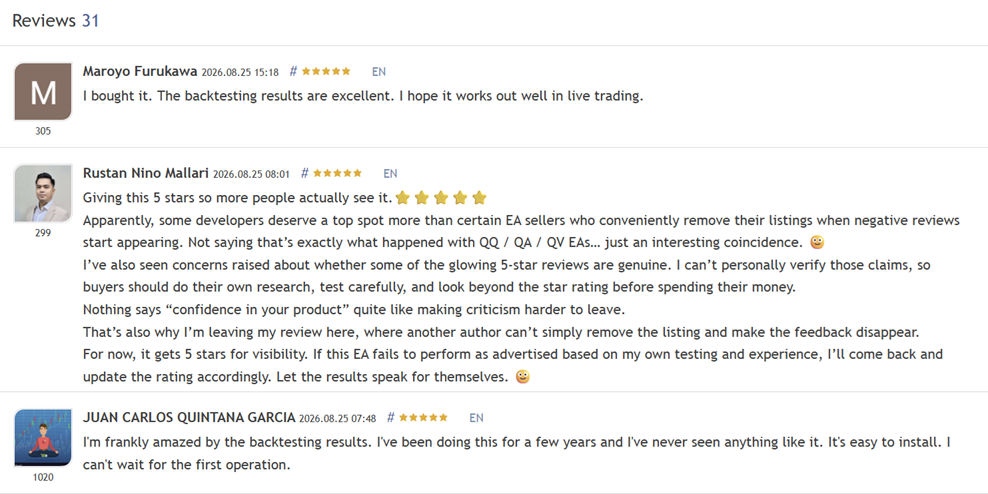
Iron Stops EA marketplace reviews showing buyers praising the backtesting results and hoping the EA works in live trading, one reviewer stating they are giving five stars for visibility rather than performance and urging buyers to look beyond the star rating, and another saying they are amazed by the backtest and cannot wait for the first operation
A sample of the reviews behind the 4.81 — note what is being praised, and what has not happened yet.

The overwhelming majority are rating the backtest, not live performance. A representative sample of what buyers actually wrote, in their own framing:

  • One bought it and said the backtesting results are excellent, and that they hope it works out well in live trading.
  • Another said they were amazed by the backtesting results and could not wait for the first operation.
  • A third said that after backtesting the profit was astonishing, and that it was now running on a simulated account and had not yet opened a position.
  • A fourth found the backtest results very interesting and said they were looking forward to results from their live account.
  • A fifth simply cited good backtest results.
  • A sixth described amazing profits in backtests with every-tick and real-tick modelling, and hoped it would work as well on their live account.

These are not reports of performance. They are reports of anticipation. Several explicitly state that live trading has not started. In a product eleven days old, that is unavoidable — but it means the 4.81 is measuring how impressive a backtest looks, which is precisely the thing the audit above calls into question.

Two reviews are worth reading closely for different reasons. One five-star review states openly that it is being given “for visibility” rather than for performance, and the same reviewer raises concerns about whether some of the glowing five-star reviews are genuine, urging buyers to look beyond the star rating. Another reviewer, who initially wrote that the EA “feels like it could be a Holy Grail,” returned days later to update that the risk-reward ratio had deteriorated significantly in the most recent month, with clearly unfavourable entries on specific dates.

That second update is the first piece of genuine forward-looking evidence in the review set, and it is negative.

The Selling Mechanics

Set the performance question aside entirely. The way this product is being sold has features worth naming, because they recur across products that end badly.

A scarcity counter that does not reconcile. The listing states: “This EA currently costs 299. Once 15 licenses are purchased, the price will increase to 399. At present, 11 copies have been sold.” On the same page, MQL5’s own counter records 188 purchases per month. Those two statements cannot both describe the same product. A reviewer writing on 23 August also referenced a price of $249, so the price has already moved to $299 — meaning the “11 copies sold” threshold has apparently been reached and reset at least once while the counter continued to display a low number.

The backtest requires the developer’s configuration file. The listing states that proper configuration is essential for accurate backtesting and asks buyers to contact him for his .ini file and instructions. In the ordinary course that is unremarkable. In the specific context of an allegation that historical setups are embedded in the file, a requirement to use the developer’s own configuration to reproduce his headline results is worth noting.

Buy one, get two. The listing offers an additional Expert Advisor free after purchase, on request.

Support and configuration gated behind a private Telegram channel. Buyers are directed to contact the developer for access to a private channel carrying updates and configuration files. Discussion that happens in a private channel does not accumulate as public evidence the way marketplace comments do.

The same copy across different products. The developer lists four products. Iron Stops opens “No gimmicks. No empty claims… traders focused on one crucial aspect: consistency. Whether you’re working through a prop challenge or overseeing client funds, this EA keeps within set boundaries.” A sibling product opens “No flashy tricks. No broken promises… traders who care about one thing: consistency. Whether you’re scaling through a prop challenge or managing client capital, this EA stays within the limits.” A third repeats the formula again. Each closes with a variant of “One chart. One weapon.” Each carries the same escalating-price notice. The instruments and timeframes differ — CADJPY M15, NZDCAD M30, GBPUSD H1, XAUUSD M30 — but the pitch is a template.

None of this is proof of anything. Collectively it describes a product being sold hard and fast on the strength of a backtest, before any live evidence exists.

What Verifiable Evidence Actually Looks Like

The useful thing to take from this is not an opinion about one EA. It is a checklist you can apply to any of them, including ours.

1. Look at trade count before anything else. Five trades is noise. A hundred trades starts to be a sample. A signal’s age in weeks matters far less than the number of independent outcomes it contains.

2. Check deposits and withdrawals. A growth percentage on an account that has been topped up is not a return. Zero deposits and zero withdrawals is what makes a growth figure mean what it appears to mean.

3. Compare the worst loss to the best win. If the largest loss dwarfs the largest win, a high win rate is arithmetic rather than edge. On the Iron Stops signal, the worst trade is more than three times the best.

4. Read the relative drawdown, not the headline. Many reports show a flattering maximum drawdown measured against a large compounded balance, while a much worse relative figure sits lower down. The relative number is what you would have lived through.

5. Be suspicious of profit factors above about 3 on a long backtest. Real strategies with genuine edge rarely sustain them. A profit factor of 6 over two decades should prompt questions, not enthusiasm — and in this case, questions were what it prompted.

6. Prefer years to weeks, and prefer independently tracked accounts. Third-party verification through a service like MyFXBook, on an account that has been running long enough to have survived bad periods, is worth more than any backtest ever produced.

For what it is worth, that last standard is the one we hold our own products to. DowGold has traded live since 2022 on a $100,000 real-money account with MyFXBook verification and a second independent tracker alongside it, and PrismAlgo offers a seven-day free trial so you can watch it work before paying anything. We make both, so weight that recommendation accordingly and go and check the accounts yourself — which is the entire point of this section.

Our Verdict

We rate Iron Stops 1 out of 5, on the evidence rather than on testing we have not done.

The case for the product rests almost entirely on a backtest. The live signal it points to is one week old, contains five trades, has a profit factor of 1.17, carries four separate MQL5 warnings that it cannot be evaluated, and has a worst trade more than triple its best. The $100,000 that makes that signal look substantial appears to be Darwinex Zero virtual capital — a subscription tier costing around $50 a month — rather than the developer’s own money, despite being marketed as “100k Real money.” The backtest those buyers are impressed by turns $1,000 into $40 million at a Sharpe ratio of 58.50, and is presented with a curve captioned as the result of a fixed 0.01 lot — a caption its own expected payoff of $46,803 per trade cannot support, since that would require the average trade to capture roughly twelve times the entire price of gold on a single ounce. The 4.81 rating is composed largely of buyers describing how impressed they are by that backtest, several stating explicitly that they have not begun live trading. And a buyer has published a detailed technical audit alleging that the backtest itself is contaminated by thousands of historical setups embedded in the compiled file — an allegation answered with a one-line thank-you.

Any one of those on its own would warrant caution. Together they describe a product where the only strong evidence is the evidence most open to question.

We may be wrong. The audit may not survive scrutiny; MetaQuotes may review the code and find nothing; the signal may accumulate hundreds of trades over the coming year and vindicate everyone who bought early. If that happens we will update this page, because we would rather be corrected than be quietly wrong. But we are not prepared to stock it, and if you are considering buying it we would ask you to do three things first: open the signal and count the trades, read the audit in the reviews section in full, and ask yourself what you would need to see before risking money — then check whether you have seen it.

Frequently Asked Questions

Is Iron Stops a scam?

We are not making that claim and we do not have the evidence to. It is a real product, delivered through the MQL5 marketplace, from a developer with a public profile and four listed products. What we can say is that its performance evidence is extremely thin, that its headline backtest figures are the subject of a serious published technical allegation, and that we would not spend money on it in that state.

What does the live signal actually prove?

Very little, and MQL5 says so itself. The account is one week old with five trades, a profit factor of 1.17 and 0.18% growth, and the platform has posted four automated warnings stating the sample is too small to evaluate and that results may be random. The $100,000 balance is impressive-looking but carries no information about strategy quality — account size and evidence are different things.

Is the $100,000 account real money?

On our checks, no — it appears to be a Darwinex Zero virtual-capital account. Darwinex Zero is a monthly subscription service where traders pay a fee to trade an account holding virtual funds hosted on a real server, in order to build a track record and potentially attract real investor allocations later. That is why the signal can show a “Darwinex-Live” server name without real capital being at risk. Published pricing puts a $100,000 Darwinex Zero account at around $50 per month. Using Darwinex Zero is entirely legitimate and many honest developers do it; describing the resulting account as “100k Real money” to sell an EA is the part we take issue with. The developer could resolve this immediately by publishing evidence of real capital.

Can the backtest really turn $1,000 into $40 million on a 0.01 lot?

No. The report shows a $1,000 deposit growing to $40,251,096 with an expected payoff of $46,803.60 per trade, and one equity curve is captioned as the result of a fixed 0.01 lot. Two things rule that out. A fixed lot produces linear equity growth because every trade earns the same nominal amount regardless of account size, yet the curve shown is exponential — only scaling position sizes can do that. And on XAUUSD a 0.01 lot is one troy ounce, so a $46,803 average payoff would require gold to move $46,803 per trade, roughly twelve times its entire price. The figures and the caption cannot both be right.

What is the embedded-template allegation?

A buyer published a technical audit stating he recovered 3,991 historical trade setups embedded in the compiled EA file, covering roughly 2004 to 2026, and that these closely match the EA’s backtest trades. He reports that when replayed on price paths outside the embedded range, the strategy produced a profit factor of 0.9755 — losing money — against an advertised historical figure near 6. He has requested a MetaQuotes review. The allegation is unverified, and we report it as an allegation, but it is specific and it has not been answered on the merits.

Why is the rating so high if the evidence is so thin?

Because most of the reviews are rating the backtest, not results. Several reviewers state plainly that they have only backtested and have not yet started live trading. One five-star review says explicitly that it is being given for visibility rather than performance. One early enthusiastic reviewer has since updated to report deteriorating risk-reward. A star average is only as meaningful as what the stars are measuring.

Should I be worried about the price-increase notices?

They are worth noticing rather than worrying about. The listing states that only eleven copies have been sold and that the price rises after fifteen, while the marketplace’s own counter on the same page records 188 purchases per month. The price has also already moved from $249 to $299. Escalating-price scarcity is a common tactic and is not by itself evidence of a bad product, but a counter that contradicts the platform’s own figures is a reason to read everything else more carefully.

What should I look for before buying any EA?

Count the trades on the live account before anything else, since a small sample proves nothing regardless of how long the account has existed. Check that deposits and withdrawals are zero so the growth figure means what it appears to mean. Compare the worst loss with the best win. Read the relative drawdown rather than the headline. Treat a backtest profit factor above roughly 3 as a question rather than a selling point. And prefer independently verified accounts with years of history over any simulation.

Will you update this review?

Yes. If the signal accumulates a meaningful number of trades and holds up, if MetaQuotes publishes a finding either way, or if the developer responds substantively to the audit, we will revise this page to reflect it. We would rather correct ourselves publicly than leave an out-of-date judgement standing.