Last updated: August 2026
MoonDog EA is a multi-strategy breakout Expert Advisor for XAUUSD (Gold) on MetaTrader 5, developed by James Vito Armin Bianchini, a Switzerland-based developer. It is his only published product, and it carries a 5.0 rating across 13 marketplace reviews.
The design idea is straightforward and, we think, sound: rather than one entry model applied to gold, MoonDog runs five independent breakout modules — Moon Nova, Apex, Zenith, Pulse and Eclipse — each reading price structure from a different angle, each carrying its own magic number, and each able to be switched off individually. Modules scan for structure, place pending stop orders in both directions, then manage whatever fills. Every position gets its own stop loss and take profit. There is no grid, no martingale, no averaging down and no floating basket held open to rescue a loser.
We rate MoonDog EA 4 out of 5. The positive lean comes from a genuinely defined-risk architecture that the live data corroborates rather than contradicts, a modular design with real practical value, an execution-quality feature we have not seen done this well elsewhere, and a backtest presentation that is markedly more candid than this category’s norm. What holds it back is the size and age of the live evidence — the account behind the headline percentage started at just over $60 — a backtest window of 18 months with commission recorded as zero, and a marketing posture built around price escalation.
⚠️ Looking for a MoonDog EA “free download”? Don’t.
Every legitimate marketplace EA ships with built-in DRM or licensing. There is no working cracked file in existence — so a “free” copy is always one of two things:
- malware, or
- bait for a Telegram payment scam where you pay and get nothing.
The only safe routes are the MQL5 marketplace or a reputable reseller. CheaperForex offers MoonDog EA at a lower price than the marketplace — see the product page here.
Five Modules, One EA — and Why That Matters

The modular architecture is the product’s defining feature, and it is worth understanding what it actually buys you.
Most breakout EAs implement one definition of a breakout. When gold’s character shifts — from clean trending expansion to choppy false breaks — a single-model system tends to fail as a whole. MoonDog splits the problem five ways. Each module has its own structural read, its own pending orders, and its own magic number, which means positions from different modules are tracked and managed entirely separately rather than pooled.
Two practical consequences follow. The first is positive: if one module’s read of the market is wrong for a period, the others are not automatically wrong with it, and you can disable a module that is underperforming without touching the rest. That is meaningfully more control than most EAs give you.
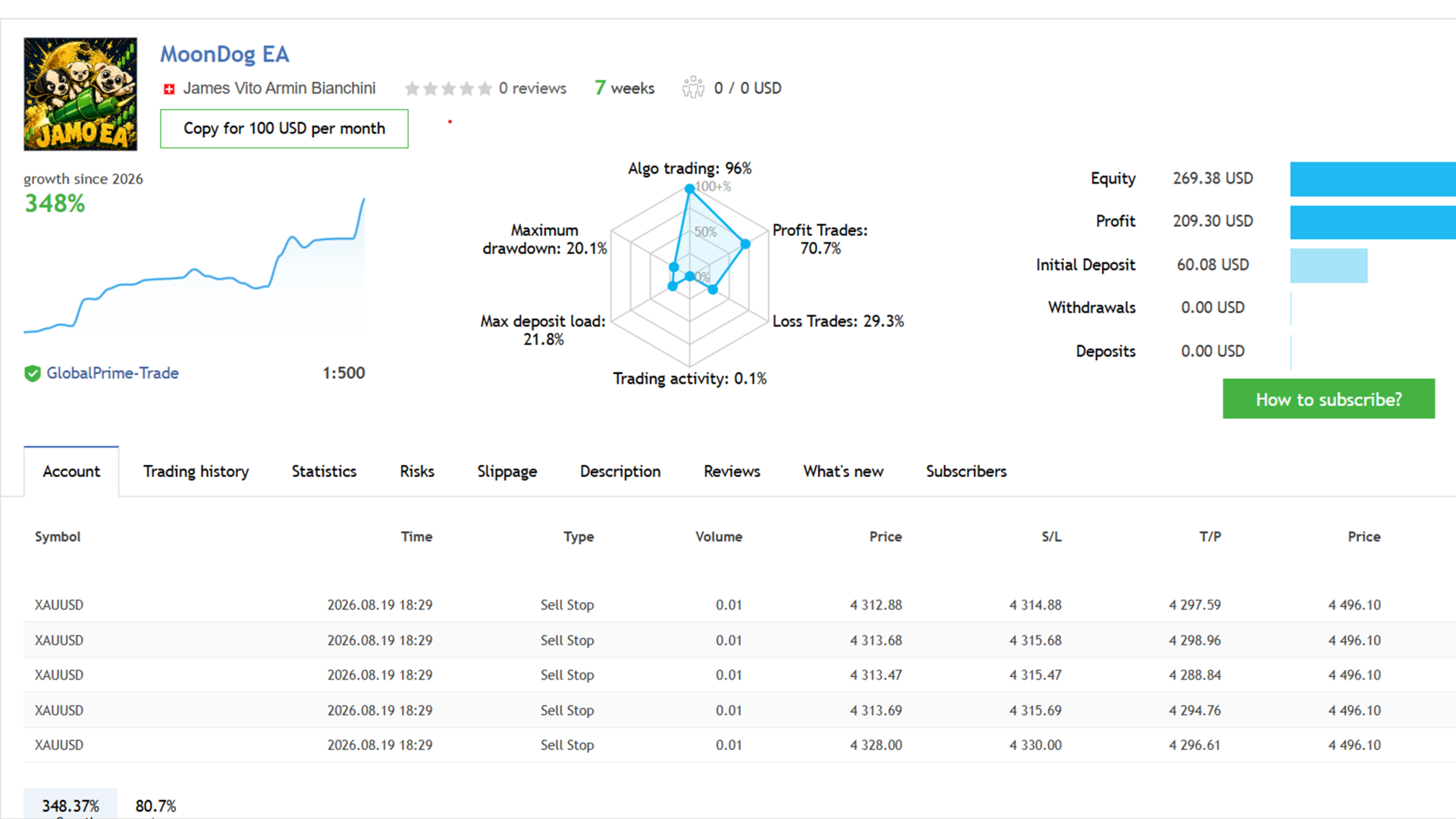
The second deserves attention before you size an account. Five modules can be in the market simultaneously. The developer’s own live trading history shows five XAUUSD sell stop orders placed at the same timestamp — one from each module. That is not a fault; it is the design working. But it means your worst-case concurrent exposure is roughly five positions, not one, and the live account’s maximum deposit load of 21.8% reflects exactly that. Size for five, not for one.
The Risk Architecture — and What the Live Data Says About It
The developer’s claims here are unambiguous: own stop loss and take profit per trade, no lot multiplication after a loss, no averaging, no recovery basket. We generally treat such claims as unproven until the data supports them, so here is the check.
Best trade $15.35. Worst trade −$6.14.
That single comparison does a lot of work. Grid and martingale systems produce the opposite shape — a long series of small wins punctuated by a loss several times larger, because losing positions are held and added to rather than cut. MoonDog’s live record shows the healthy pattern: its largest loss is smaller than its largest win. Combined with a genuine 30% loss rate rather than an implausible near-perfect one, this is consistent with a system that takes defined losses and moves on.
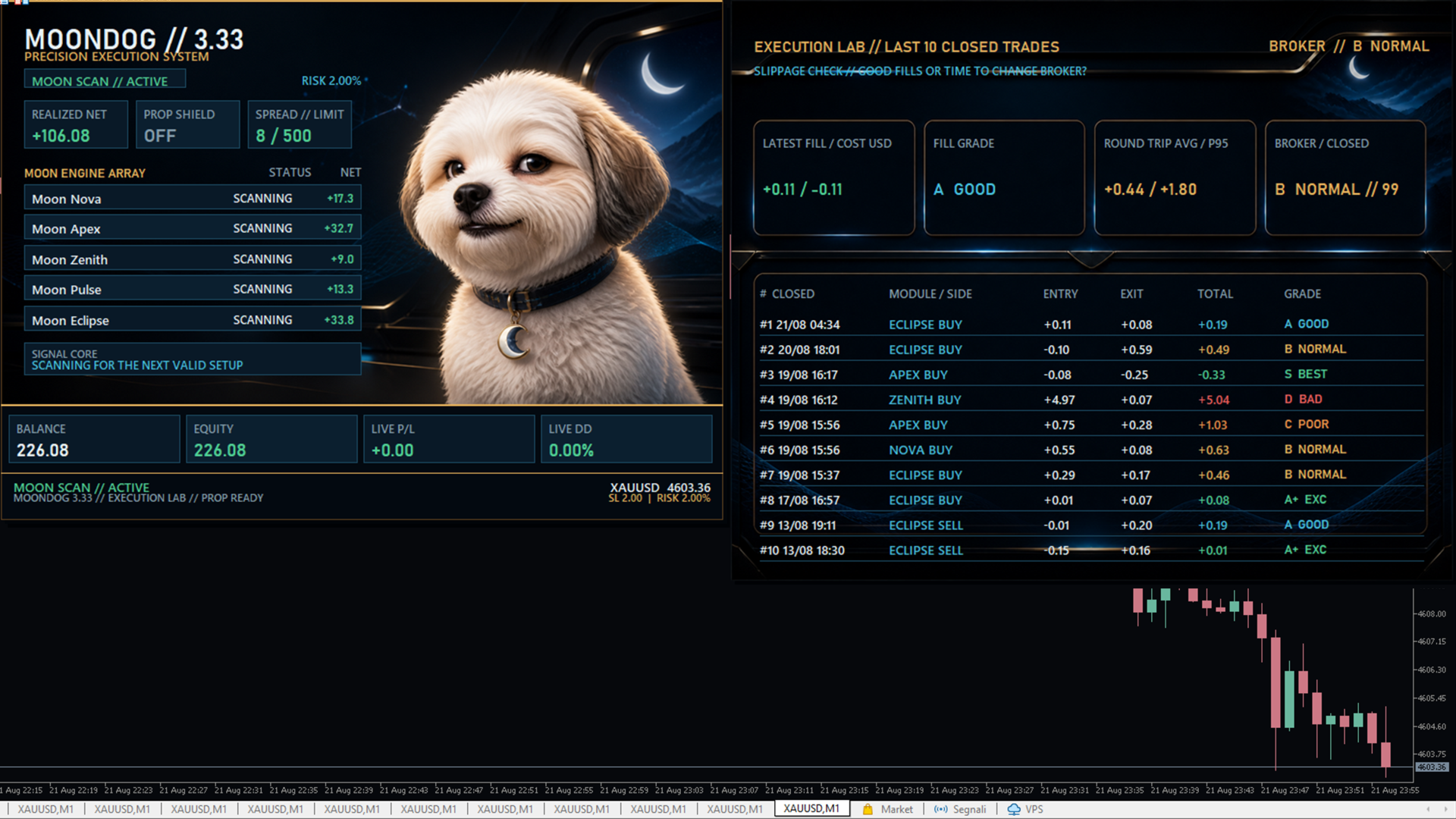
The on-chart panel corroborates it too, displaying a fixed stop loss setting and a per-trade risk percentage rather than any recovery logic. And a detailed buyer review describes the same behaviour from the other side: small, contained losers closed quickly, with no second larger position opened to fix them.
When the developer’s description, the panel, the trade distribution and independent buyer reports all agree, the claim is about as well-supported as it can be without source code. This is the strongest part of the product.
The Three Risk Profiles — an Unusually Honest Presentation

We spend a lot of these reviews dismantling backtest graphics, so it is worth acknowledging when one is presented properly. This is.
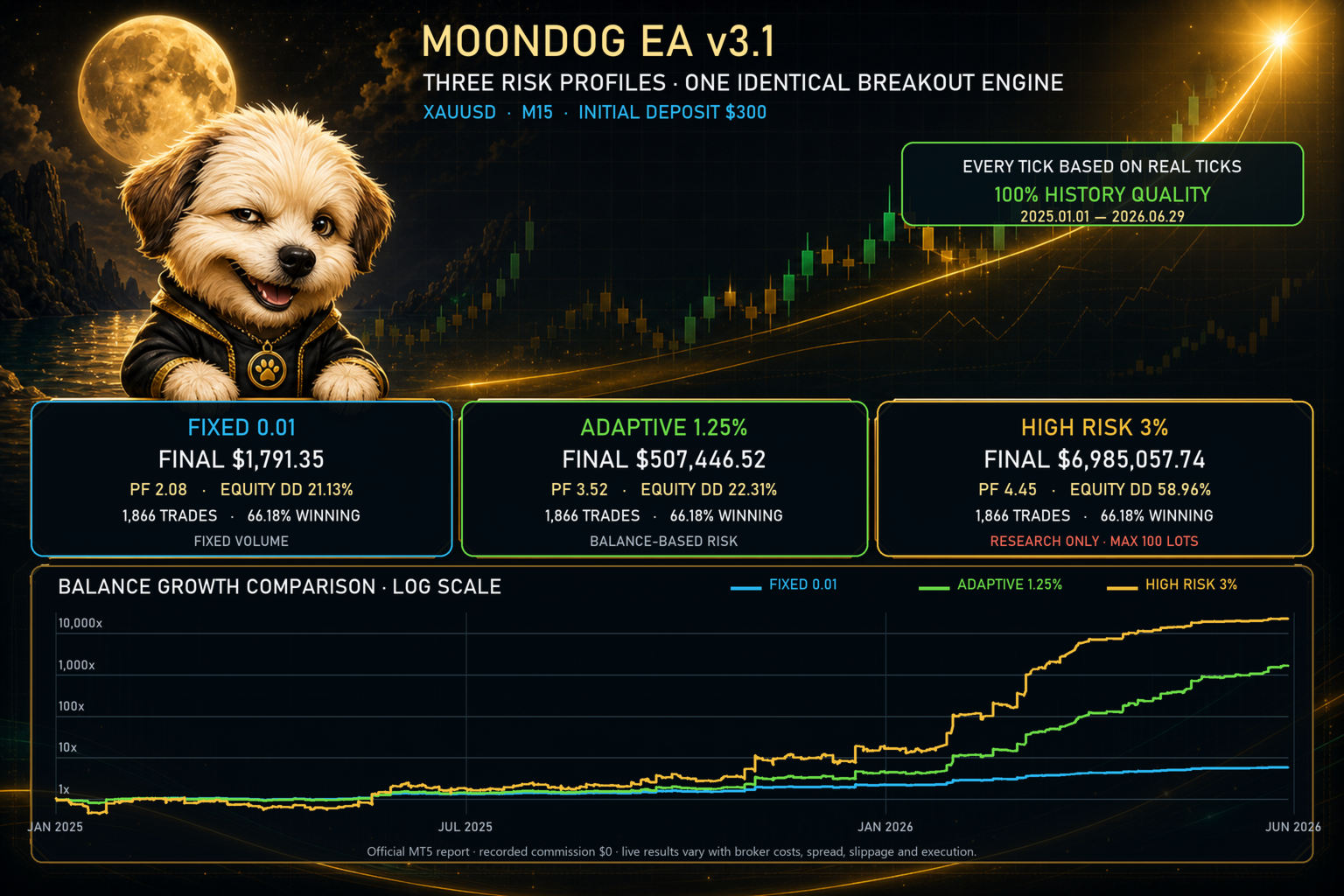
All three profiles run the identical engine over the identical 1,866 trades with the identical 66.18% win rate. The only variable is position sizing:
- Fixed 0.01 lot: $300 grows to $1,791.35. Profit factor 2.08, equity drawdown 21.13%.
- Adaptive 1.25%: profit factor 3.52, equity drawdown 22.31%.
- High risk 3%: profit factor 4.45, equity drawdown 58.96% — labelled “research only” by the developer.
Three things make this presentation better than most. The fixed-lot result is shown first and prominently, and it is a believable number: roughly six times the starting balance over 18 months at a profit factor of 2.08 is the kind of figure a real strategy produces. The aggressive profile is explicitly marked research only, with its 59% drawdown stated rather than hidden. And the graphic itself discloses that commission was recorded as $0 and that live results vary with broker costs, spread, slippage and execution.
That last disclosure is a genuine limitation and we would not want it lost in the praise. Across 1,866 trades, zero modelled commission is material — on a Raw account paying commission per lot, that cost compounds meaningfully, and it will pull real results below the tested ones. The developer says so himself, which is to his credit, but buyers should factor it in rather than skim past it.
The other caveat is the window. January 2025 to June 2026 is 18 months. That covers a strong period for gold and does not span multiple market regimes. A profit factor of 2.08 over 18 months is encouraging; it is not the same as a system proven across years.
The Live Signal — Read the Deposit, Not the Percentage

The public signal runs on Global Prime at 1:500 leverage and is roughly two months old.
What is genuinely good. There are zero deposits and zero withdrawals, so the growth figure is a real return on the money that was actually there rather than a percentage inflated by topping up the account. That is more than a large share of marketplace signals can say. The win rate is a believable 70% with a genuine 30% losing, across 165 trades — a reasonable sample for the timeframe. Best trade exceeds worst trade. Nothing here needs unpicking.
What limits it, and it is significant. The account opened with $60.08. The headline growth of roughly 348% — since updated to around 389% — therefore represents a little over $200 of profit. Gross profit across the whole record is about $362 against gross loss of about $129.
We want to be careful to be fair here, because a small account is not dishonest and the developer has not hidden the figure. But it does constrain what the signal can prove. A $60 account trading 0.01 lots tells you the logic functions and takes defined losses. It cannot tell you how the system behaves when position sizes are large enough for slippage and partial fills to matter, which for a pending-order breakout strategy is precisely the question that decides real-world performance. The live Sharpe ratio of 0.38 is also a long way below what the backtest profit factors imply.
One further note for transparency: the signal has since been renamed to reference a beta test of a forthcoming AI version, so if you open it expecting the original name you will find it under a different title.
The Execution Panel Is Better Than It Looks

At first glance the execution panel looks confusing, and it is worth explaining because it is one of the more genuinely useful things in this product.
The panel lists recent closed trades with a grade from S down to D. But those grades are not rating profitability. In the developer’s own screenshot, a trade that returned +5.04 is graded D BAD while a trade that lost −0.33 is graded S BEST. The panel is scoring fill quality and slippage — how close the actual execution came to the intended price — independently of whether the trade made money.
For a pending-order breakout strategy this is exactly the right thing to measure. Breakout entries fill during the fastest moments in the market, which is when spreads widen and slippage bites. A strategy that backtests at profit factor 2.08 can be dragged under water by an execution environment that costs a fraction of a point on every fill. Most EAs leave you to discover that over months of underperformance. MoonDog puts a running grade on your broker, alongside a round-trip average and a slippage cost readout.
The developer has also published guidance on broker choice for this strategy, naming Global Prime — the broker of his own live account — along with FP Markets and Tickmill as Raw-account alternatives, while stating explicitly that he has no affiliation, partnership or financial arrangement with any of them. Given how routinely EA developers monetise broker referrals, an unprompted disclosure of no affiliation is worth noting.
What Buyers Are Saying

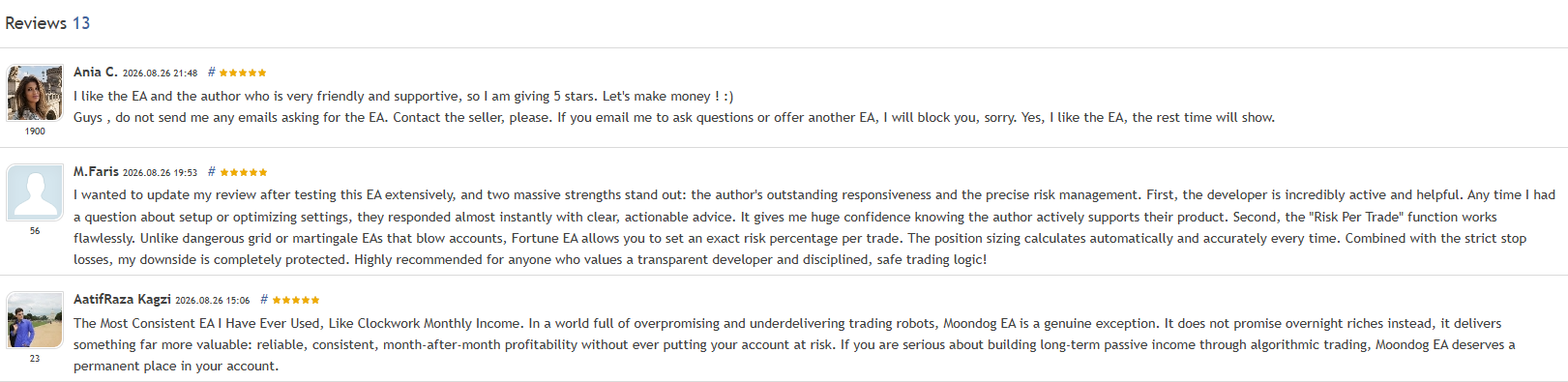
The review base is small but positive, and the most useful entries are specific about mechanics. One buyer running it live describes the fake-breakout protection working as intended: losers small, contained and closed quickly, with no second larger position opened to fix them, every trade carrying its own SL and TP, and drawdown staying roughly where the risk setting implies. That is a substantive report and it aligns with what the trade data shows.
Two observations for balance, because we would rather you noticed them here than felt misled later.
First, one enthusiastic review describes the EA as delivering month-after-month profitability and calls it the most consistent EA the reviewer has used. The product and its signal are roughly two months old. Whatever the reviewer’s experience, a claim of sustained month-after-month consistency cannot yet be supported by a track record of that length.
Second, and more concretely: one five-star review praising the risk-per-trade function refers to the product by another EA’s name partway through. That is not a typo. The identical review text — same wording, same praise for the same feature — was posted on an entirely different developer’s product some six weeks earlier, where the name it uses belongs. It is a recycled review rather than an assessment of MoonDog, and it should carry no weight in your decision.
We raise this not to make much of one reviewer, but because it bears on how you read the number. A 5.0 average from 13 reviews on a two-month-old product is a positive signal rather than a proven one, and if one of the first three entries was written about something else, the evidence base behind that average is thinner than it appears. Judge this EA on its architecture and its trade distribution, both of which stand up well — not on its star rating.
Who MoonDog EA Is For
It might be a fit if you:
- Want a genuinely defined-risk gold system with its own SL and TP per trade and no recovery mechanics
- Value modularity — being able to disable an underperforming entry model without abandoning the EA
- Care about execution quality and would use a live slippage grade to judge whether your broker suits the strategy
- Will size for five concurrent module positions rather than one
- Are comfortable running the fixed or adaptive profile and ignoring the research-only setting
- Accept that the live evidence is young and small, and intend to build your own record before scaling
Look elsewhere or wait if you:
- Need a substantial live track record on a meaningful account — this one started at $60
- Would read a 348% growth figure as a return rather than as roughly $200 on a tiny balance
- Trade on a wide-spread or slow-execution account, which a pending-order breakout system punishes hardest
- Want a backtest spanning multiple years and market regimes, with commission modelled
- Would be tempted by the 3% profile despite its research-only label and 59% drawdown
- Trade only on MT4 — this is an MT5 product
Our Verdict
We rate MoonDog EA 4 out of 5.
The engineering here is good and the honesty is better than average. Five independent breakout modules with separate order identities give real control rather than marketing differentiation. The defined-risk claim holds up under the checks that matter: the worst live trade is smaller than the best, the loss rate is realistic, and independent buyer reports describe losers being cut rather than rescued. The execution grading panel addresses the single biggest hidden cost in pending-order strategies, and we have not seen it implemented this thoughtfully elsewhere. And the three-profile backtest leads with the modest fixed-lot result, marks its aggressive setting research only, and discloses its own commission limitation — a presentation that would embarrass several better-known products.
What keeps it at four is the weight of evidence rather than any flaw in the design. A $60 live account over two months proves the logic runs and takes defined losses; it cannot show how the strategy handles size, where slippage and partial fills start to decide outcomes. The backtest is 18 months with zero commission modelled. The review base is thirteen entries on a two-month-old product, with one claiming a consistency the timeline cannot support. And the listing is sold on escalating-price urgency and a forthcoming AI upgrade, which is a marketing posture rather than a product problem, but not one we are inclined to reward.
Practical recommendation: run the fixed or adaptive profile, never the research-only one. Size your account for five concurrent module positions, not one. Watch the execution panel’s grades early and treat consistently poor fills as a signal to change broker rather than to persevere. Demo first, then run a small live account for several weeks — long enough to see a losing cluster and judge how it recovers — before scaling. Bought through CheaperForex at a lower price, that evaluation costs you meaningfully less.
Frequently Asked Questions
Is MoonDog EA legit, or a scam?
Legitimate. It is a published MQL5 marketplace product with a public real-money live signal showing no deposit or withdrawal distortion, a documented five-module architecture, and a positive review base. The developer has also published broker guidance stating he has no affiliation with the brokers he names. The scams are the “free download” sites and Telegram sellers offering cracked copies that cannot exist — those are malware or payment scams. Legitimate does not mean proven, though: the live record is young and on a small account.
Does MoonDog use a grid or martingale?
No, and the data supports the claim. Every position opens with its own stop loss and take profit, with no lot multiplication after a loss and no averaging. The live account’s best trade of $15.35 against a worst trade of −$6.14 is the decisive detail: grid and martingale systems produce the opposite shape, where the largest loss dwarfs the largest win because losers are held and added to rather than cut.
How much can be open at once?
Up to five positions, one per module. The developer’s own trade history shows five XAUUSD pending orders placed at the same timestamp, and the live account’s maximum deposit load of 21.8% reflects that concurrency. This is by design rather than a fault, but it means you should size your account for five simultaneous positions rather than one.
Which risk profile should I run?
Fixed 0.01 lot or adaptive 1.25%. The 3% profile is labelled research only by the developer, and its backtested equity drawdown of 58.96% explains why — that is a setting for studying the engine’s behaviour, not for trading a real account. The fixed-lot backtest, growing $300 to $1,791 at a profit factor of 2.08 over 18 months, is the realistic reference point.
Why do profitable trades sometimes get a bad grade on the panel?
Because the grades score execution quality, not profit. The panel measures how closely your fills matched the intended prices, so a winning trade that filled badly grades poorly and a small loser that filled cleanly grades well. For a breakout strategy that enters during fast market conditions, this is the more useful measurement — persistently poor grades tell you your broker’s execution is eroding the strategy.
Is the 348% live growth figure realistic to expect?
No, and the reason is the denominator. The percentage is genuine in that no capital was added or withdrawn, but the account started at $60.08, so the figure represents a little over $200 of profit. Percentages on very small balances are not comparable to returns on a funded account. Judge the system on the backtest’s fixed-lot profit factor, the loss distribution, and your own testing rather than on that headline.
How much weight should I give the 5.0 rating?
Less than the number suggests. It is a genuine 5.0, but it comes from 13 reviews on a product roughly two months old, and two of the first three entries have problems: one describes month-after-month consistency the timeline cannot support, and another is a recycled review whose identical text was posted on a different developer’s EA six weeks earlier. There are substantive reviews in there — one describing exactly how the fake-breakout protection cuts losers — but judge this EA on its architecture and its live trade distribution rather than its star average.
What broker and setup does it need?
A Raw or commission-based account with tight XAUUSD spreads and fast execution, on MetaTrader 5 with an M15 chart. The developer’s live account runs on Global Prime, and he names FP Markets and Tickmill as alternatives while stating he has no affiliation with any of them. A low-latency VPS is strongly recommended, since pending-order strategies depend on prompt activation at the moment structure breaks.
Why is it cheaper at CheaperForex?
The product is identical — the same EA and the same future updates from the developer. You pay less. Given the live track record is short and on a small account, you will want to demo it and validate on your own broker before committing meaningful capital, and paying less makes that evaluation cheaper.