
TheYenMaster EA MT5 concentrates twelve breakout strategies on USDJPY. Its appeal is the combination of separate entry and exit designs with straightforward activity selection and account-level stops. The main considerations are shared exposure to one currency pair, lot sizes that do not fall after losses, and a public signal with only a short history.
Ready to Buy The Yen Master EA MT5?
$159.96 with crypto · $199.95 by card
Official version · Instant download · Free lifetime updates · 7-day money-back guarantee

Sources checked 26 September 2026. We inspected BKapital Holding B.V.’s listing, original gallery, public comments section and linked MQL5 signal. We have not traded the software or independently reproduced its tests. This review evaluates the documented design and available evidence.
What the twelve-strategy portfolio actually changes
The EA locates unbroken swing highs and lows on H1 and H4, then uses pending stop orders to enter a breakout. Each component has separate levels, stops, targets and management. The Low, Moderate and High settings activate six, nine or twelve strategies, respectively. Low selects one variant from each design family, rather than merely slowing a single entry algorithm.
That offers variation in timing and exits, but every strategy still trades USDJPY. Several entries can therefore respond to the same yen or dollar move. Twelve strategies do not mean twelve independent markets, and increasing activity can increase simultaneous exposure. A hedging account is required for the documented multi-position design; the listing’s no-grid/no-martingale description does not mean one position at a time.
The sizing rule that needs particular attention
Fixed-lot mode uses the selected volume for each strategy. Risk-per-trade mode uses stop distance to calculate volume. Automatic mode instead weights each component from its own historical maximum drawdown, aiming to give strategies a comparable share of risk. These choices answer different questions: the risk on the next stopped trade is not the same as a strategy’s allocation across a historical losing sequence.
The developer explicitly states that Automatic and Risk % modes increase lots at new balance highs but do not reduce them after a loss. As an illustration, an unchanged cash risk of 100 on an account falling from 10,000 to 8,000 rises from 1% to 1.25% of the remaining balance. This arithmetic illustrates the consequence; it is not a recommended setting or a reconstruction of the EA’s internal code.
Pending orders are resized after a 5% balance change, insufficient free margin can prevent an order, and a maximum lot size can cap individual orders. None of those controls automatically caps the sum of all open strategy risks. Inspect concurrent volume as well as per-trade sizing on demo.
Account stops, news windows and persistent halts
The daily-loss control includes closed and floating results. Total loss is referenced to a starting balance, with an override available; equity stop and target use fixed equity levels. A triggered halt closes exposure and stops trading, and the halted state survives a chart reload or terminal restart until reset from the panel. The daily-loss setting has a next-day resumption rule.
The source’s parameter list describes the daily-loss percentage relative to an equity peak, while the overview describes the day’s combined closed and floating result. Buyers with a strict daily-loss rule should verify the exact calculation and reset time in practice instead of treating those descriptions as interchangeable. A prop firm’s reset clock, trailing threshold and treatment of floating profit may differ.
The NFP filter can block new orders and optionally close positions or delete pending orders. A separate USD/JPY economic-calendar filter applies only in live trading. Monday start and Friday closure can use server time or GMT. Test the broker’s summer/winter offsets and understand which actions each filter enables: pausing entries and flattening existing exposure are different choices.
Reading the original backtests without mixing their numbers
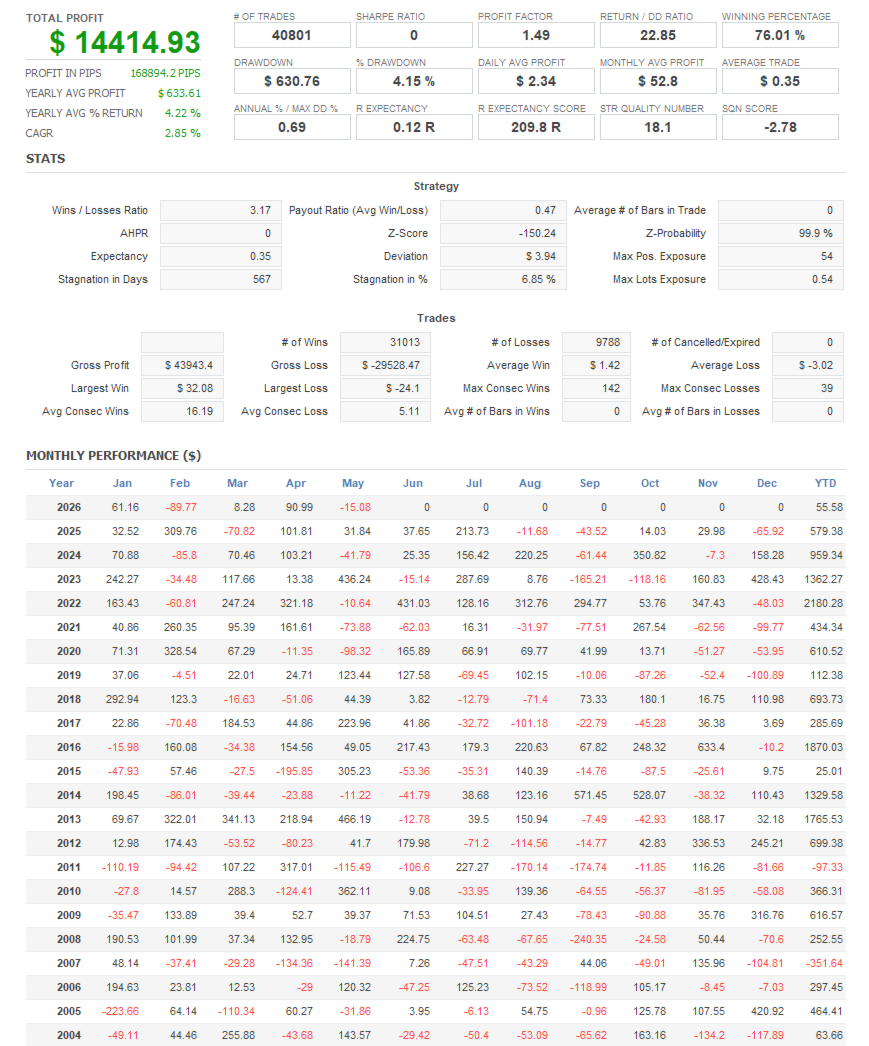
The developer’s portfolio statistics image reports 40,801 trades, a 1.49 profit factor and 4.15% drawdown. Its monthly table contains losing periods, including a negative annual result in 2011. Those details are more informative than simply presenting an upward curve as a promise of consistent monthly gains.
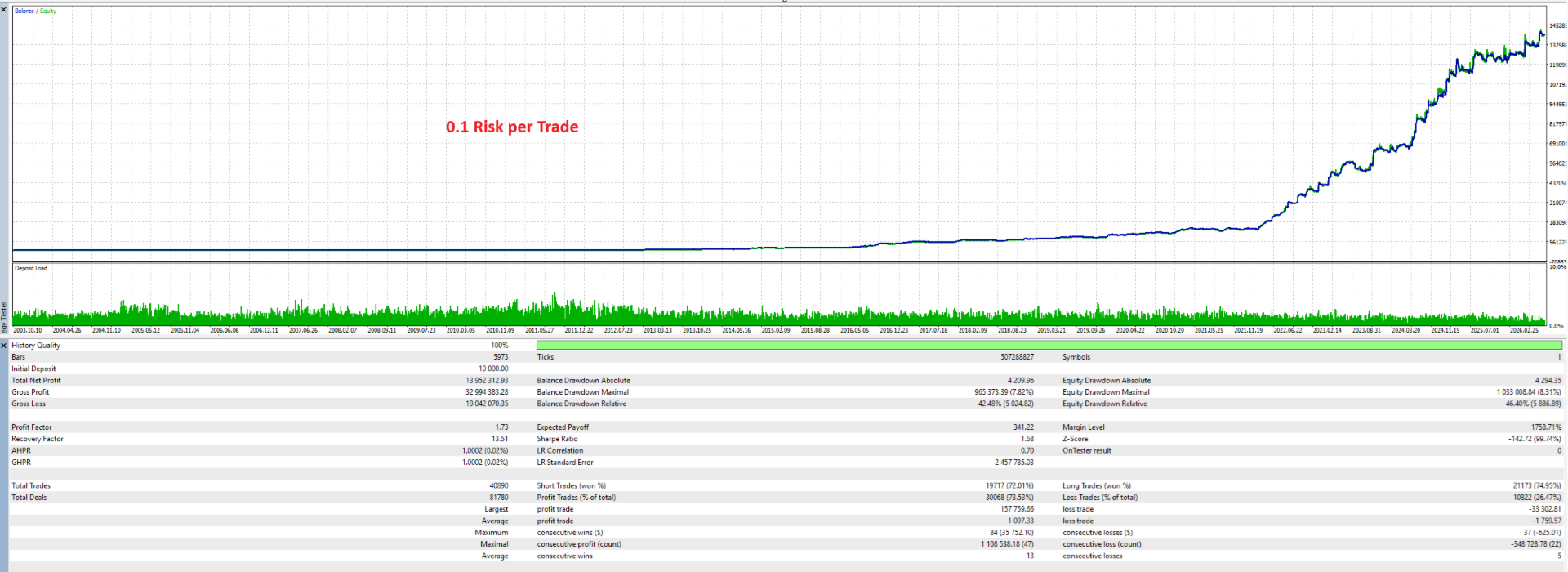
The separate MT5 report, labelled “0.1 Risk per Trade”, shows 40,890 trades and a 1.73 profit factor. Its relative equity drawdown is 46.40%, with 42.48% relative balance drawdown. The 8.31% shown beside maximal equity drawdown is a different field; it should not replace the larger relative figure when describing this test’s risk. The first image’s 4.15% is not an appropriate summary of this second run.
Different sizing, compounding and test configurations can substantially change the account experience. The supplied images alone do not reconcile all differences, and we have not reproduced their data or costs. The listing also describes a separate 6,575-trade code-verification run; that is a developer claim about a verification run, not the trade count of either displayed portfolio report.
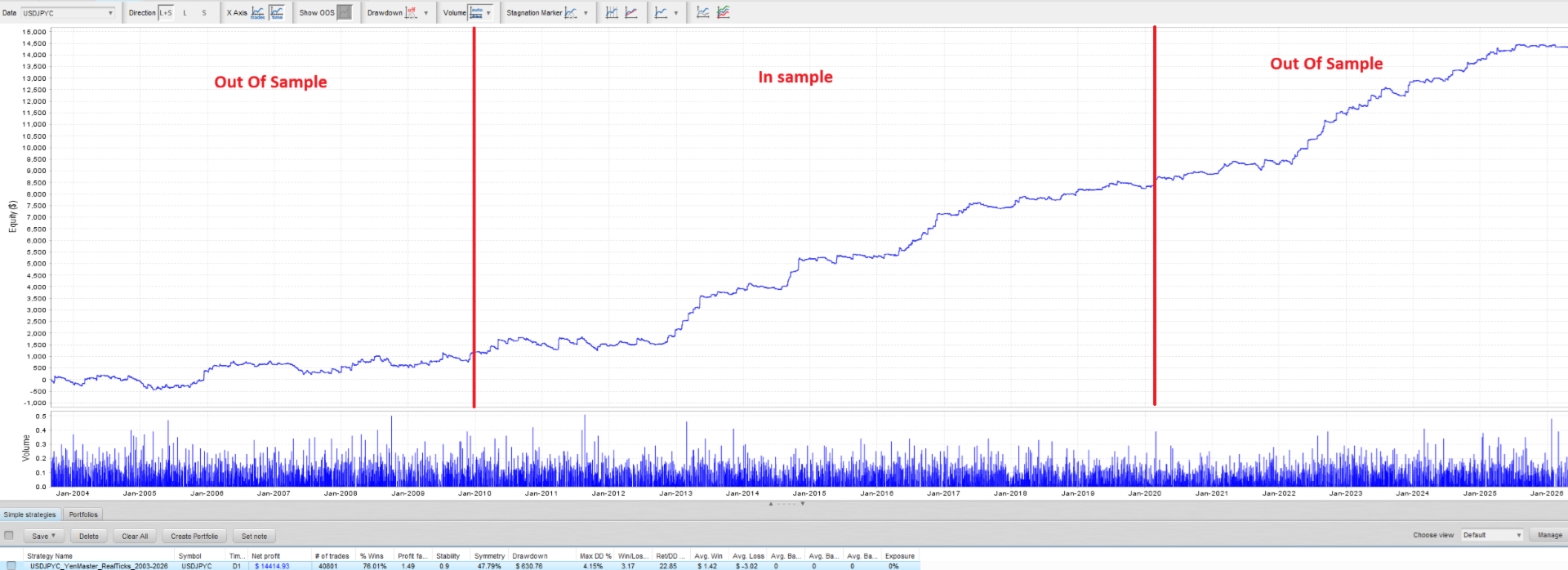
The third chart labels a middle development interval and earlier/later out-of-sample sections. That is useful context to request when assessing optimisation. A label by itself does not establish that parameters were fixed before each evaluation period or that no later research used those periods. Treat all three images as historical simulations, separate from monitored trading.
What the public signal shows so far
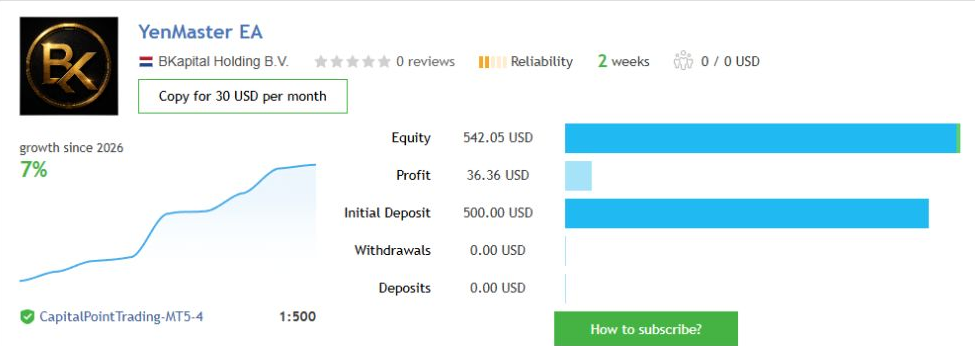
On 26 September 2026, signal 2391870 showed 7.28% growth, 36.36 USD profit, a 536.36 USD balance and 542.05 USD equity from a 500 USD initial deposit. MQL5 marked the CapitalPointTrading-MT5-4 account as real, with leverage of 1:500. This identifies how the platform labels the account; it is not an independent assessment of the broker or a guarantee that a buyer will obtain the same execution.
The displayed history was two weeks, with monitoring starting on 18 September. All 69 completed trades in the statistics were USDJPY buys and shown as profitable. That short, one-directional sample cannot establish how the system behaves through sustained adverse conditions or short trades. MQL5 also displayed a warning that frequent deals can harm copying results.
The statistics reported 0.12% maximal balance drawdown and 0.00% relative equity drawdown at this snapshot. The page’s approximately 0.1% headline is not evidence that the EA’s future risk is limited to that level. The monitored period is far shorter than the tests, and the displayed 98% algorithmic-trading share does not prove every transaction came from an unchanged retail configuration.
Customer feedback and available setup material
The product was published on 24 September 2026 and had no customer reviews or substantive public comments at our check. There is therefore no customer-review screenshot or rating evidence to present. The listing contains a detailed parameter reference, but no separately linked public manual or downloadable preset pack. Its twelve strategies are built in, so no separate SET files are required.
The gallery also contains an older external-account screenshot without a corresponding public account link in the overview. We have not used it as verified current evidence. The linked MQL5 account is the identifiable source readers can revisit.
Our assessment
The Yen Master is a clear candidate for someone specifically seeking a USDJPY breakout portfolio with explicit stops, frequency selection and an integrated control panel. The built-in strategies simplify deployment, while persistent halts and news options provide meaningful operating controls. The unresolved question is sustained forward behaviour: the current public history is too young to answer it.
Before committing real funds, check the hedging account, USDJPY suffix, minimum volume, broker clock and combined position risk. Examine how lot sizing behaves after a losing sequence, and confirm that a triggered account limit and its reset match your intended rules. If your requirement is a mature live record or automatic reduction of cash exposure after losses, those requirements need particular attention here.
Verify it yourself
- Official listing: TheYenMaster specifications, parameters and original gallery.
- Public account: YenMaster EA public MQL5 account — examine the current history and risk statistics.
- Seller profile: BKapital Holding B.V. / Bas Knappers.