
Ultrarealism is an MT4 Forex EA that combines four indicator modules and requires majority agreement on direction. Its distinctive feature is the combination of configurable entry consensus, sequence-based position sizing and several exit-protection layers. The supplied evidence consists of five H1 backtests, with relative drawdown ranging from 16.56% to 27.33%.
Our assessment: a configurable system for users who want access to indicator and position-management inputs. The main consideration is its expanding exposure and the gap between impressive simulated growth and an independently observed live record. This is a review of the developer’s public material, not a claim that we have live-tested the EA.
View product details and current pricing.

Source check: 13 September 2026. MQL5 publication date: 8 September 2026.
How the four-module entry filter works
SuperTrend contributes a volatility-sensitive trend reading. Fisher Transform supplies an assessment of overbought and oversold conditions. Schaff Trend Cycle adds fast, slow and cycle-length inputs, while Vortex evaluates direction and strength. The description says a majority of active modules must confirm the same direction.
This gives the user several ways to alter sensitivity, but four named indicators do not establish four statistically independent sources of edge: each ultimately responds to market price. Agreement may filter conflicting signals, yet it can also delay entries. The listing does not disclose tie handling, the precise execution sequence or a study comparing the combined filter against individual modules.
Capital regulation and sequence risk
AutoCapitalRegulationOn adjusts volume using account parameters and drawdown. CapitalExposureRatio, BaseContractSize, PositionChainDepth and AllocationScalingExponent govern allocation and sequence sizing. The supplied tests show automatic regulation enabled, exposure set to 50, base size 0.01, sequence depth 10 and scaling exponent 1.6.
These are historical test inputs, not suggested settings for your account. The specification describes exposure as allocated capital, which should not be equated automatically with a fixed percentage loss at a stop. Nor does the public description establish the exact spacing or loss-trigger logic of subsequent positions. It would be misleading to label the system universally no-grid or no-martingale on this evidence.
The report size bars grow dramatically toward the end of each test. Compounding and scaling therefore matter when interpreting the headline profit: the later test is trading substantially different sizes from the beginning. A useful evaluation would also include fixed-size tests and limits on combined open exposure.
Stops, trailing and correction settings
The fixed profit and loss inputs are supplemented by trailing activation and distance, an additional protection threshold, pending trailing and a correction strategy that tightens protection during prolonged sequences. The pictured tests use profit ceiling 1400, loss floor 1100, trailing start 300 and trailing stop 50. All are source input values; broker point conventions must be checked before transferring them.
The correction function can be disabled with zero. A fixed stop on each position does not itself establish a maximum account-level loss when multiple positions and scaling are involved. Gaps and execution differences can also change realised exits. The listing’s InstitutionalExecutionMode describes additional checks and stricter filtering, not proof of institutional execution quality.
All five developer backtests
The original reports cover approximately September 2020 through early September 2026 on H1, with a 10,000 initial deposit and displayed spread of 20. They show an Every tick model, 99.00% modelling-quality label and zero mismatched-chart errors. Those labels are part of the supplied reports; they do not independently establish tick provenance, variable live spreads, commission treatment, slippage or reproducibility.
EURUSD: 607 trades, 16.65% relative drawdown
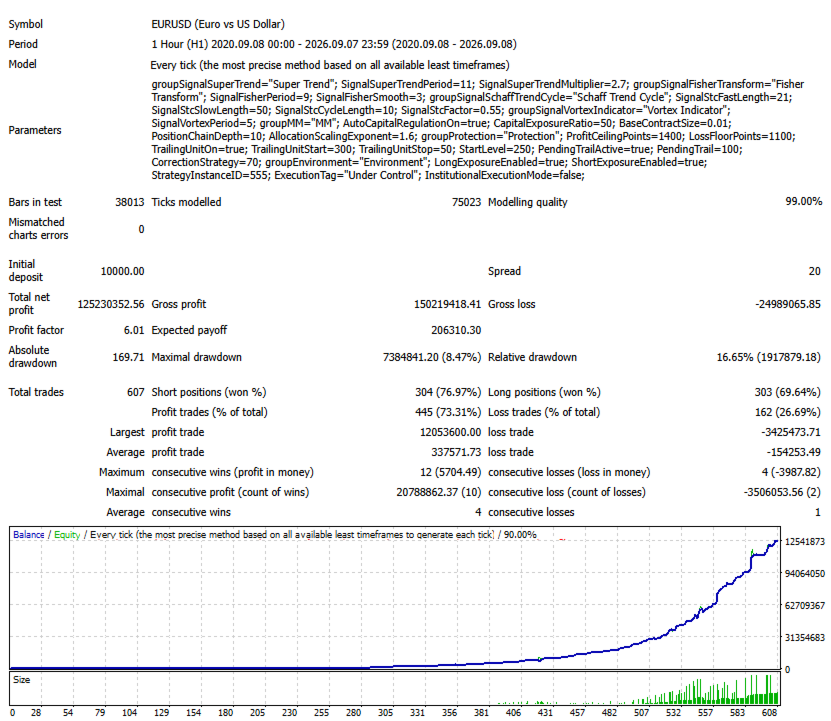
The EURUSD report displays a profit factor of 6.01 and 16.65% relative drawdown. Its reported net profit is 125,230,352.56 in account-currency units, starting from 10,000. This is an exceptionally large simulated result under expanding position sizes, not a verified live return or an earnings forecast.
USDCAD: 684 trades, 22.44% relative drawdown
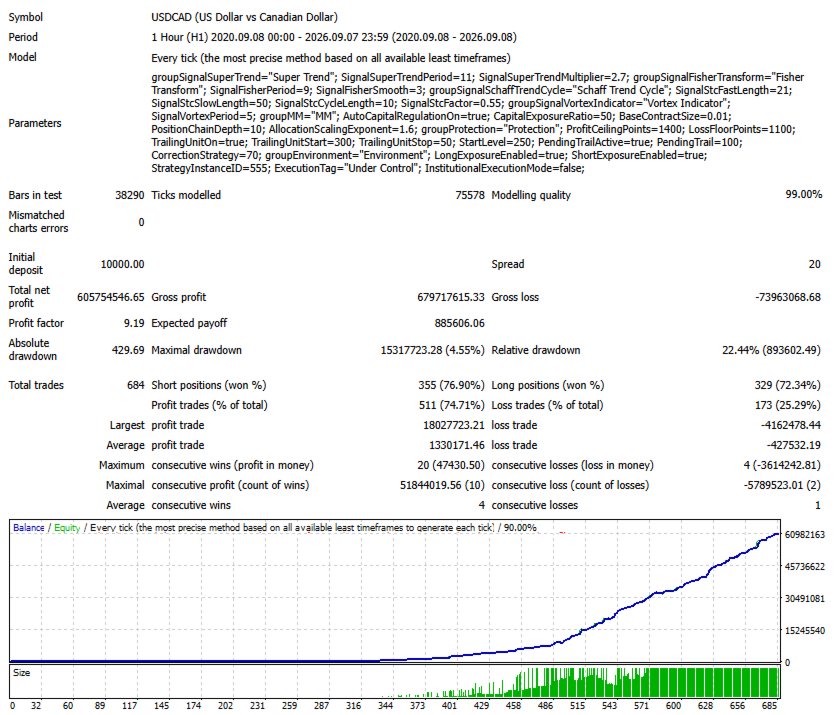
The USDCAD report displays a profit factor of 9.19 and 22.44% relative drawdown. Its reported net profit is 605,754,546.65 in account-currency units, starting from 10,000. This is an exceptionally large simulated result under expanding position sizes, not a verified live return or an earnings forecast.
AUDUSD: 720 trades, 16.56% relative drawdown
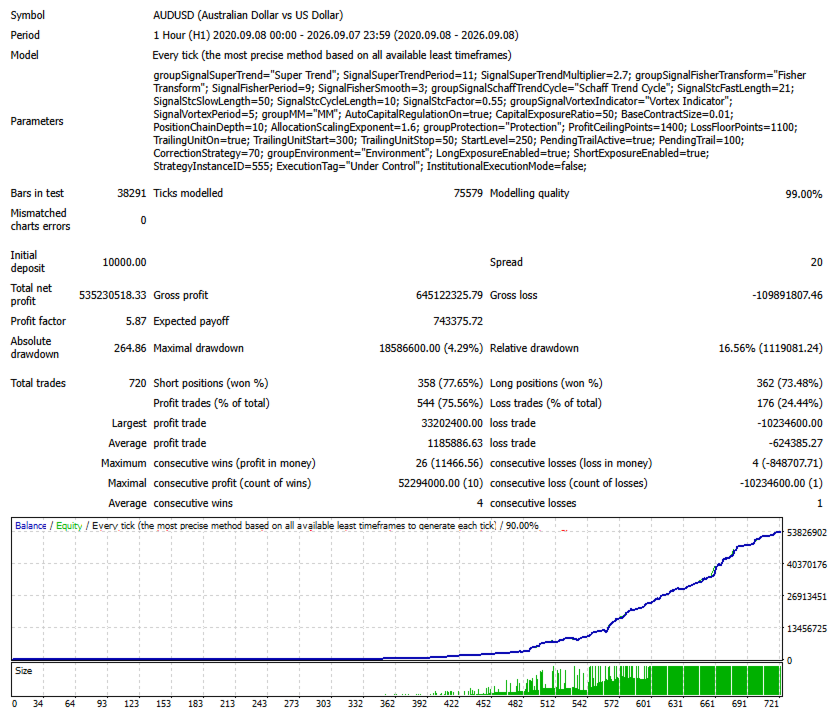
The AUDUSD report displays a profit factor of 5.87 and 16.56% relative drawdown. Its reported net profit is 535,230,518.33 in account-currency units, starting from 10,000. This is an exceptionally large simulated result under expanding position sizes, not a verified live return or an earnings forecast.
CADJPY: 686 trades, 17.20% relative drawdown
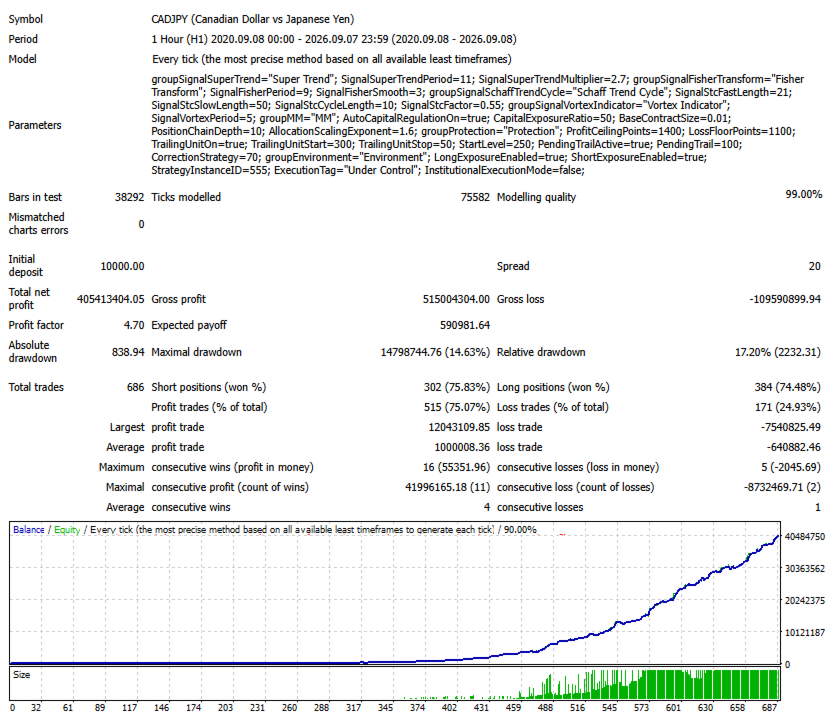
The CADJPY report displays a profit factor of 4.70 and 17.20% relative drawdown. Its reported net profit is 405,413,404.05 in account-currency units, starting from 10,000. This is an exceptionally large simulated result under expanding position sizes, not a verified live return or an earnings forecast.
EURGBP: 807 trades, 27.33% relative drawdown
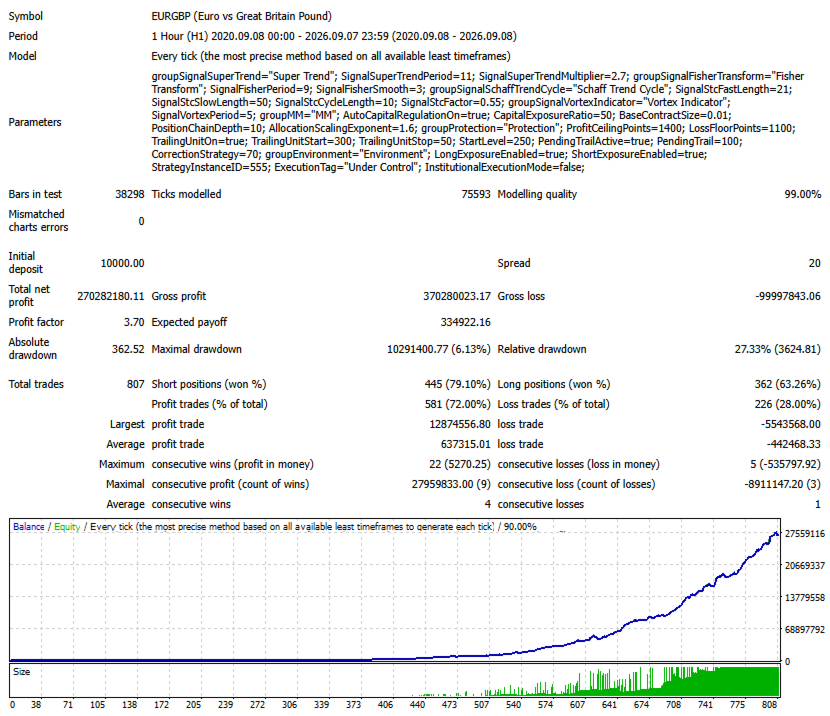
The EURGBP report displays a profit factor of 3.70 and 27.33% relative drawdown. Its reported net profit is 270,282,180.11 in account-currency units, starting from 10,000. This is an exceptionally large simulated result under expanding position sizes, not a verified live return or an earnings forecast.
EURGBP has the highest displayed relative drawdown and lowest profit factor of these five examples. USDCAD shows the highest profit factor, but also a higher relative drawdown than EURUSD, AUDUSD or CADJPY. These individual-symbol reports do not show the drawdown of running all five together. Shared currency exposure and simultaneous sequences can make a combined account behave differently.
What would strengthen the evidence?
The six-year charts are historical simulations, not six years of product monitoring: the retail listing was published in September 2026. There is no disclosed out-of-sample split or walk-forward procedure in the written material. The screenshots alone cannot establish how much parameter selection took place after seeing the test data.
A reproducible settings file, clearly identified data and trading costs, and a public forward record would help connect these reports to practical execution. Testing realistic variable costs and a range of parameters would be more informative than relying on one smooth compounded curve.
Customer feedback and public documentation
The Reviews tab displayed no reviews and the Comments page contained no public discussion when checked on 13 September 2026. There are no Ultrarealism customer reviews to screenshot or summarise yet. No public monitoring signal or separate manual was linked in the main specification or seller page we inspected. We have not substituted feedback from the author’s other products.
Who may find it useful?
Ultrarealism is most relevant to an MT4 user comfortable evaluating multi-indicator entries and sequence exposure. Its parameter explanations provide a useful starting point for understanding the controls. It is less suitable for someone expecting the backtest profit figures to stand in for a proven live history or a ready-made account risk limit.
Read the original specification · Check current MQL5 reviews · Read product discussion