
Stack Horizon 4 Review: MT4 Strategy & Tester Evidence
Stack Horizon 4 is a tick-driven scalping robot for MT4. Its entry logic combines quote sequences, impulse-size thresholds and confirmation steps, with separate controls for spread, trading costs and position chains.
Our assessment: the configurable tick engine may appeal to experienced scalper users who can test execution carefully. The main limitation is the evidence: the developer’s MT4 listing displays MT5 tests using an .ex5 file and zero-latency ideal execution. Those images do not establish equivalent MT4 or live results. This review examines the public specification and original gallery; it is not our own live test.
View Stack Horizon 4 MT4 features and current pricing

Source check: 14 September 2026. The MQL5 listing was published on 31 August 2026.
What the tick engine is trying to capture
The strategy reads incoming quotes rather than relying solely on candle-close signals. CountTick and CountSteck shape the observation sequence. MinPips, StepPips and MaxPips define the movement thresholds, while minimum/maximum confirmation steps help control when an impulse qualifies. This is a configurable signal framework, not a guarantee that every fast move is tradable.
Tick feeds can differ between brokers. A sequence that qualifies on one feed may not be identical on another, and the spread paid at entry can materially change the outcome. This makes both feed quality and realistic cost testing central to evaluating this EA.
Spread, costs and order handling
The Spread/Amplitude Guard and optional CriticalCostGuardOn are intended to reject adverse conditions. Session restrictions and NewsBufferMinutes provide additional operating controls. The public description does not disclose every implementation detail, including the news-data source or a complete account-level emergency-loss rule.
InstitutionalExecutionMode is the name of an alternative broker-handling setting. It should not be read as proof of institutional infrastructure or exchange-level high-frequency execution. Requotes, stop distances, commissions and live slippage still depend on the trading environment.
Sizing and position chains
Automatic capital regulation and MoneyManagementPercent offer an alternative to fixed lots. ProfitCeilingPoints and LossFloorPoints define exit distances. PositionChainDepth and PositionChainGrid govern additional positions. The number and size of simultaneous trades matter alongside each individual stop; a stop-distance setting is not the same as a fixed maximum loss across the whole account.
The gallery is MT5 evidence on an MT4 listing
Each supplied screenshot identifies Stack Horizon.ex5 in the MT5 strategy tester. The visible tests use EURUSD M1, a $100 initial deposit, 1:100 leverage and the period 1 January–30 August 2026. The settings explicitly show zero latency, ideal execution, no forward segment and disabled optimisation for the displayed run.
The screenshots display “100% real ticks”, but that is a tester data label rather than proof of live execution. The written listing also recommends the MT5-style “Every tick based on real ticks” mode. We do not present that as a native MT4 option or assume the two platform implementations produce the same trades.
How the parameter examples compare
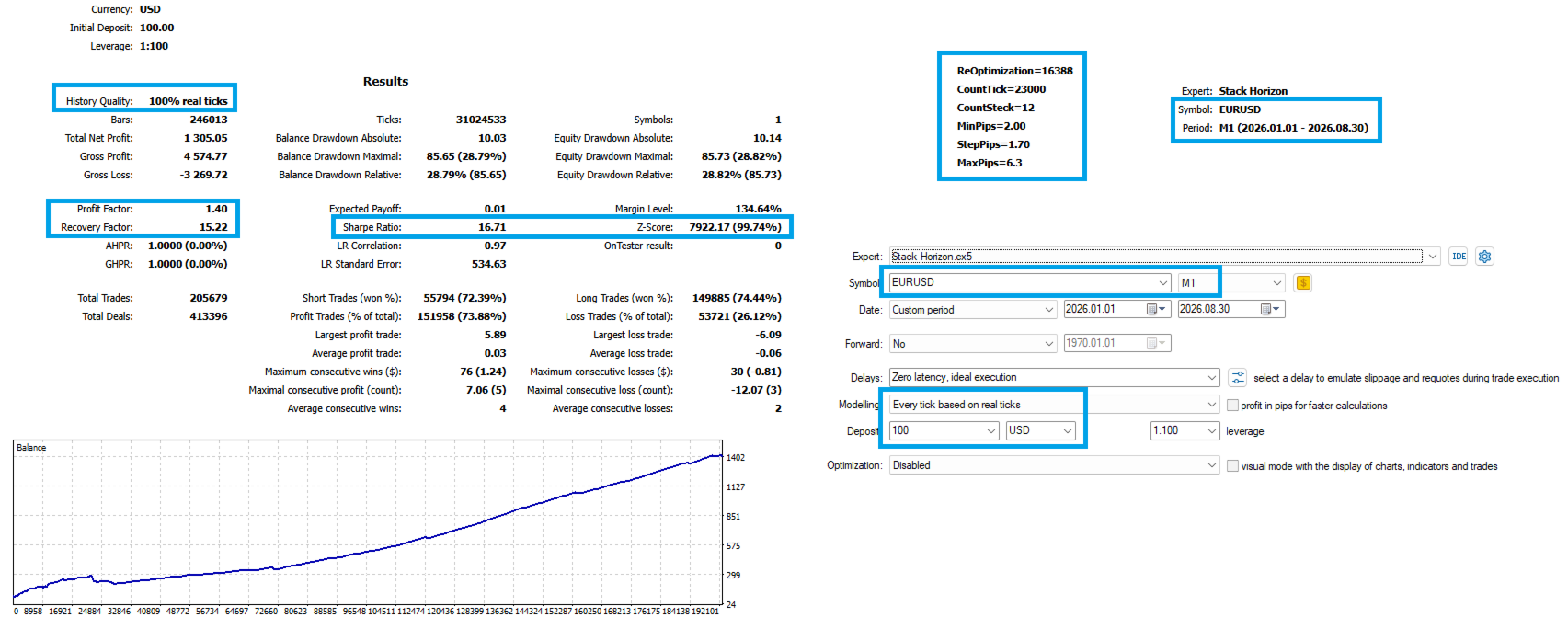
The first report uses CountSteck 12, StepPips 1.7 and MaxPips 6.3. It shows net profit 1,305.05, a 1.40 profit factor and 28.82% relative equity drawdown. Its 205,679 trades explain why transaction-cost assumptions deserve close attention.
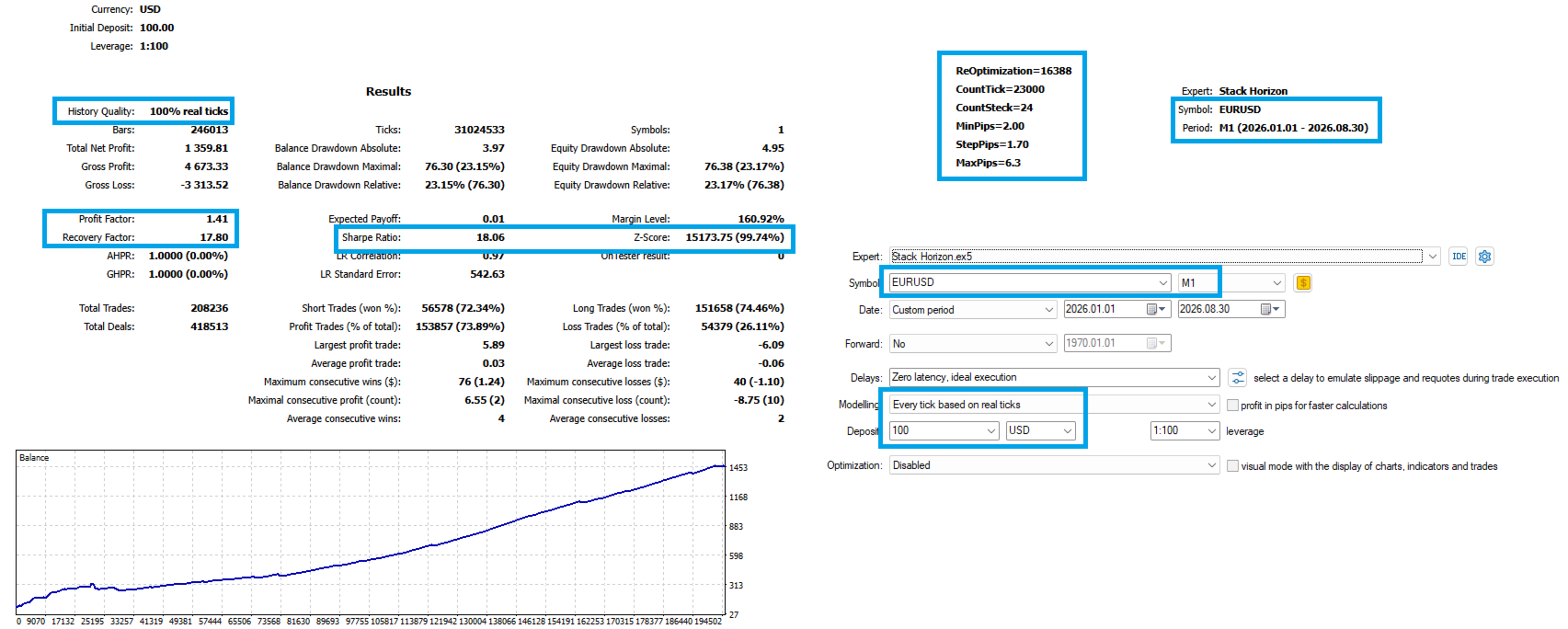
Changing CountSteck to 24 produces a displayed 1.41 profit factor and 23.17% equity drawdown, with 208,236 trades. This is another parameter example on the same historical period, not an independent live account.
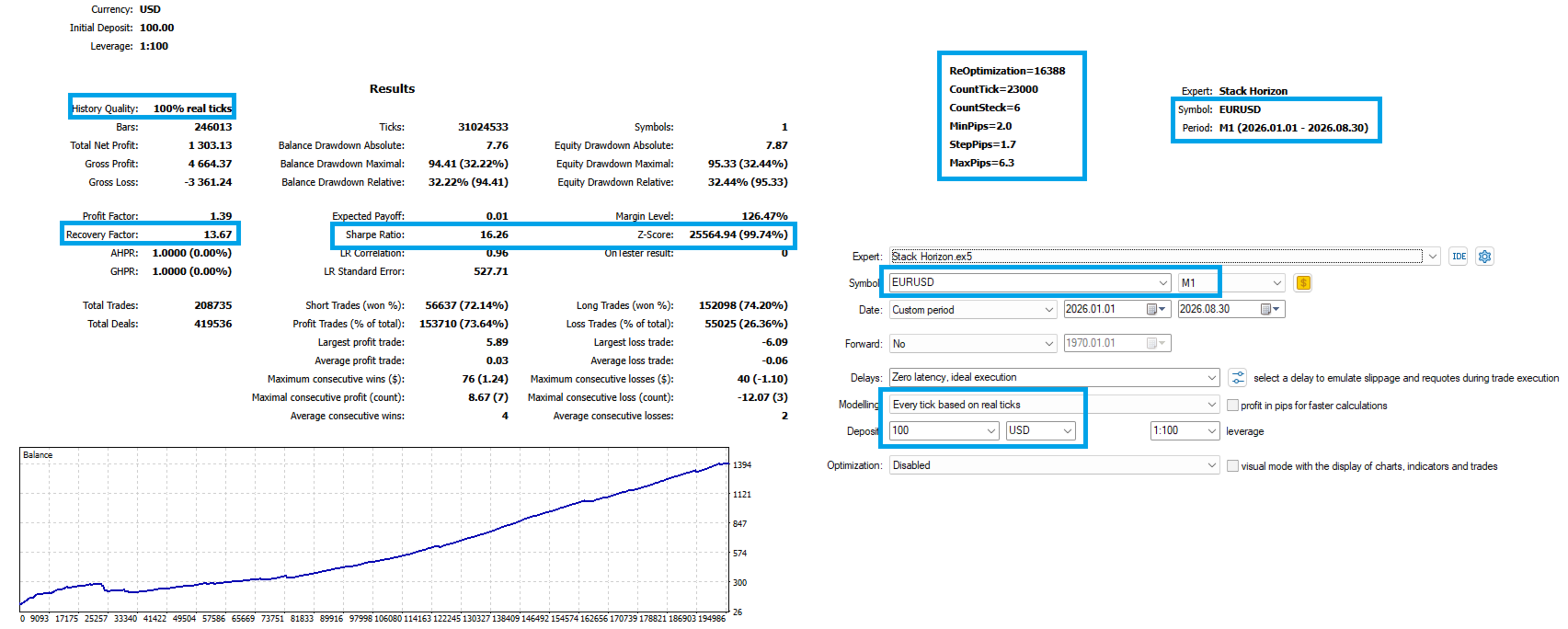
CountSteck 6 shows a 1.39 profit factor and 32.44% equity drawdown. Comparing it with the larger sequence sizes shows that similar profit factors can coexist with materially different drawdowns.
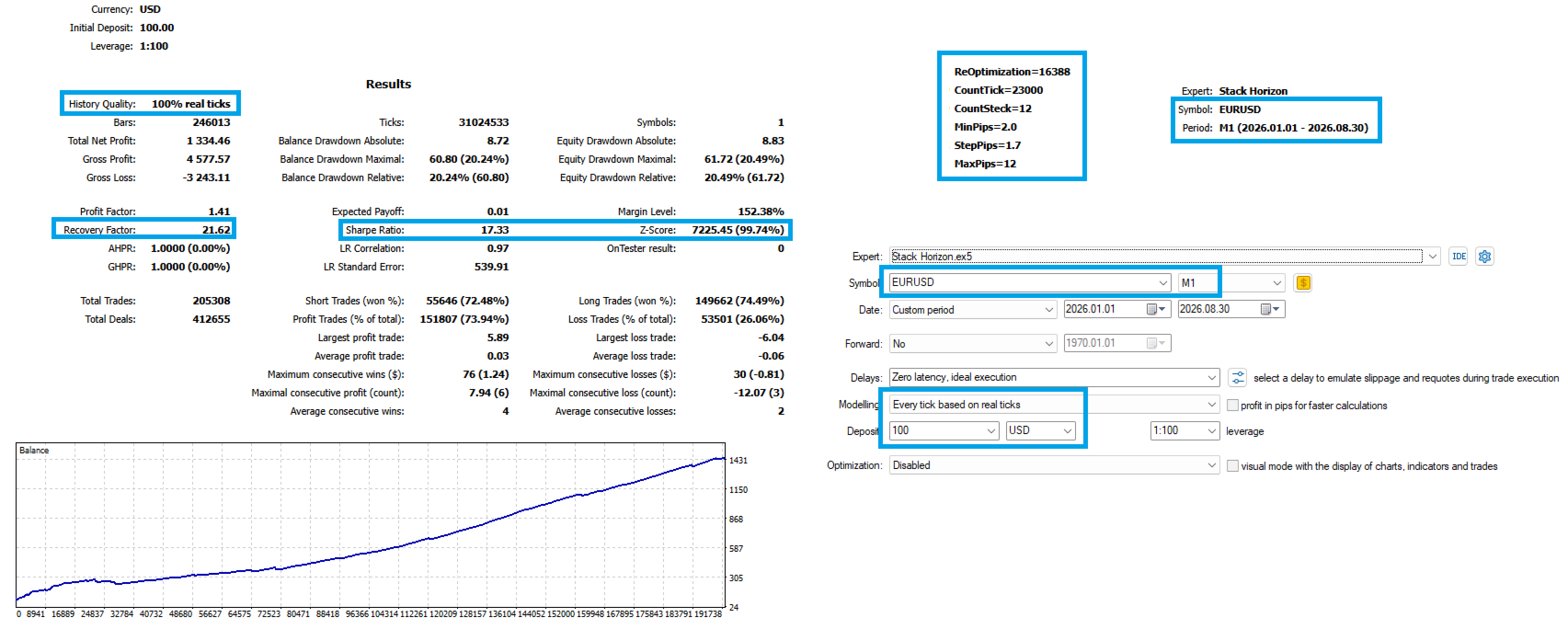
The MaxPips 12 example, with CountSteck 12 and StepPips 1.7, reports a 1.41 profit factor, 20.49% equity drawdown and 205,308 trades. A sixth gallery image repeats this configuration and displayed figures, so we retain the five distinct examples rather than counting the repeated report as extra evidence.
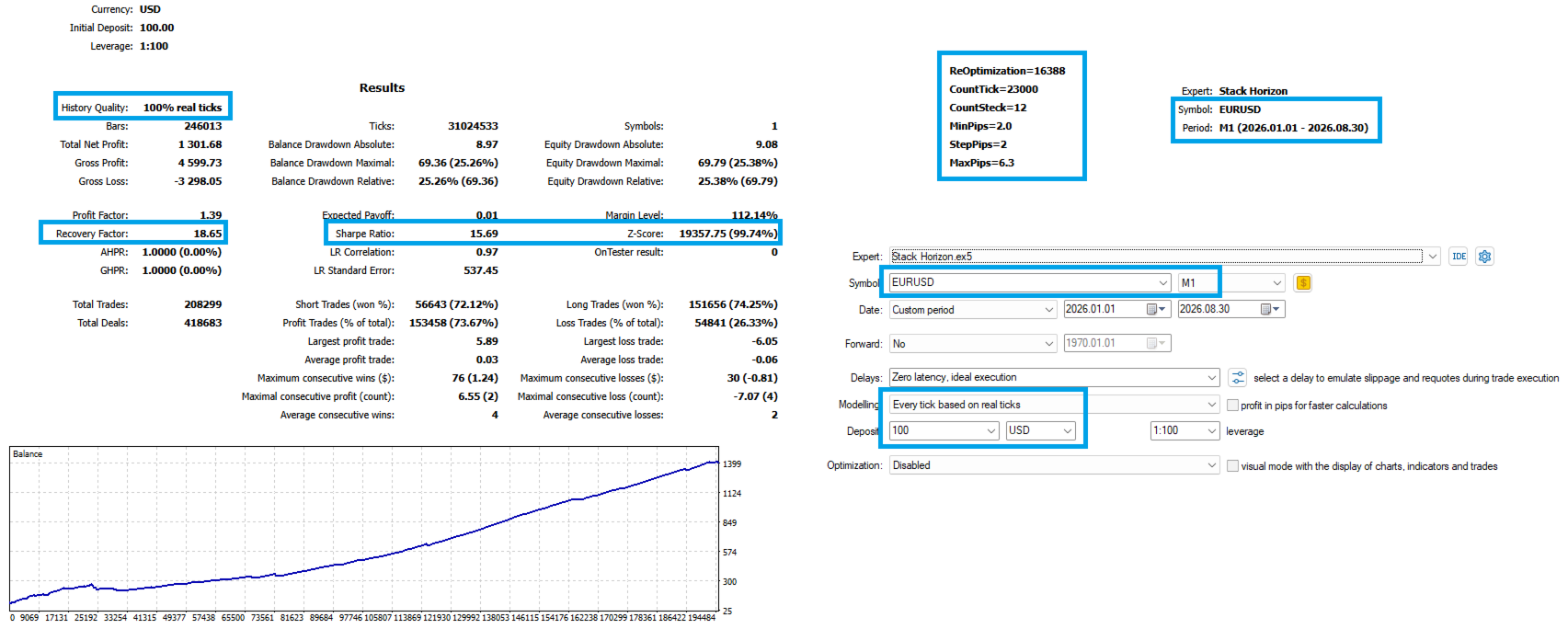
The StepPips 2 example shows a 1.39 profit factor and 25.38% equity drawdown across 208,299 trades. The initial deposit in these illustrations is a test input, not a recommended account size.
What the impressive trade counts leave unanswered
All five reports round expected payoff to $0.01 per trade. With hundreds of thousands of trades and ideal execution, even small changes in spread, commission or fill quality deserve testing. The screenshots alone do not establish the broker cost model, reproducibility on the MT4 file, or performance on unseen data.
Similar results across a few settings may be interesting, but every displayed run uses the same period. That is not a substitute for a separate forward test. The public material does not establish that these settings were chosen before the period or that the figures would survive different broker feeds.
Customer reviews and live monitoring
The Reviews area showed no reviews, and the Comments page had no public discussion at the source check. There are no customer review excerpts to screenshot yet. No separate public manual or live monitoring link was found in the listing or inspected seller page. We have therefore kept the assessment focused on the published controls and original tests.
Stack Horizon 4 versus the author’s other products
Explosion Potential MT4 uses fair-value gaps, liquidity sweeps and trend filters rather than this tick-sequence emphasis. Its separate review examines the multi-pair test reports. We also sell Ultrarealism MT4. Compare their entry and exposure rules individually; a shared developer does not demonstrate low correlation.
Who it fits
Stack Horizon 4 is most relevant to MT4 users comfortable validating a short-term system on their own feed and checking its cost sensitivity. Before relying on the gallery, reproduce a test with the actual MT4 file, realistic commission/spread assumptions and a separate forward period. The strongest reason to investigate it is its configurable tick logic; the current screenshots alone are not sufficient to call the MT4 performance verified.
Read the original specification · Check current MQL5 reviews