
Smart Sniper AI System MT5 is a gold EA with an H1 breakout engine and a separate AI-assisted decision engine. Its main appeal is the ability to run AI, breakout or Hybrid mode while keeping each engine’s trade identifiers, stops and trailing controls distinct.
Our assessment: a useful configuration for XAUUSD traders who want to evaluate rule-based and AI-assisted entries separately. The main consideration is evidence: the developer’s aggressive backtest covers the breakout engine and shows substantial relative drawdown. Short promotional results do not validate the combined system.
This is a source-based review of the public listing, release history and customer comments checked September 30, 2026. We have not independently run the EA.
Ready to Buy Smart Sniper AI System?
$279.99 with crypto · $349.99 by card
Official version · Instant download · Free lifetime updates · 7-day money-back guarantee

What each engine contributes
The breakout engine works from H1 high and low levels, placing stop orders subject to entry filters. This gives it a defined mechanical basis that can be tested without the external AI service. The AI engine instead assembles market context from H4, H1 and M15, adding trend structure, RSI, ADX, ATR, spread, volatility and regime information to its analysis.
Hybrid mode enables both approaches. It should not be assumed to be safer merely because two engines are active: they can still create exposure to the same gold move. Separate magic numbers and comments help attribute trades, but they do not make the positions uncorrelated.
- Breakout exits
- Pip-based stop settings and their own trailing controls.
- AI exits
- Fixed, ATR-based or Hybrid stop-loss/take-profit settings, with separate trailing management.
- Decision threshold
- A configurable confidence gate; the number is not a verified win probability.
- Chart context
- M30 or H1 operation, with additional H4 and M15 market information.
Risk profiles need broker-specific checks
Five profile labels range from Safe to Aggressive. Treat those as settings names rather than assurances. The same profile can produce different monetary exposure when contract sizes, leverage, spreads or stop distances differ. Lot and margin validation check whether a trade can be submitted; they do not establish that its risk suits your account.
The developer explicitly rules out grid, martingale and doubling after losses. Daily loss limits, consecutive-loss cooldowns, news and spread filters provide additional controls. Test how those controls interact with pending orders and both engines before combining them. Sharp gaps and slippage can still cause losses beyond the intended stop execution.
Reading the aggressive backtest
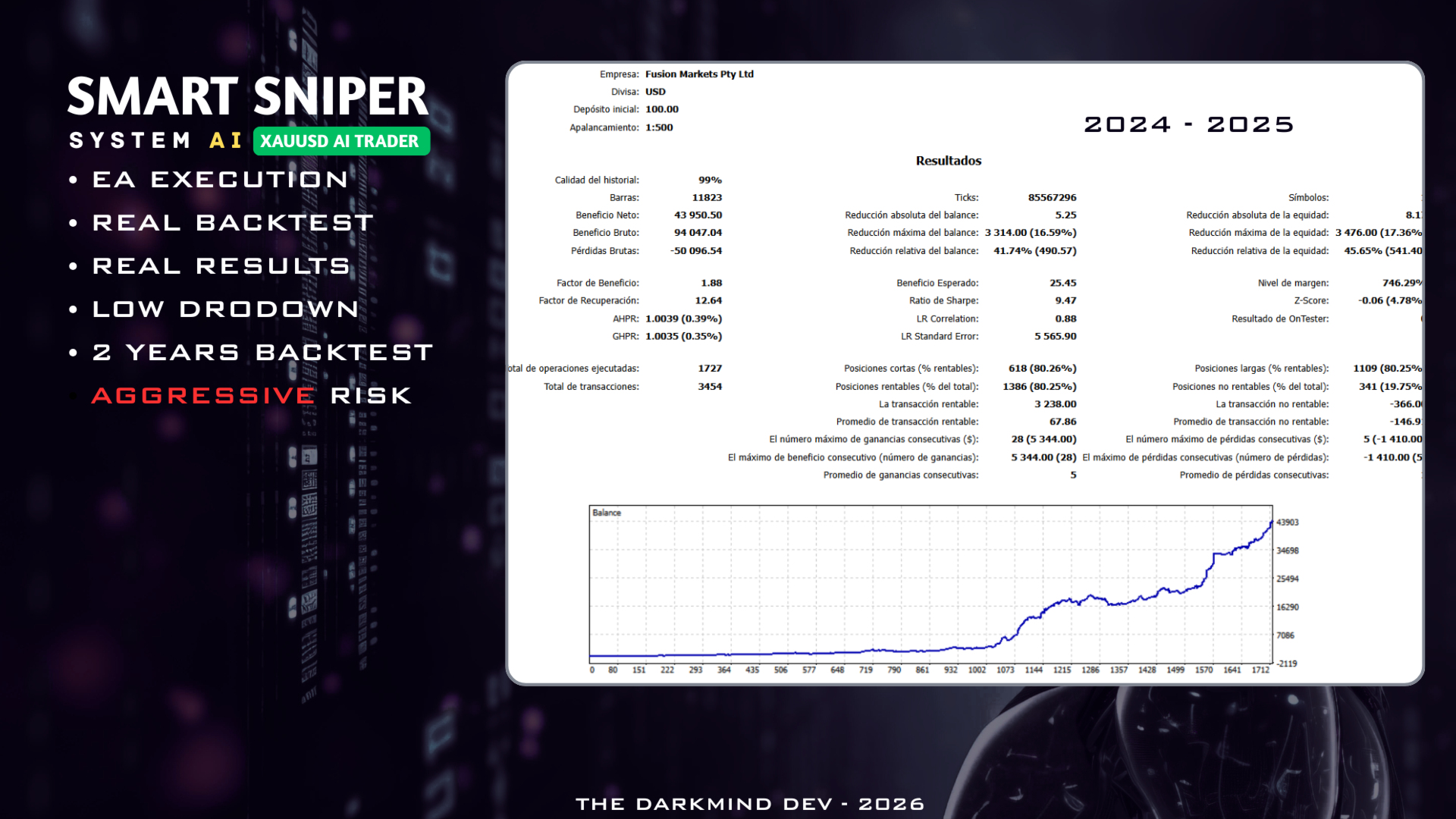
The supplied 2024–2025 report is labeled aggressive, uses 1:500 leverage and shows 1,727 trades with a profit factor of 1.88. Its relative equity drawdown is 45.65%. The same report shows 17.36% next to maximum equity drawdown; those fields measure different drawdown quantities, so citing only the smaller percentage would omit material risk.
The February 21 release notes explicitly say AI is disabled in historical testing and those tests reflect the H1 breakout engine. We found no later note establishing that this old report tests Hybrid mode. It therefore supports discussion of one historical configuration, not a forecast of AI performance or a current account result.
What the dashboard can tell you
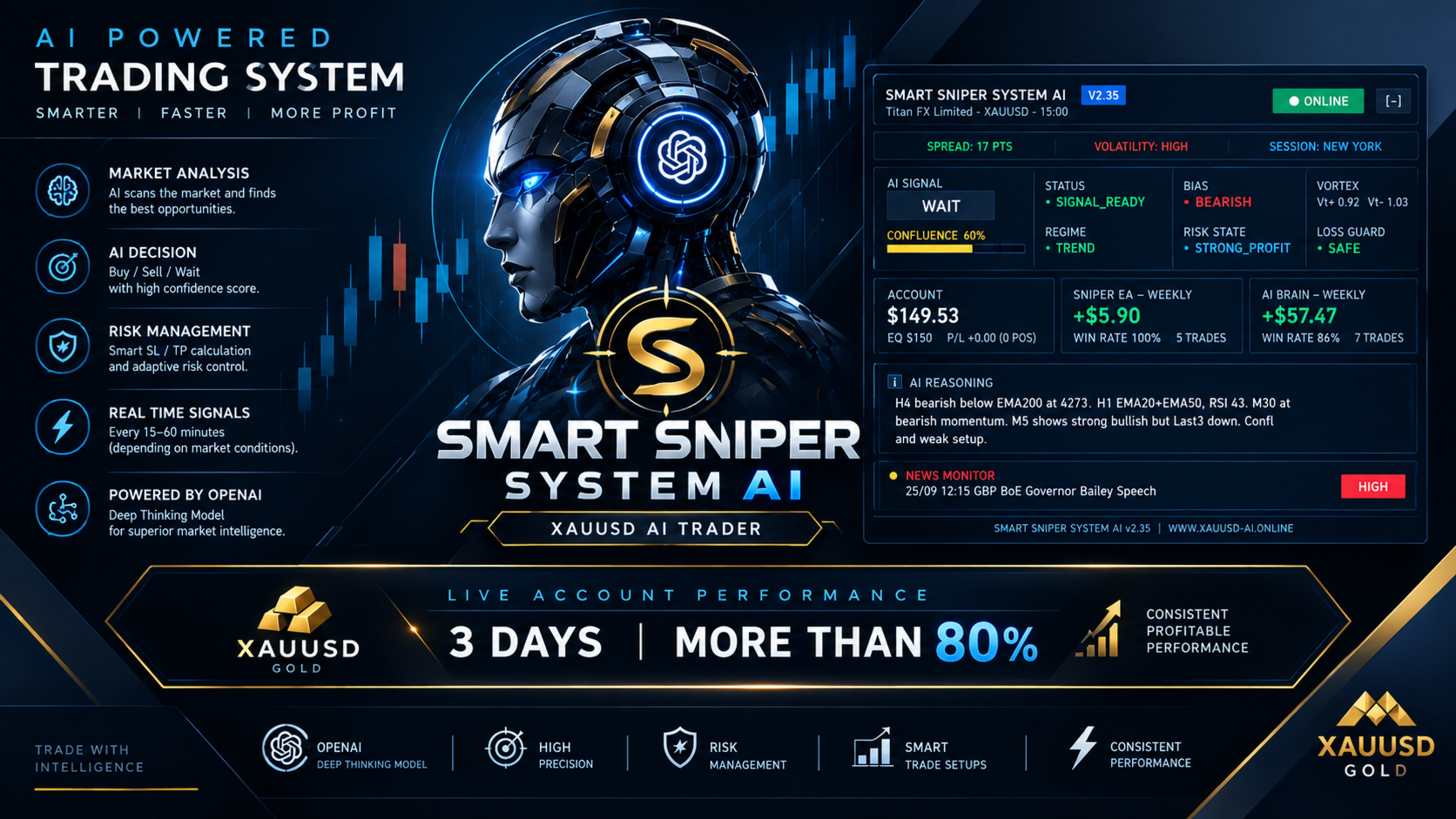
Separate weekly counters for AI and EA activity are useful for checking which engine contributed trades. The illustrated panel also shows bias, regime, confidence, spread and session state. Its three-day promotional claim is too short to assess sustained performance, and the image does not provide a complete independently monitored account history.
Check rejected signals and loss pauses as well as completed trades. A quiet EA can be following its filters; changing several thresholds to force activity makes it harder to identify which change affected behavior.
API setup and meaningful release changes
AI mode needs a working external OpenAI connection and permission for https://api.openai.com in MT5’s WebRequest list. The breakout engine does not need that AI connection, though live execution still needs broker connectivity. Public product information does not confirm whether API access is supplied or customer-configured, or what usage allowance applies. Clarify that arrangement rather than assuming unlimited service credits are part of the EA.
September 23, 2026 release notes describe stricter validation against missing-data fallbacks, revised RSI signal filtering, high/medium news countdowns and improved pending-order comment traceability. Those changes matter for diagnosis and execution; they are not proof of higher returns. An older optional live-event filter also references YouTube access, so only enable it after checking the corresponding instructions.
Customer reports: useful, but brief
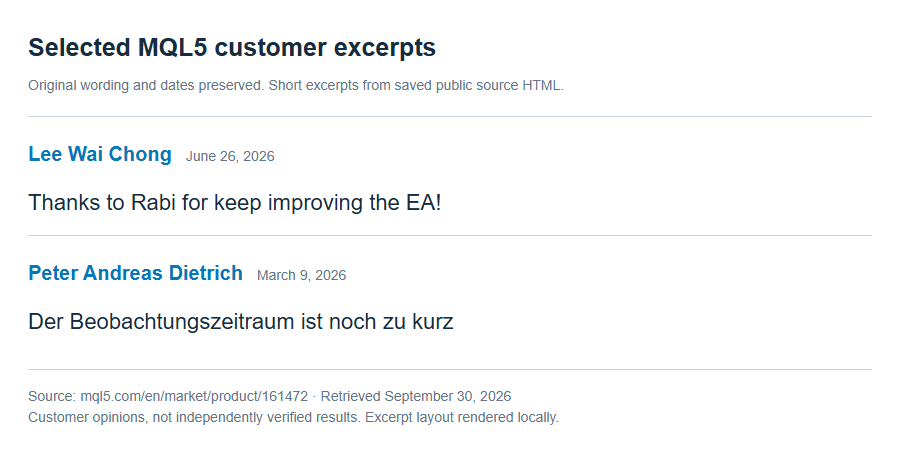
Lee Wai Chong’s June review praises continued development and reports different results across brokers. In the public comments, the same user posts a screenshot described as that week’s results. This is customer-supplied evidence, not a continuous independently verified signal or a controlled broker comparison.
Peter Andreas Dietrich’s March review discusses a rental test and explicitly says the observation period is still too short. That qualification matters more than treating a handful of profitable weeks as established reliability. The excerpts above preserve the original wording; the German sentence means the observation period is still too short. These third-party opinions are separate from CheaperForex purchase ratings.
Smart Sniper or Sentinel X?
Sentinel X Gold EA is another Rabi Oudani dual-engine gold system. Its documentation more explicitly describes a configurable 40-bar H1 range, closed-candle confirmation and AI pending-order management. Smart Sniper emphasizes H1 stop-order breakouts with AI, EA and Hybrid modes. Compare controls and demo behavior rather than choosing from the promotional profit numbers; our Sentinel X review examines its separate evidence limitations.
Frequently asked questions
Who this configuration suits
Smart Sniper is best approached by someone prepared to inspect trade history by engine, validate lot sizes and measure behavior over a meaningful sample. Start by isolating the breakout and AI modes, keep the settings record, and assess drawdown alongside return. The appeal is control over two gold strategies, not a demonstrated guarantee that AI improves the result.
Sources checked September 30, 2026: MQL5 product and customer reviews, release history and public customer comments. Original developer images are retained with their claims and context; the cover is promotional artwork.