
Quantum Valhalla EA MT5 trades XAUUSD through six cores combining breakout, momentum, reversal and fade methods. Its distinctive controls assess trade progress, detect failed breakouts and manage positions that lose momentum. Several cores can operate together, while the EA handles all protective exits internally.
Our assessment: the appeal is a mix of entry approaches with active trade management. It suits gold traders prepared to maintain a reliable VPS and assess total simultaneous exposure. The main considerations are dependence on uninterrupted EA operation and very limited public forward evidence. This review uses sources checked 21 October 2026; it is not a firsthand trading test or an independently reproduced backtest.
View Quantum Valhalla EA MT5 features and pricing

Six approaches to the same gold market
Bogdan Ion Puscasu describes Valhalla as a development of Quantum Valkyrie’s foundations, with six trading cores and a redesigned management framework. Breakout methods seek directional moves; momentum methods assess strength; reversal and fade methods look for exhaustion. Session timing, market-regime filters and separate buy/sell selection refine the entries.
The public description does not disclose each algorithm’s rules or every user input. The developer states that the system avoids grid and martingale, but we have not inspected its executable. Different methods can reduce dependence on one entry pattern, yet all six trade gold. Simultaneous positions may share the same directional or event exposure.
Protective exits depend on the EA running
Position-progress checks, called Proof-of-Life Management by the developer, assess whether a trade is developing as intended. Failed-breakout detection seeks earlier exits from unsuccessful moves. Stale-position management handles trades that lose momentum, alongside fixed/adaptive stop methods and emergency protection.
The crucial operating requirement is explicit: all protective exits are managed internally by the EA. A VPS is mandatory for continuous 24/5 operation. Exit logic cannot guarantee execution while the terminal is stopped or disconnected, and fast markets can produce losses beyond planned levels. Do not treat an emergency-stop label as an account loss ceiling. Monitor terminal uptime and trade permissions as well as the strategy.
The launch backtest uses extreme risk
The developer’s original gallery report is labeled 2025–2026, Extreme Risk Level. It shows a 10,000 starting deposit, 16,647 trades, a 2.84 profit factor and 99% history quality. Its headline net profit is 624,426,692.72. That unusually large simulated outcome should be read with the risk setting and the report’s separate drawdown fields:
- Relative drawdown
- Balance: 33.12% (2,190,617.09). Equity: 38.44% (38,793,474.42).
- Maximal drawdown
- Balance: 42,608,342.78 (8.48%). Equity: 79,642,952.50 (14.93%).
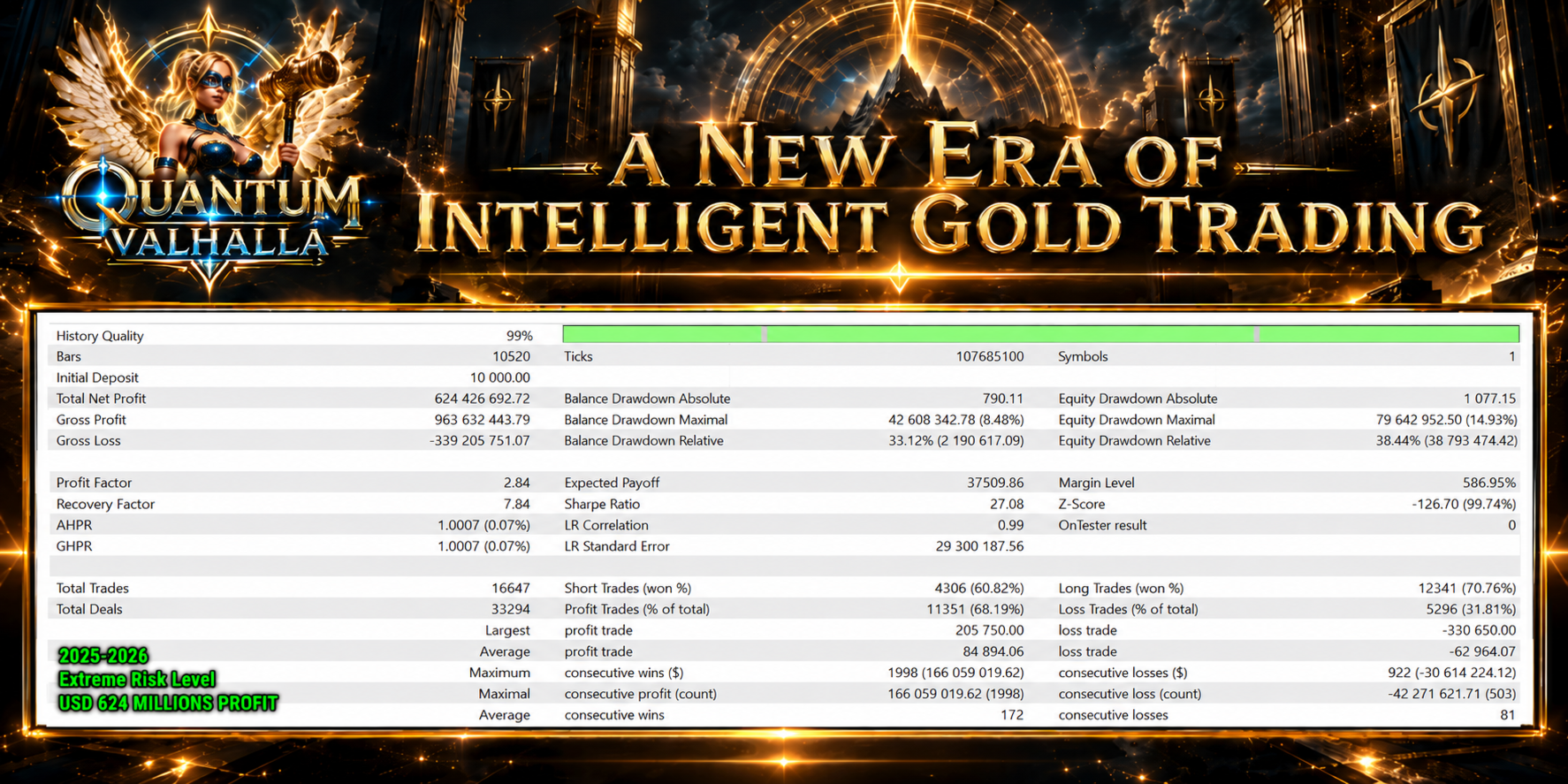
The percentage fields use different definitions and denominators; the smaller maximal percentage must not replace relative drawdown. Exact test dates, full inputs and all execution assumptions are not supplied in this image. It does not establish results for a $500 account, a lower-risk configuration or future trading. Floating exposure and compounding assumptions deserve particular scrutiny.
The forward account has only a short monitoring window
The linked Quantum Valhalla signal was labeled Real Account on ICMarketsSC-MT5-3, with 1:500 leverage. At the source check on 21 October 2026 at 21:52 UTC, it showed:
- Growth and cash flows
- 7.53% growth; $300 initial deposit, $22.60 profit and $322.60 balance/equity. No additional deposits or withdrawals.
- Trades and outcomes
- 18 XAUUSD trades: 12 wins and six losses; profit factor 1.44. Average profit $6.13 versus average loss $8.49 in magnitude.
- Drawdowns
- Maximal balance: $20.69 (6.07%). Relative balance: 6.04% ($20.61). Relative equity: 2.62% ($8.67).
The page displayed five weeks of account history, but its Started field was 20 October 2026 at 09:18:47, and the source tooltip identified only one day and one hour of monitoring. Historical account trades are not the same as five weeks of contemporaneous public monitoring. Some history also predates Valhalla’s retail release, so it does not prove unchanged current-build settings throughout.
MQL5 warned that the account was newly opened and had too few deals to assess trading quality. Average holding time was 42 minutes and the latest trade was 11 hours before the check. Eighteen trades are too few to establish robust losing-streak behavior or agreement with the extreme-risk backtest. The real-account label is attributed to the source rather than an independent audit of transactions.
Account preparation and available feedback
The developer specifies a hedging account, low-spread ECN/RAW conditions, a $500 minimum balance and $1,000 or more recommended. Minimum leverage is 1:100, with 1:500 suggested. Capital and leverage guidelines do not guarantee a particular drawdown. Test the intended broker’s gold contract size, costs, execution and several concurrent positions. The public launch overview does not specify a chart timeframe.
The listing launched on 21 October 2026 and showed version 10.0 when checked. No buyer reviews were available; the single comment was the developer’s launch announcement. The release number and marketing description are not evidence of a long public track record.
For related products, see Quantum Valkyrie EA MT5, its separate review and Quantum Titan MT5 EA. Assess each edition’s controls and evidence separately.