
Silent Exit MT5 EA brings several FX markets into one setup. The useful buying questions are how to configure that setup, what its loss controls actually cover, and how much confidence to place in the public results.
Our assessment: the chart instructions and published controls provide a practical starting point. The evidence is much less mature: the forward record is short, uses virtual capital and concentrates most of its gross profits in one trade. It supports inspection, not a conclusion about dependable returns.
Review scope: CheaperForex sells Silent Exit with managed installation. This review uses public documentation and genuine captures checked on 10 September 2026 UK. We have not run the EA or reproduced the developer’s tests. Official Silent Exit listing.
View Silent Exit pricing & installation →
Jump to: Configuration · Signal evidence · Historical test · Feedback · FAQs
Turn the strategy description into an operating plan
The author’s volume-acceleration concept describes an intended entry approach. It does not disclose enough to independently reconstruct the decision or establish an advantage. The more useful next step is to understand the controls you can observe and the exposure they permit.
All of the listed pairs involve the US dollar. That does not make their trades identical, but it gives you a concrete reason to inspect positions together. Count the account’s combined exposure when several pairs are active, rather than assuming that a larger symbol list automatically supplies diversification.
The shared developer guide, dated July 2025, documents these choices. It predates Silent Exit, so compare its labels with the installed build rather than assuming every older control is unchanged.
| Documented control | Practical interpretation |
|---|---|
| Lot calculation / fixed lot | Record the selected mode before interpreting its number. A value only makes sense with its units. |
| News before/after windows | The guide uses hours. Check the units before entering a duration. |
| Friday close | The guide uses −1 to switch this option off. Inspect the installed value deliberately. |
| Daily loss in balance currency | A currency amount is different from a percentage. Confirm the calculation and action before relying on it. |
For that last control, the unanswered details matter: which losses count, whether open positions are included, when the reference resets and what happens to existing trades. The public guide does not settle those points. A setting name alone cannot establish an account-wide hard stop.
The author also recommends distinct magic numbers when sharing an account with another EA. Identifiers help keep trade management separate; they do not create separate pools of money or margin. Keep the configuration record alongside the trade history when assessing the combination.
What the public Silent Exit signal shows
The provider identifies this as Darwinex Zero. Darwinex’s own description distinguishes its USD 100,000 virtual equity from deposited cash. We therefore treat the record as market-connected virtual-capital evidence, not proof of an equivalent real-money investment.
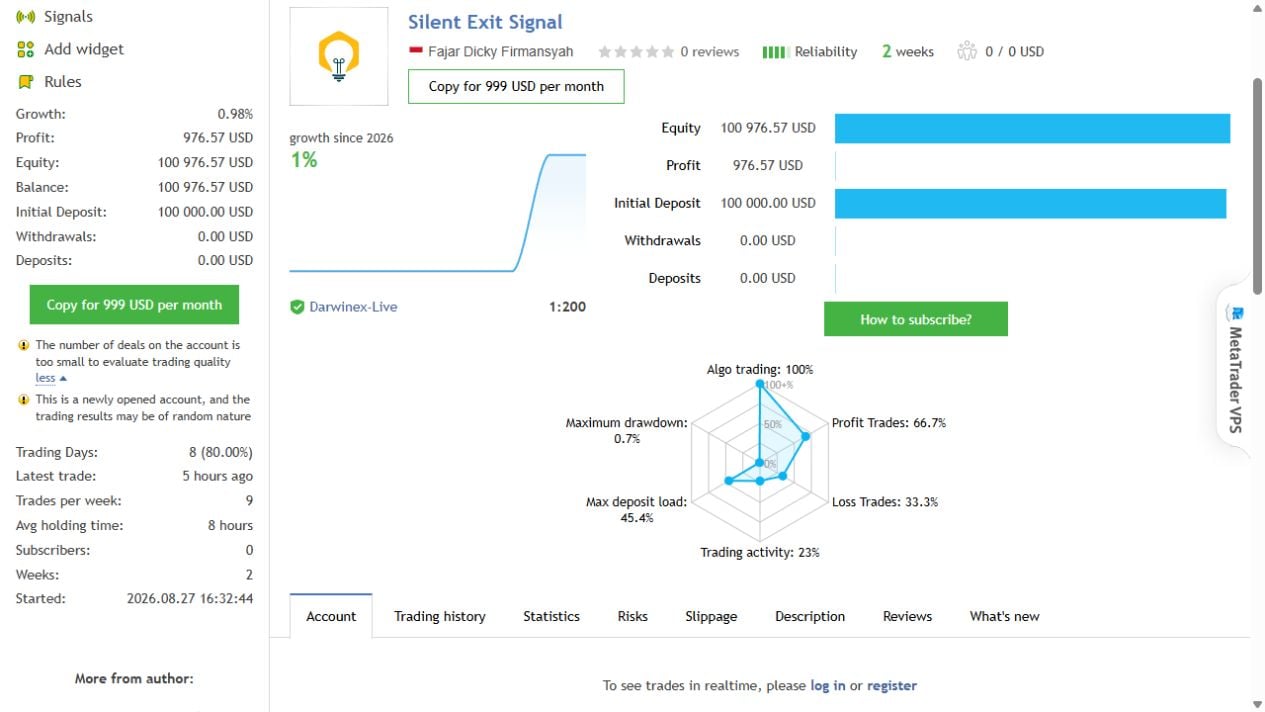
| Field | Displayed value |
|---|---|
| Growth | 0.98% |
| Recorded profit | USD 976.57 |
| Trades | 15: 10 winners, 5 losers |
| Profit factor | 27.75 |
| Maximum balance drawdown | 0.03% |
| Relative equity drawdown | 0.70% |
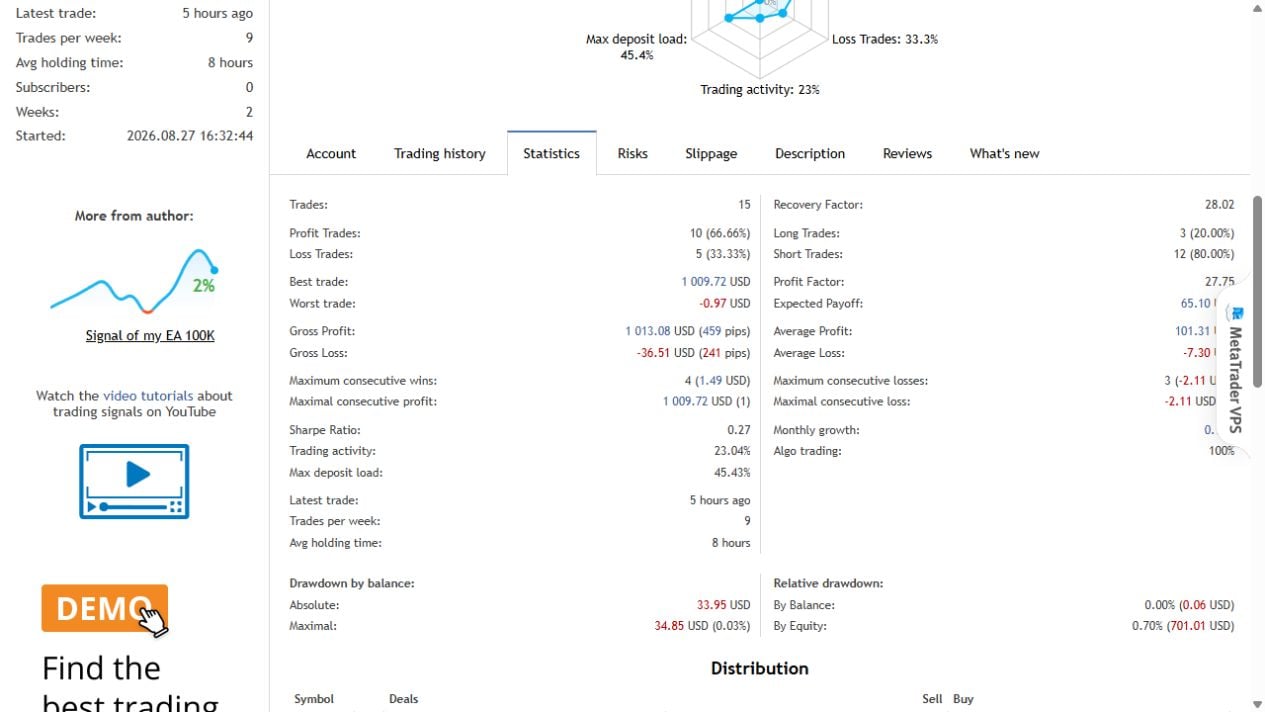
One winner dominates the current result
The largest winning trade is USD 1,009.72, against gross profits of USD 1,013.08: approximately 99.7%. This calculation explains why the profit factor needs context. The question is whether the strategy can produce a useful pattern across many opportunities, not whether one realised winner was large.
A longer record could answer a different question from the one these observations answer today. Look for a broader distribution of results, periods without that exceptional winner and the behaviour of open exposure during difficult conditions. Fifteen trades leave those questions largely open.
Balance and equity describe different parts of the experience
The separate drawdown fields prevent a common misreading. Closed results can look smooth while positions fluctuate before they close. The equity measure includes that changing open-position value, so substituting the smaller balance percentage would hide part of the account’s recorded experience.
The capture is a dated reference point. It does not demonstrate that another broker account, configuration or later market period will follow the same path. The separate MQL5 copying service is also distinct from purchasing the EA with managed installation.
Read the developer’s historical report as a test
The original gallery image below displays 1,534 trades, a profit factor of 8.95 and 0.59% relative equity drawdown. It is a historical simulation with no visible build identifier, and we have not reproduced it.
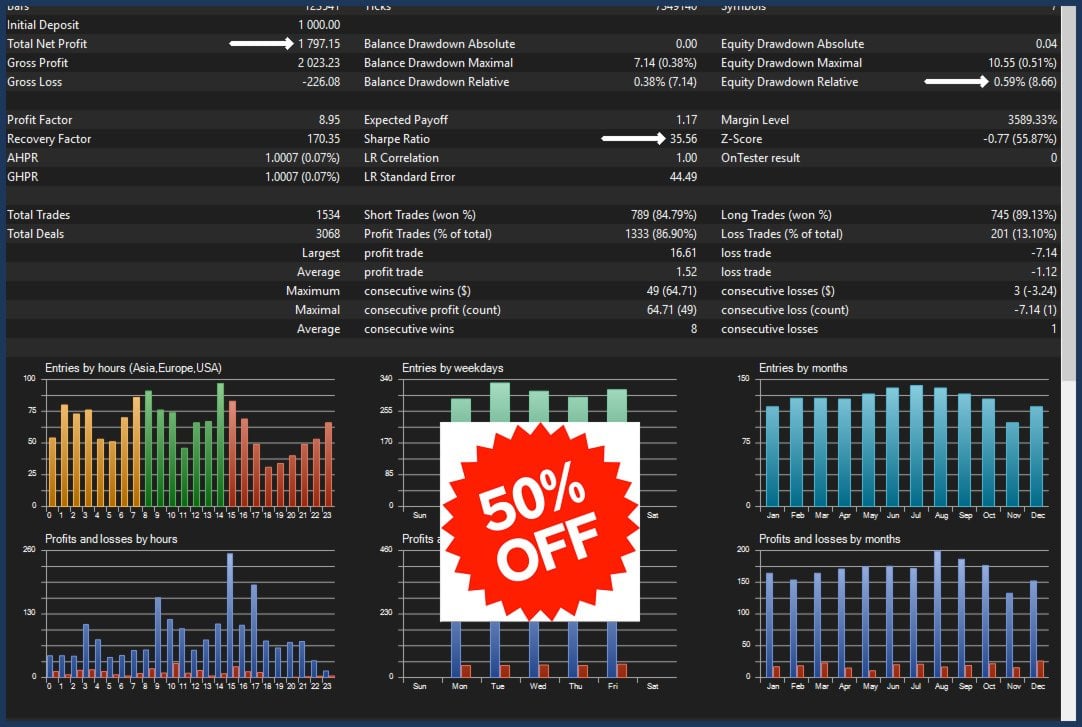
The larger trade count gives the simulation more observations than the current forward sample, but it does not make the two datasets interchangeable. Before using a historical report to choose a configuration, retain the dates, inputs, price data and cost assumptions that produced it. This cropped image does not provide that complete reproducible package.
Software history adds another reason to keep the records separate. The version 2.78 release note, dated 29 August 2026, reports an entry-filter fix. It identifies a change worth checking in a saved setup; it does not certify that an older illustration represents the corrected build.
In the public discussion, a buyer questioned multi-pair versus individual-pair backtests. The author’s reply acknowledges a fix and says USDJPY will be checked. That exchange is a specific reason to compare like-for-like runs, rather than a basis for declaring every concern resolved.
Early feedback includes a contrary experience
Positive entries include qasym’s favourable backtests with live evaluation ongoing and originon’s praise for responsiveness. In contrast, Ronaldo Grinstein Bonassoli’s 8 September review reports near-break-even or slightly negative trading and stopping real-account use. These are attributed experiences, not independently verified results.
Support responsiveness, a promising simulation and a sustained trading record answer different questions. The feedback is useful when kept in those categories; turning it into one performance score would obscure the differences.
What would make the next evaluation more useful?
Keep one dated setup record: build, intended inputs, active pairs and relevant terminal messages. Compare observations against that record before changing several settings at once. If an update changes the entry logic, distinguish the observations before and after it rather than merging them into one apparently uniform test.
For a buyer comfortable doing that work, the public controls and instructions offer concrete starting points. Someone seeking an established long-term performance record will need more evidence than the material currently available. Our Silent Exit purchase page covers the $139.95 managed offer, delivery instructions and free lifetime updates.
Silent Exit MT5 EA review FAQs
Is the reference account a real-money USD 100,000 investment?
No. The provider identifies it as Darwinex Zero virtual capital. Its public trading record is useful to inspect, but the starting figure should not be presented as cash the author deposited.
Why can a strong profit factor be misleading in a short record?
Profit factor compares gross profits with gross losses. A single large winner can dominate the numerator before there is enough history to assess repeatability. Examine the distribution of outcomes as well as the headline ratio.
Does using one chart mean only one trade can be open?
No such position limit is established by the chart instruction. A host chart tells you where the EA runs; it does not by itself define total positions, simultaneous exposure or whether additional entries are permitted.
Can distinct magic numbers separate the risk of two EAs?
They help identify and manage trades, but the EAs still share the same account balance and available margin. Review combined exposure separately from order identification.
Should a backtest match the public signal exactly?
No. Different dates, prices, execution and inputs can produce different outcomes. A useful comparison keeps those differences visible and uses the same build and configuration where possible; a screenshot alone cannot establish equivalence.
Is the daily-loss control enough to confirm prop-firm compatibility?
No. The public guide does not establish every calculation, reset rule or action that a firm might require. Confirm how the installed setting works and compare it with the relevant account rules before treating it as a safeguard for those rules.
View Silent Exit MT5 EA and managed installation →