
Cepheus MT5 EA offers a useful choice to investigate: run a gold-breakout approach, a swing-based approach, or combine them under one allocation system. The most important detail is what happens to that allocation when you change the enabled engines. We also compare the three public signal records and explain what the current release changes mean for an older manual.
Our initial assessment: Cepheus is most relevant to someone who wants to select and supervise engine combinations. Its documented controls give that buyer specific decisions to work through. The three linked accounts provide early observations, but their results are not a controlled ranking of which combination is best.
Review scope: CheaperForex sells Cepheus through managed installation. This assessment uses public documentation, genuine MQL5 captures and attributed feedback checked on 9 September 2026. We have not performed a hands-on trading test.
View Cepheus pricing & installation →

Jump to: Engines · Allocation · Three signals · Protection · Who it suits · FAQs
Discipline and Loyalty: what each contributes
The official description positions Discipline around directional expansion and structural breakouts, using volume and volatility confirmation. Loyalty follows broader swing structure and adaptive trade management. Those are different ways to decide when to participate in the same gold market.
A practical comparison starts with the type of opportunity each engine is looking for. A breakout asks whether a directional move has enough confirmation to enter. A swing-based approach gives broader structure a different role. Neither label tells you the eventual holding time, win rate or cash exposure of your chosen setup.
The manual’s strategy section explicitly mentions Loyalty stacking. Do not translate the developer’s no-grid/no-martingale description into a single-position promise. When reviewing an engine combination, inspect its open positions together and distinguish an individual order from the total exposure being managed.
Why switching off an engine can redirect its budget
The allocation description gives Loyalty 75% and Discipline 25% of the available risk budget by default. If one engine is disabled, the remaining engine receives the full budget. Fixed lots are described separately as volume per order; the weighting is not a promise of three-times-larger orders or three-times-the-profit.
This is useful to understand before comparing two account records. A single-engine run may give that engine a different allocation from its share in a combined run. Different results can reflect that difference as well as the entry logic. Keep the enabled combination, sizing mode and account conditions with each observation.
Both engines still operate in gold. Two labels do not establish independent returns or protection from the same market disruption. The benefit to assess is having alternative entry logic and explicit allocation choices, while keeping the combined exposure visible.
Three Cepheus signals, three separate observations
The developer links Loyalty, Discipline and Ultimate, the combined-engine account. All three titles include High Risk. These are public records checked on 9 September 2026, with different samples and starting conditions. Their MQL5 copy subscriptions are separate from buying the EA.
Ultimate: the combined-engine account
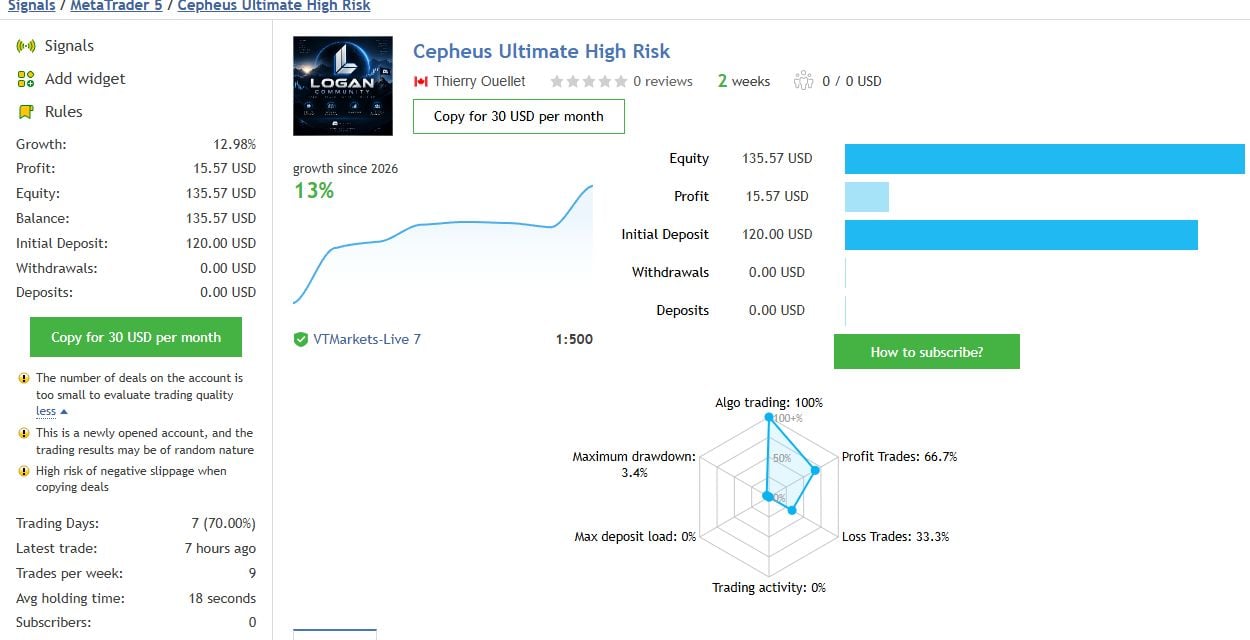
Ultimate showed 12.98% growth across 15 trades, with USD 15.57 profit on an initial USD 120 and a USD 135.57 balance. Ten trades were classified as wins and five as losses. This is the most directly relevant linked account for inspecting a combined setup, but we did not verify that its entire history used today’s build or your intended settings.
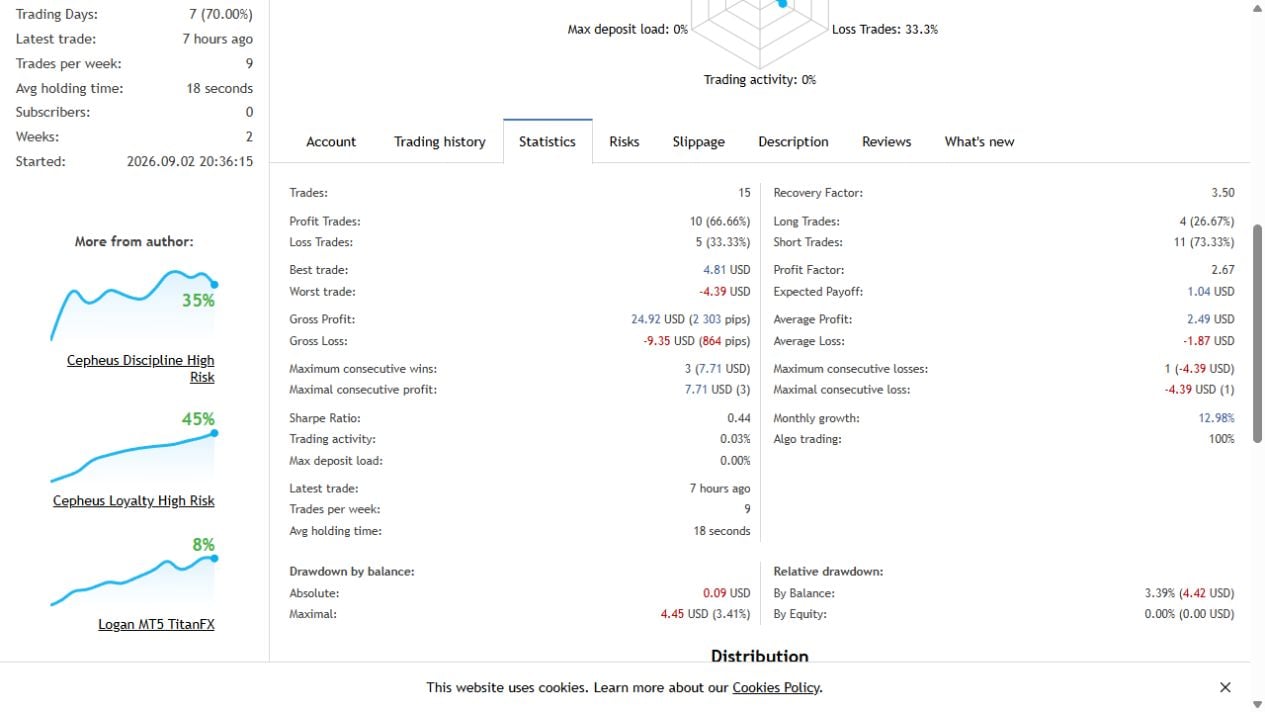
The statistics show 3.41% maximum balance drawdown alongside 0.00% reported relative equity drawdown. The second field cannot sensibly be presented as proof of no losses when the same record contains losing trades. We have not independently established why these measures differ so sharply; preserving their labels is more honest than selecting whichever looks best.
Loyalty: keep the account currency visible
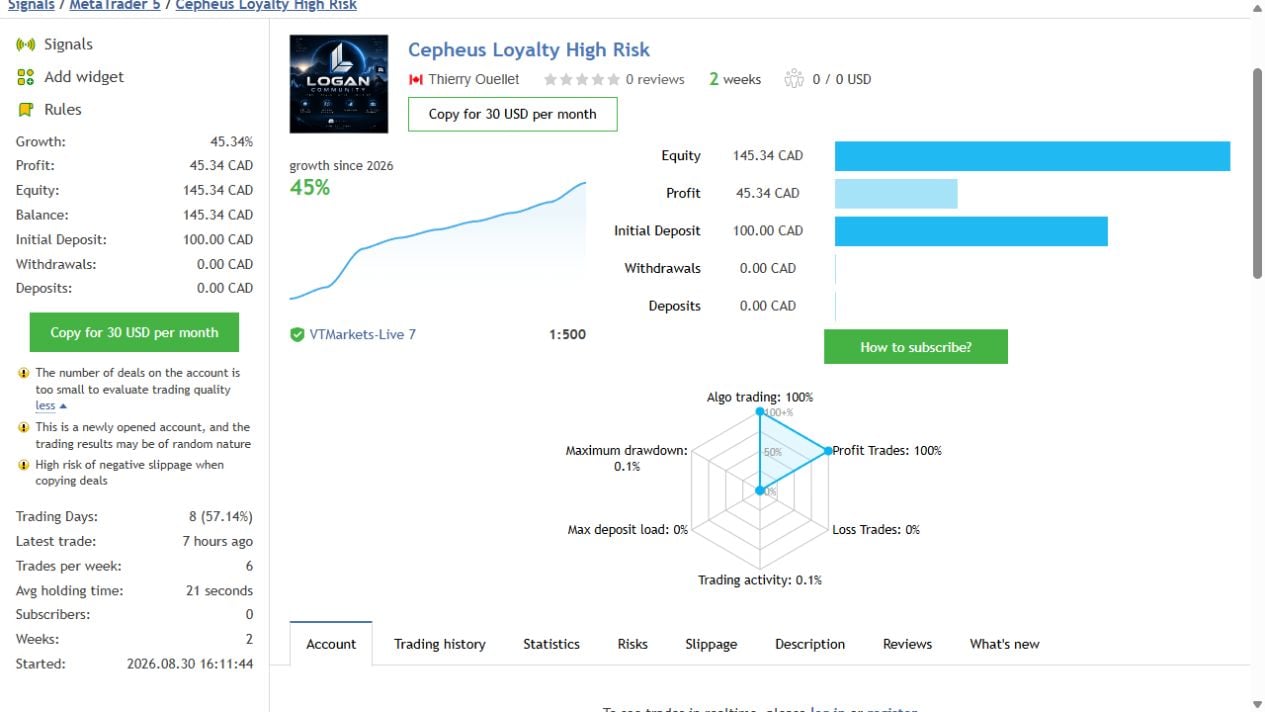
Loyalty showed 45.34% growth across 12 trades, with CAD 45.34 profit, CAD 100 initial funding and CAD 145.34 balance. All 12 trades were classified as wins. The observed maximum balance drawdown was 0.03%; reported relative equity drawdown was 0.14%. A short winning sequence has not shown how the configuration behaves through a substantial loss.
Do not compare CAD 45.34 directly with a USD profit figure as if they were the same unit. Even comparing percentages does not remove differences in sizing, sample dates or engine selection. A higher result in this snapshot is a reason to inspect the configuration, not a conclusion that Loyalty is the better choice.
Discipline: concentration matters alongside growth
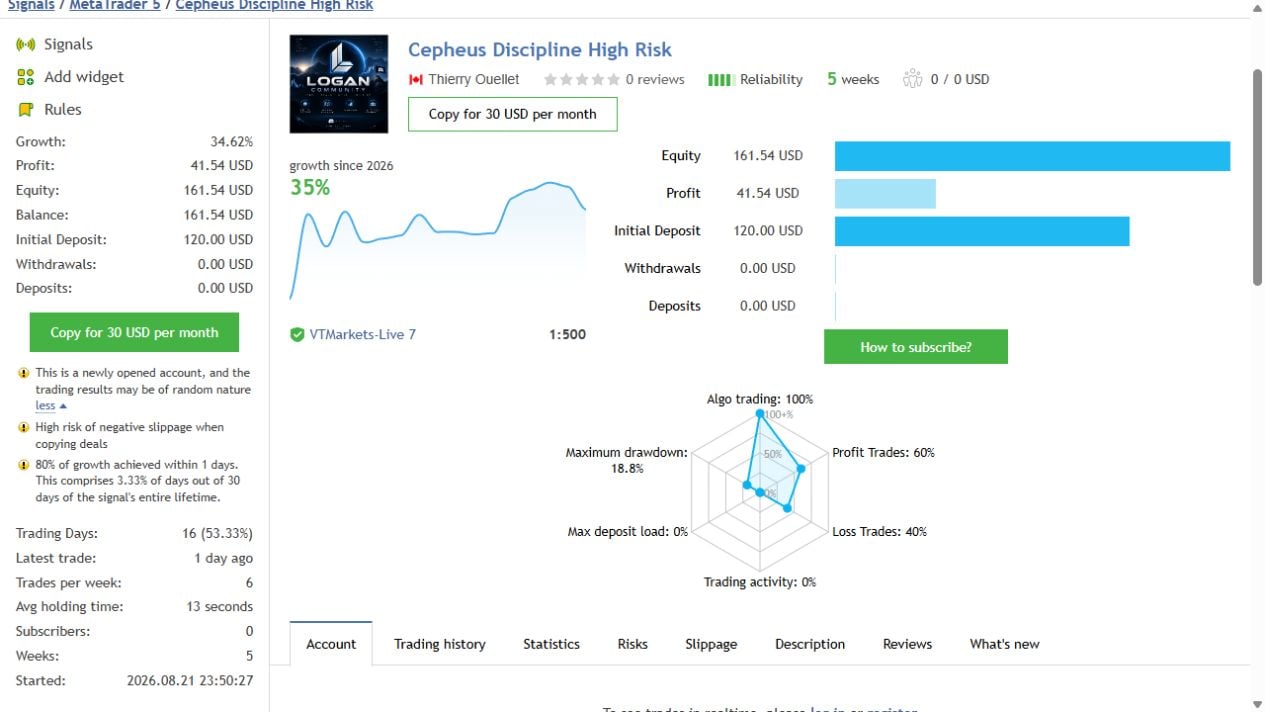
Discipline showed 34.62% growth across 40 trades, with USD 41.54 profit and USD 161.54 balance from USD 120 initial funding. Its Statistics page reported 18.90% maximum balance drawdown; the reported relative equity field was 0.21%. The overview graphic rounds differently, so use the named statistics field for the precise comparison.
The concentration warning changes how to read the headline. If much of the growth comes from one day, the percentage gives less information about the rest of the observation period. A buyer should examine the losing periods and the exposure behind that successful day, rather than extrapolating a regular monthly income.
| Account | Trades / growth | Maximum balance drawdown |
|---|---|---|
| Ultimate | 15 / 12.98% | 3.41% |
| Loyalty | 12 / 45.34% | 0.03% |
| Discipline | 40 / 34.62% | 18.90% |
These are separate observations. Adding their growth figures would not describe the return of a real combined account.
Daily protection: read the action as well as the threshold
The manual describes a daily equity limit referenced to the start of the broker day. The v1.2 release notes add closing open trades when the threshold is reached, beyond pending-order cancellation and a trading halt. The older manual therefore does not tell the whole story.
Before relying on that control on a shared account, establish what is measured and which positions its closing action can affect. The public wording does not precisely settle the treatment of unrelated manual or other-EA positions. A limit also needs an enabled switch and a chosen threshold; the manual does not provide a definite default state.
The v1.3 note about floating P/L referring to Cepheus trades is a display correction. It should not be stretched into proof that the daily circuit breaker measures only Cepheus activity. This distinction matters more than the reassuring word “global.”
News and pending orders: inspect the broker-clock boundary
Cepheus uses the native MT5 calendar without an external WebRequest address. The manual describes news periods that block entries and remove pending orders. Its Friday cutoff also removes pending orders; that is not the same as closing every open position for the weekend.
A useful setup record pairs the broker time, next calendar event and entry status with the orders actually present. This helps distinguish an expected pause from a configuration problem. Avoid bypassing a filter just because the terminal has not opened a trade.
MetaQuotes documents that native calendar functions are unavailable in Strategy Tester; historical calendar use requires a separate data mechanism. We did not establish Cepheus’s exact historical-news implementation. The absence of WebRequest setup does not, by itself, demonstrate identical backtest and live filtering.
Version 1.4 and the age of the evidence
The listing was published 5 September 2026 and the current release checked here is 1.4, dated 9 September. Its change log reports revised Discipline execution and fixes for interaction with other EAs. Earlier releases addressed three-decimal dashboard sizing and a backtest slippage/stop-loss issue. The public manual still displays a v1.00 example.
These changes are useful operating context. Save the installed build with a configuration before comparing a later run. The fact that a developer publishes fixes is evidence of changes being documented; it is not our verification that every reported improvement has the claimed effect.
What early users actually describe
Invest3IO’s 9 September review praises Loyalty-only use and support, with a later Discipline assessment planned. sharpeye’s 7 September review expresses enthusiasm about structure and backtests. brainiacz’s 8 September entry has no written comment. These are early reactions, not substituted CheaperForex customer ratings.
Who should investigate Cepheus?
Most relevant: an MT5 gold trader who wants to understand and select engine combinations, inspect allocation after changes, and review each engine’s record separately. The public manual gives this buyer a useful starting point for setup questions.
Less compelling: a buyer seeking a guaranteed one-position system or an already mature, like-for-like comparison proving which configuration will perform best. The available material does not establish either. Our view is that the allocation mechanics are the most useful feature to understand before evaluating the results.
CheaperForex offers managed installation for $149.99, with delivery instructions provided for your order. Free lifetime updates are included. The Cepheus product page explains delivery and the account details needed for setup.
Cepheus MT5 EA review FAQs
Is Cepheus a single-position EA?
Do not assume that. Its manual describes Loyalty stacking entries. No-grid and no-martingale claims do not establish a one-position limit. Inspect the exposure of the chosen engine combination.
Does the 3:1 allocation predict the share of profits?
No. It describes how the documented risk budget is allocated. It does not promise how often either engine trades, its contribution to profit, or the final size of a loss.
Why compare the three signal records separately?
They represent different engine selections and account histories. Loyalty’s account currency is CAD; the other two are USD. Their starting conditions and exact build history were not matched in this review, so neither adding returns nor ranking by cash profit is a controlled comparison.
Does a reported 0.00% equity drawdown mean there were no losses?
No. Ultimate also shows losing trades and a nonzero balance-drawdown figure. Keep the labels and the underlying trade sample together instead of using one field as an overall loss claim.
Does the manual describe the latest drawdown action?
The manual displays a v1.00 example. Version 1.2 added closing open trades when the daily threshold is reached. The public wording does not fully establish what happens to unrelated manual or other-EA positions; confirm that scope before relying on it on a shared account.
Has CheaperForex independently tested Cepheus?
No. This review assesses public documentation, dated MQL5 captures and attributed feedback. We have not run the EA, reproduced its backtests or verified a future return.
View Cepheus MT5 EA and managed installation →