
Chiroptera EA MT5 is a multi-currency Forex night scalper that combines limit-order entries with adaptive lot allocation across major and minor pairs. Its distinctive features are a one-chart portfolio, learned pair weights and detailed controls for trading costs, overnight conditions and stop handling.
Our assessment: Chiroptera offers more control over pair allocation and overnight execution than a simple fixed-lot scalper. It is most relevant to traders willing to check broker conditions and understand the stop settings. The current Global Prime record is considerably longer than the figures in our earlier review, but its 45.51% relative equity drawdown makes risk assessment essential.
Sources checked September 29, 2026. We examined the developer’s MQL5 specification, release notes, linked public signal and customer feedback. This is not an independent live test. CheaperForex sells Chiroptera.
Ready to Buy Chiroptera EA MT5?
$359.99 with crypto · $449.99 by card
Official version · Instant download · Free lifetime updates · 7-day money-back guarantee

How Chiroptera selects and manages trades
The current MQL5 specification describes single trades during a short overnight session, with limit-order entries and adjustable stops and targets. It explicitly rules out grid and martingale. News, holidays, price activity and trading costs can prevent entries when conditions fail the strategy’s checks.
The advertised two-to-three-hour window describes active trading time, not a strict deadline for closing every position. Global Prime’s public statistics showed an average holding time of seven hours at our check. A trader must therefore account for rollover, subsequent sessions and potential weekend exposure rather than assuming the account is flat for the rest of each day.
28-pair support and adaptive lot sizing
Chiroptera now supports all 28 major and minor Forex pairs. The overview and May 2026 release notes confirm the expansion, including the addition of CADJPY. The listing still contains an older input example with 21 pairs; it should not be confused with the complete current capability. Actual exposure depends on the selected pair list and allocation settings.
The learning system assigns different lot weights to pairs, with more emphasis on recent history. This lets the portfolio’s allocation respond to changing results rather than assigning the same volume to every symbol. It cannot remove the effects of poor execution, a changing market or shared currency exposure across several trades.
The 60-day learning distinction matters: the developer says backtests initially use minimum lots while learning, usually producing a flatter early curve. Live accounts can start from the learned weights embedded in the current EA. An optional custom file can be generated in the Strategy Tester, but a live buyer does not automatically need to spend 60 days trading equal allocations first.
Custom files use MT5’s Common folder. The developer notes that MQL5 VPS does not synchronize that folder for this optional workflow, so anyone choosing custom weights must check how the file reaches the machine running the EA. This limitation does not make custom weights a requirement for normal startup.
What the current Global Prime signal shows
The developer’s main product description links Chiroptera Global Prime on MQL5. The figures below are a snapshot retrieved September 29, 2026, not a forecast or a promise that another broker will match the account.
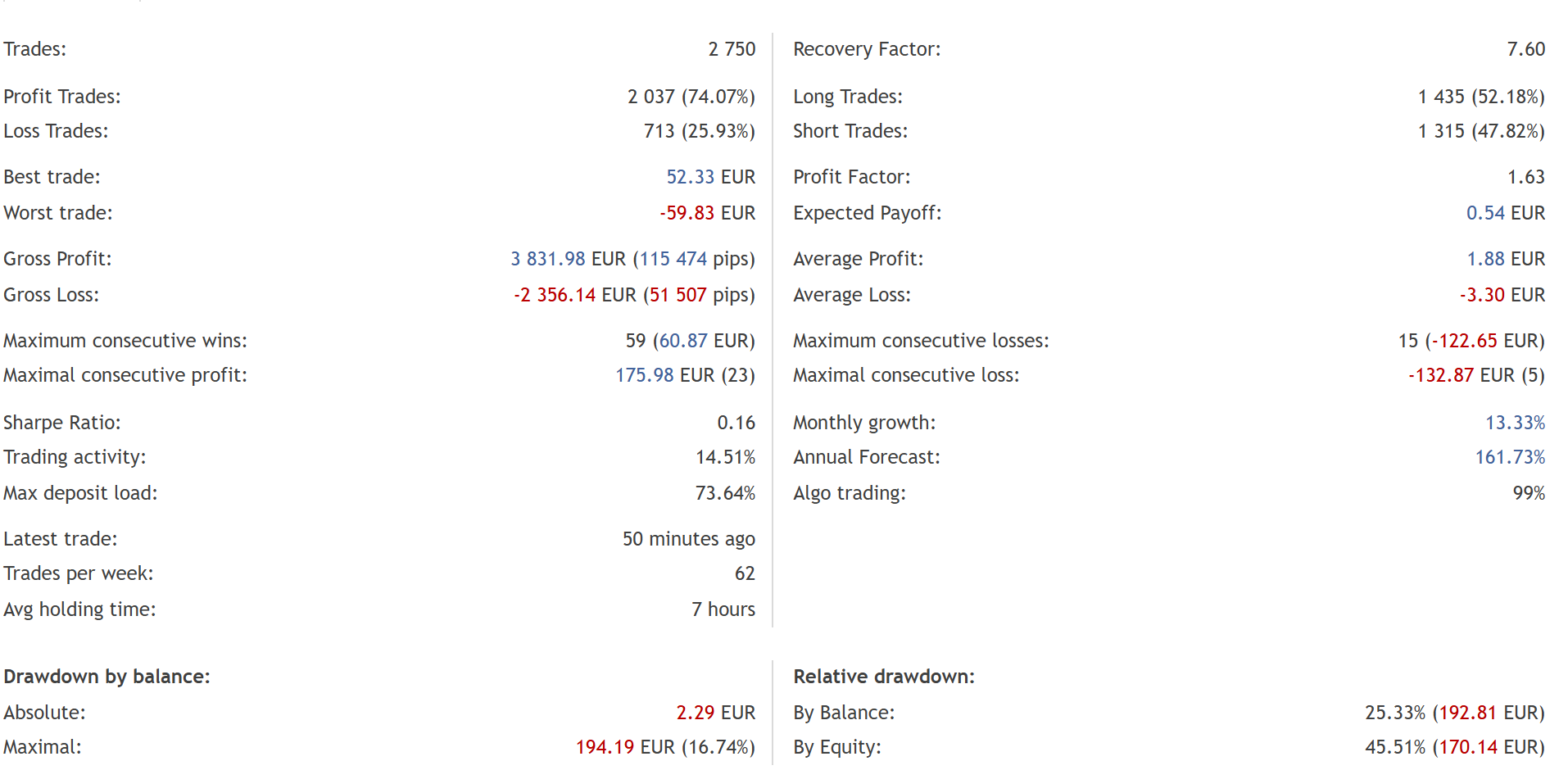
- Reported growth
- 2,129.84%
- Account history
- 51 weeks shown by MQL5; Started field October 24, 2025.
- Relative drawdown
- 45.51% by equity and 25.33% by balance.
- Trades and profit factor
- 2,750 trades; profit factor 1.63.
- Profitable trades
- 74.07%; average profit €1.88 and average loss €3.30.
- Cash flows
- Initial deposit €230.11; deposits €2,718.88; withdrawals €3,598.00.
- Account at capture
- Balance and equity €826.83; reported profit €1,475.84.
- Holding and exposure
- Average holding time seven hours; maximum deposit load 73.64%.
The drawdown is material. Equity drawdown includes floating losses and is considerably higher than the balance measure. A profitable-trade rate above 70% does not prevent a difficult losing period, particularly when the average losing trade is larger than the average winner.
The account includes both deposits and withdrawals. It is incorrect to describe the result as an untouched initial deposit growing by the headline percentage, or to claim that no extra deposits occurred. The MQL5 growth measure, cash profit and account balance answer different questions.
About “12 months live results”: the current source artwork uses that phrase. MQL5 showed approximately a year of account history at 51 weeks, but the October 24, 2025 Started date was still under 12 months before this review’s September 29, 2026 check. Historical trades and monitoring duration should be kept distinct. The record also spans changes to Chiroptera’s code and risk settings; it is not a full year of one unchanged current build.
A second account: Hantec Markets Standard
The same developer’s signal profile also lists Chiroptera Hantec Markets Standard. This is an additional account, rather than the signal linked in the product description. On September 29, 2026 it showed 184.69% growth, 1,154 trades and a 1.24 profit factor, with 49.75% relative equity drawdown. MQL5 displayed 29 weeks of account history and a Started date of May 7, 2026.
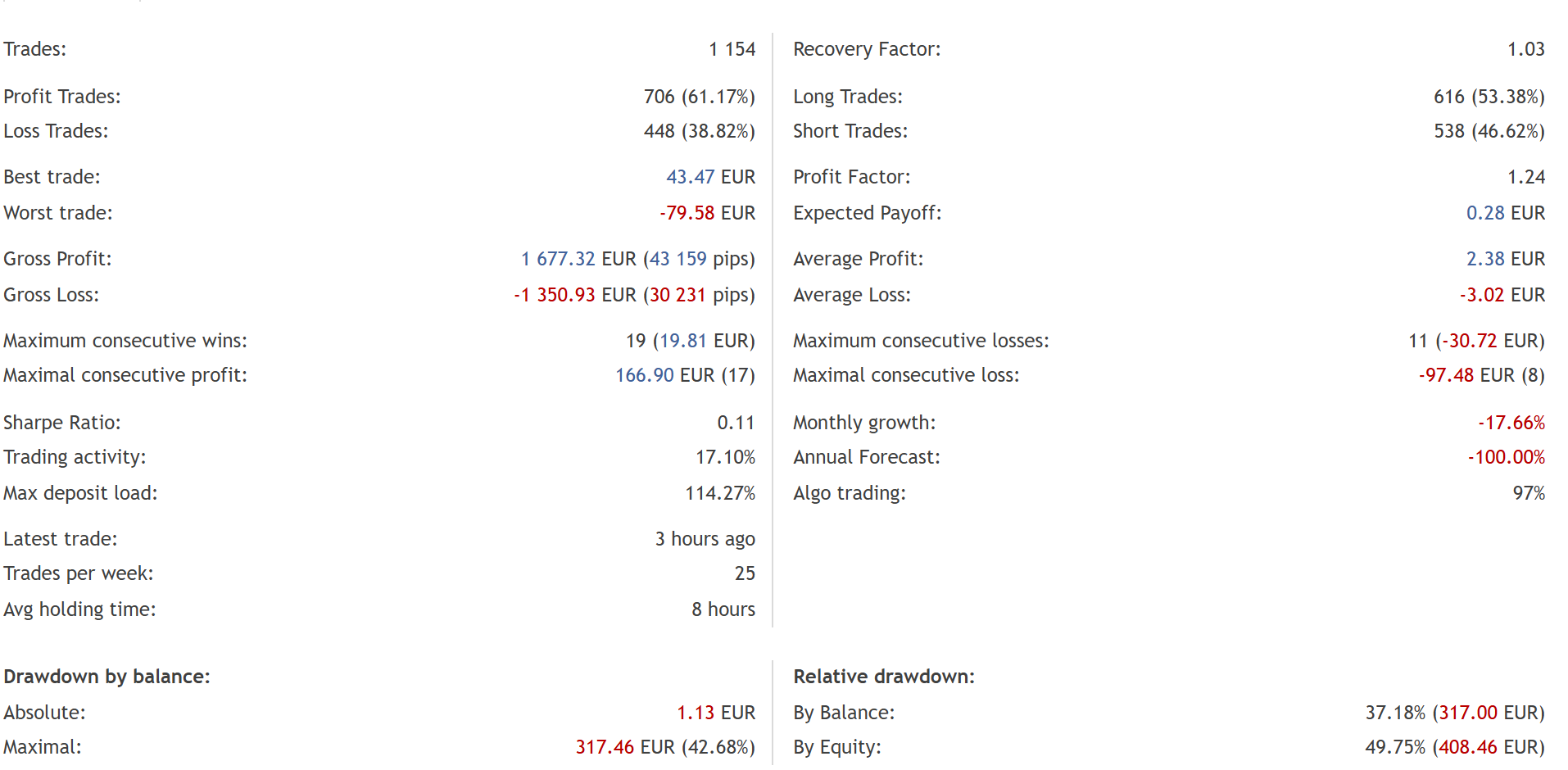
MQL5 warned that 80% of the account’s growth occurred within seven days, while its displayed monthly growth was negative at −17.66%. The account had an initial deposit of €100, additional deposits of €108.76 and no withdrawals at capture. These details qualify the headline growth: the path was concentrated and included substantial drawdown, not consistent gains every month.
The two accounts are useful examples of different broker outcomes, but they are not a controlled broker comparison. Settings, timing, funding and historical builds can differ. Neither record establishes a return or drawdown ceiling for a new account.
RiskFactor, stop handling and prop-firm limits
The documented RiskFactor is a balance-based sizing multiplier, currently capped at 3. It is not a 3% risk-per-trade ceiling. The June release notes changed the cap and corrected risk calculations, so older recommendations using much higher values are no longer an appropriate guide to the current inputs. A static-lot override is also available.
The published settings include ImmediateStopLossPlacement and TemporaryRemoveStopLoss. The first addresses accounts that require a stop as the order triggers. The second can remove the broker-side stop during high-spread periods, including around rollover. That may avoid a spread-triggered exit, but it also removes that protection temporarily. The StopLoss field can also be set to zero. These are choices to understand before trading, not details to bury behind a “no martingale” label.
A daily-loss guard appears in the release history. The developer describes a once-per-minute check from a rollover-based reference and warns that a fast market can still breach a broker’s limits. Friday controls also have exceptions: trades from an earlier session can remain open when a holiday prevents normal closure. A prop firm’s equity rules, reset timezone and holding restrictions need individual checking.
Limit orders do not make execution cost-free or slippage-free. Entry orders may go unfilled, and exits can differ from the intended price. Spread, swap and commission filters are relevant, but some documented defaults disable particular checks. Confirm the actual input values and observe results on the intended account.
Recent release changes worth knowing
The release history showed version 6.92, dated August 13, 2026, at this review’s check. This is a dated source reference, not a promise about the file in a particular order.
- May 2026: full major/minor pair support, revised minimum-lot learning behavior and additional commission and margin checks.
- June 2026: embedded weight-file and news-interface changes, the RiskFactor cap of 3, and corrections to news and risk calculations.
- August 2026: position-management and information-panel changes, followed by several bug fixes through version 6.92.
This history explains why older setup instructions and early signal snapshots should not be treated as a complete description of the current design. A report generated with an earlier build or risk setting remains evidence of that earlier configuration.
The older backtest is not the current live record
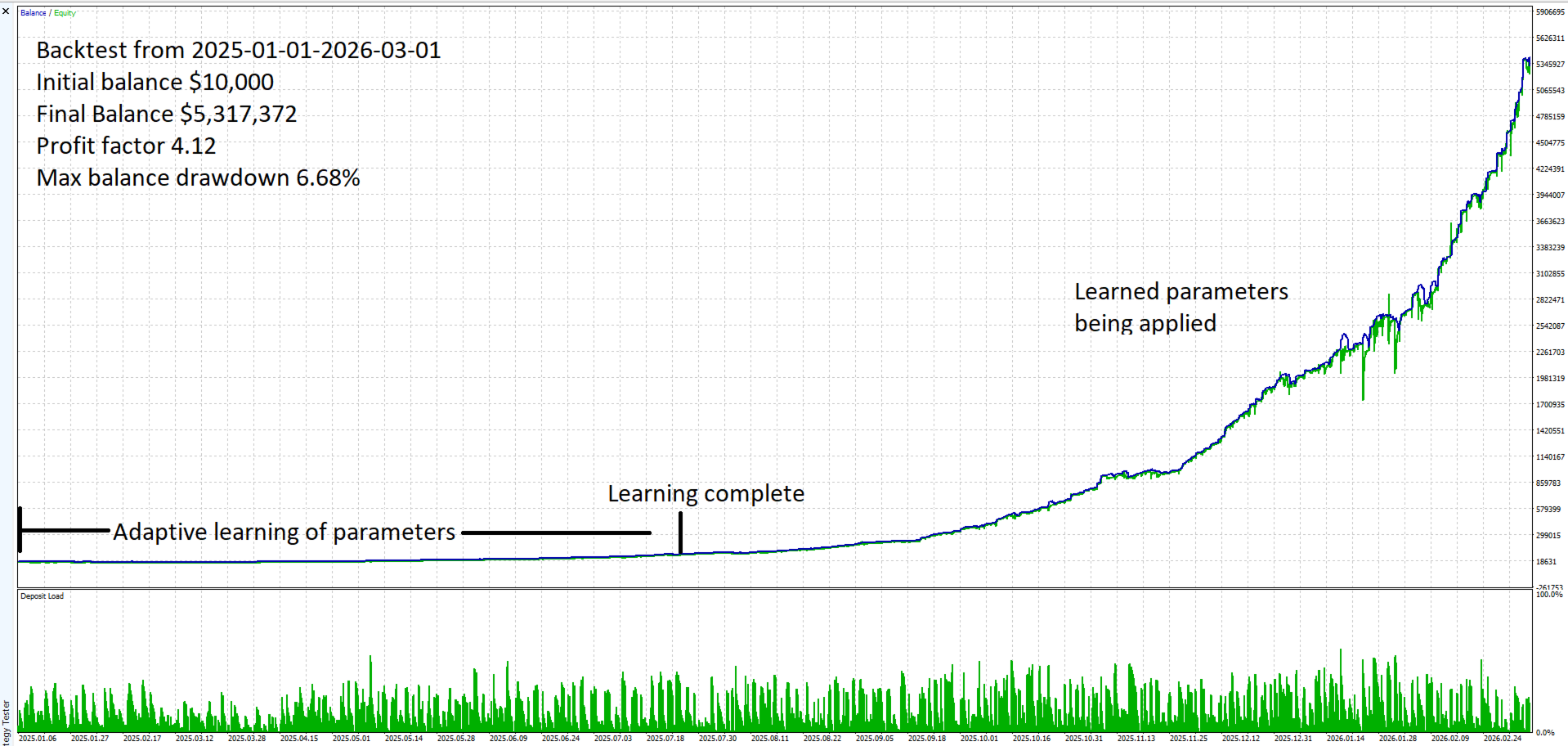
The report shows a starting balance of 10,000, a final balance of approximately 5.32 million, profit factor 4.12 and maximum balance drawdown of 6.68%. These striking figures belong to the developer’s historical test. We have not independently reproduced its data, configuration or costs.
Do not compare its balance drawdown directly with the current signals’ relative equity drawdown as if the measures were identical. They cover different kinds of loss, periods, conditions and potentially settings. The backtest does not establish that the much larger live drawdowns can be avoided, or that its returns are repeatable.
Customer feedback: support praise and broker-specific concerns
The MQL5 customer reviews are mixed in their detail. Some buyers praise the developer’s responsiveness and results. Others report losses or a significant difference between their broker and the published account. These are customer accounts of their experience, not independently reproduced tests.

An August review reported losses on TMGM; the developer’s reply emphasized that tight rollover spreads were essential. A different August reviewer described positive results but also substantial broker variation and occasional weekend holdings. Other buyers praised helpful support. Taken together, the useful lesson is to evaluate the actual broker, costs and holding behavior rather than rely on the overall star score.
Some comments make stronger accusations about broker restrictions or strategy behavior. We have not independently established those allegations and do not present them as findings. They nevertheless make the developer’s broker guidance and the account’s permitted trading conditions important points to resolve before live use.
Who Chiroptera is best suited to
Chiroptera is a candidate for traders who want a configurable Forex portfolio with an overnight entry schedule and adaptive pair allocation. Its setup rewards attention to broker costs, live execution and stop behavior. It is a less suitable choice for someone expecting guaranteed short holdings, identical results across brokers or a low-risk strategy based only on the absence of a grid.
When evaluating it, check symbol recognition, lot sizes, overnight spread behavior, stop placement, Friday settings and mobile alerts on the intended account. Include the 60-day learning period when interpreting a fresh backtest, and separate historical simulation from forward performance. Past results do not establish future returns.
Chiroptera review questions
Does the 12 months live results claim mean 12 months of monitoring?
Not exactly at the date checked. MQL5 displayed 51 weeks of account history on September 29, 2026, while the signal’s Started field was October 24, 2025. Account trading history and the period monitored by MQL5 are different measures.
What changed from the older Chiroptera information?
The current releases expand support to 28 Forex pairs, include learned weights for live startup, and cap the documented RiskFactor at 3. The current listing links Global Prime; the older four-broker growth figures should not be treated as current results.
Does a high win rate make the strategy low risk?
No. At the dated Global Prime check, 74.07% of trades were profitable, but the average loss was larger than the average win and relative equity drawdown reached 45.51%. Win rate alone does not describe the size or timing of losses.
Are these independently reproduced trading results?
No. This review evaluates the developer’s published specification, release notes, public MQL5 signal and customer feedback. It does not represent a CheaperForex live trading test, and the product artwork is separate from genuine source captures.