Last updated: August 2026
ThunderGold Scalper is a XAUUSD (Gold) Expert Advisor by Brazilian developer Jorge Luiz Guimaraes De Araujo Dias, running on the M15 timeframe and available in two separate builds — one for MetaTrader 5 and one for MetaTrader 4. This review covers both. It launched at the end of July 2026 and is the sister product to his established TwisterPro Scalper.
The thing that stands out about this listing is not a performance claim — it is a warning. Buried in the developer’s own documentation is a passage stating that the EA uses a relatively short stop loss, that “several consecutive Stop Losses may occur during unfavorable market conditions,” that this is normal rather than a technical problem, and that users should avoid increasing lot size after a losing trade. A developer who tells you in advance that his product will have losing streaks, and specifically instructs you not to martingale your way out of them, is doing something most of this marketplace does not.
We rate ThunderGold Scalper 4 out of 5. The positive lean comes from a genuinely no-grid architecture with real stops, an unusually deep execution-protection layer, a backtest whose risk structure holds up to scrutiny better than most, and a developer who documents the downside honestly. What holds it back is the thinness of the live evidence: a clean but very small account over a short window, a recent release date, and a strategy the developer himself describes as highly broker-dependent.
⚠️ Looking for a ThunderGold Scalper “free download”? Don’t.
Every legitimate marketplace EA ships with built-in DRM or licensing. There is no working cracked file in existence — so a “free” copy is always one of two things:
- malware, or
- bait for a Telegram payment scam where you pay and get nothing.
The only safe routes are the MQL5 marketplace or a reputable reseller. CheaperForex offers both builds at a lower price than the marketplace — see the MT5 product page or the MT4 product page.
The Developer: Jorge Luiz Guimaraes De Araujo Dias

Jorge Dias is a Brazil-based developer with a small but genuinely active catalogue of gold-focused Expert Advisors, and a marketplace rating in the low fours across a couple of hundred ratings. His best-known product is TwisterPro Scalper, which has accumulated a substantial review base over time; the range also includes NeonGamer, NeonScalper and CatFather.
Two things are worth noting about how he operates. First, he responds to reviews individually and updates products regularly — ThunderGold has already received updates in its first week of release. Second, and more importantly for a buyer, his documentation is candid in a way that costs him sales. The risk management section of this listing is not boilerplate; it explains a genuine weakness of the strategy and pre-empts the single most destructive thing a user could do in response to it. That is a meaningful signal about the person behind the product.
The counterweight is straightforward: a couple of hundred ratings is a modest base by marketplace standards, and this particular product is only weeks old with a handful of reviews, all posted in its launch window.
How ThunderGold Trades
The strategy is described in reasonable operational detail. Entries run through a multi-factor decision engine combining market structure, trend direction, candle quality, volume and momentum — the EA is designed to wait for these to align rather than open positions continuously.
The trade management is conventional and, importantly, defined:
- No grid strategy. Stated explicitly by the developer, and consistent with everything else in the design — there is no averaging language anywhere in the documentation.
- Automatic stop loss and take profit on every position. Risk is set at entry, not managed reactively.
- Dynamic trailing stop. Protects gains as a move develops.
- Risk-based or fixed-lot sizing. Your choice, with recommended risk of 0.5%–1% and 2% named as the maximum.
Where this product goes further than most is the execution layer around the strategy. A high-impact news filter with configurable blocking windows before and after events. Holiday and market-closure protection. A slippage adjustment system. A daily trade limit with cooldown control, which stops the EA from overtrading after a burst of activity. Automatic broker-specific point adjustment for Exness. Individually none of these is remarkable; collectively they represent more thought about real-world execution conditions than a typical gold scalper bothers with.
Short Stops: What It Actually Means for Your Account
This deserves its own section, because it is the defining characteristic of the strategy and the thing most likely to make an unprepared buyer panic.
A short stop loss keeps each individual loss small. The trade-off is that it gets hit more often, and — critically — it gets hit in clusters when the market is choppy or moving against the system’s read. The developer says this plainly: several consecutive stop losses can occur in unfavourable conditions, and this is normal behaviour rather than a sign that something has broken.
What that looks like in practice is an equity curve that grinds upward through a high proportion of small wins, punctuated by occasional runs of small losses that arrive close together. If you are watching trade-by-trade, a losing streak feels alarming. If you are watching the account, it should be contained — which is exactly why the developer’s second instruction matters more than the first.
Do not increase lot size after a loss. The listing calls this out directly, along with “recovery strategies, emotional intervention and excessive risk.” This is the failure mode that destroys accounts running otherwise sound scalpers: a trader watches four stops in a row, decides to “make it back,” doubles the lot, and turns a manageable drawdown into a serious one. The strategy is built on the assumption that you will not do this. If you know you would, this is not the right product for you, and there is no shame in recognising that in advance.
Practically: run the developer’s recommended 0.5%–1% risk rather than the 2% ceiling, start at 0.01 lot, and give yourself enough trades to see a losing run happen and resolve before you judge it.
The Backtest — Better Structured Than Most

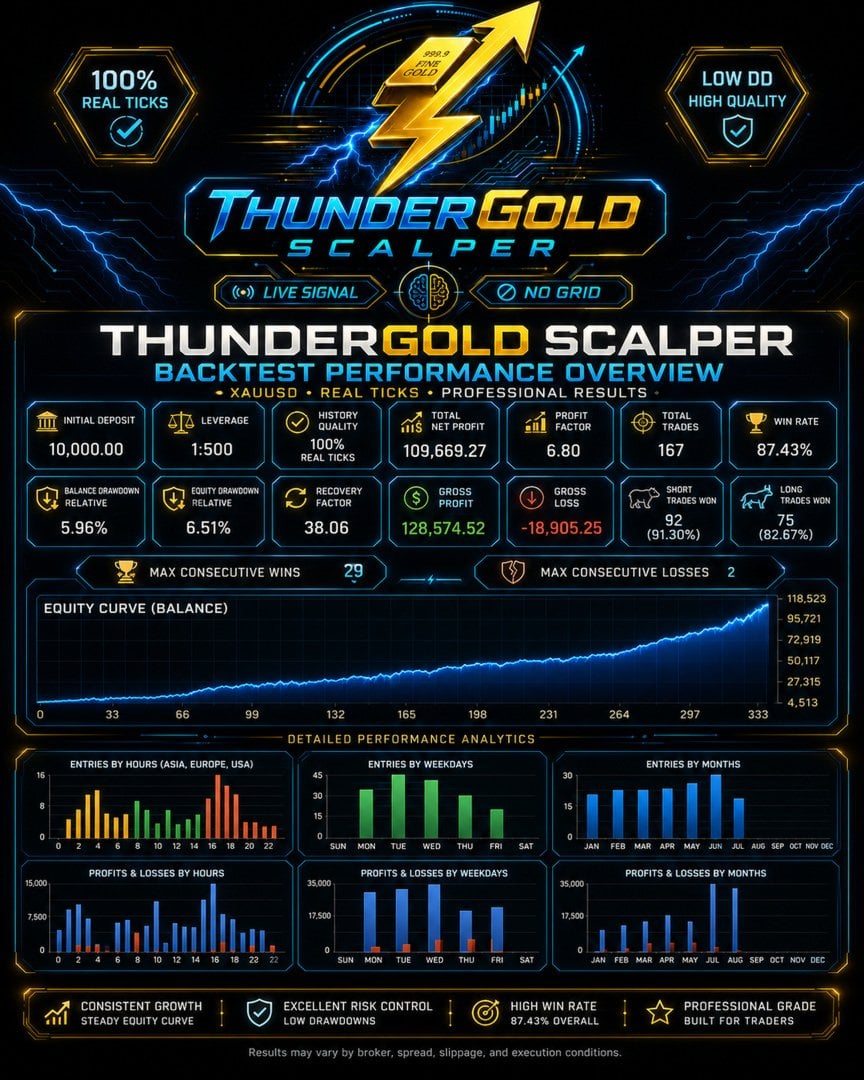
The published backtest runs on XAUUSD using 100% real tick data from a $10,000 deposit at 1:500 leverage, across 167 trades with a profit factor of 6.80 and an 87.43% win rate.
Start with the caveat. The headline profit is compounding at an aggressive rate over the test window, and it is not a forecast. The test also covers roughly seven months and 167 trades, which is a limited sample — it does not span multiple gold regimes, and no backtest can reproduce live spread, slippage and execution conditions.
Now the part that genuinely distinguishes it. We have reviewed a run of gold EAs recently where the friendly headline drawdown concealed a much uglier relative figure — reports showing a 7% maximum equity drawdown while quietly recording a 40% or even 60% relative drawdown earlier in the test. That is not the case here. ThunderGold’s relative drawdowns are 5.96% on balance and 6.51% on equity. Those are the honest, deepest-percentage figures, and they are genuinely low.
The win/loss ratio holds up too. Gross profit of roughly $128,575 across about 146 winning trades gives an average win near $880. Gross loss of roughly $18,905 across about 21 losing trades gives an average loss near $900. In other words, wins and losses are approximately the same size. This matters enormously: a high win rate paired with oversized losses usually means the system holds losers until they hurt, whereas a high win rate with symmetrical trade sizes suggests the edge is in entry quality rather than in deferring losses. Maximum consecutive losses of 2 in the test supports the same reading — though live conditions will produce longer streaks than a backtest, which is precisely what the developer warns about.
None of this makes the backtest a guarantee. It does mean this is one of the few we have looked at recently where the structure of the result is consistent with the strategy as described, rather than quietly contradicting it.
The Live Signal — Clean, But Small

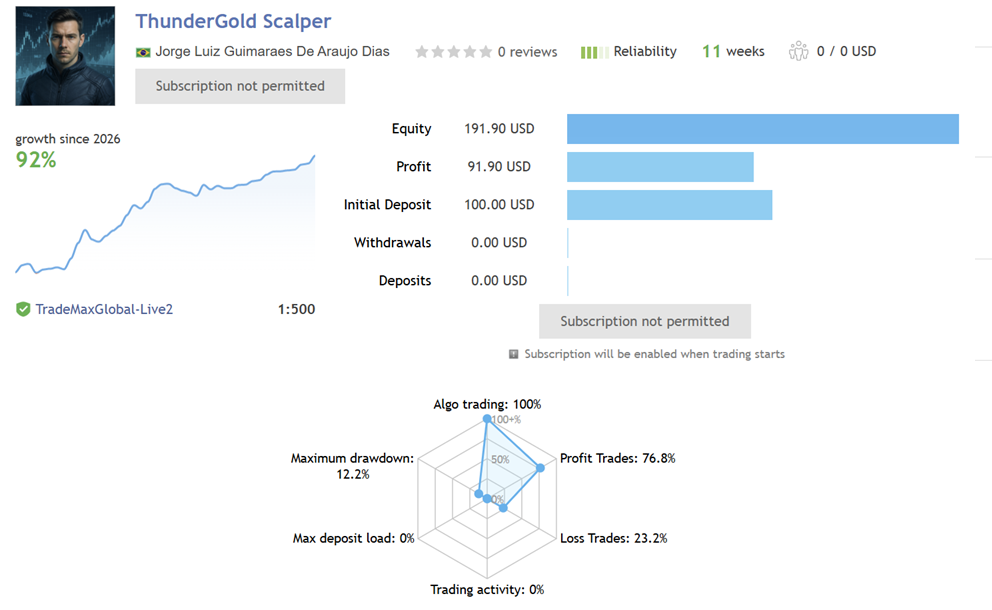
The public live signal runs on TMGM at 1:500 leverage.
What is good about it. The account opened at $100 and stands at roughly $191.90, for about $91.90 of profit — with zero deposits and zero withdrawals. There is nothing to unpick: the growth figure means what it says. The win rate of 76.8% comes with a genuine 23.2% loss rate, which is a believable distribution and sits comfortably below the backtest’s 87%, exactly the direction you would expect live results to move. Maximum drawdown of 12.2% is modest.
What limits it. Two things, and they are significant. The account is $100 — small enough that it cannot demonstrate how the strategy handles execution at meaningful size, where slippage and partial fills start to matter. And the record spans roughly 11 weeks, which for a scalper is a reasonable number of trades but a short calendar window that has not yet met a genuinely hostile stretch for gold.
The honest framing: this is credible evidence that the EA works as described, on a real account, with real money. It is not yet evidence of durability or scalability. Given the developer explicitly warns that broker conditions significantly affect results, your own account on your own broker is the test that actually matters.
The On-Chart Panel

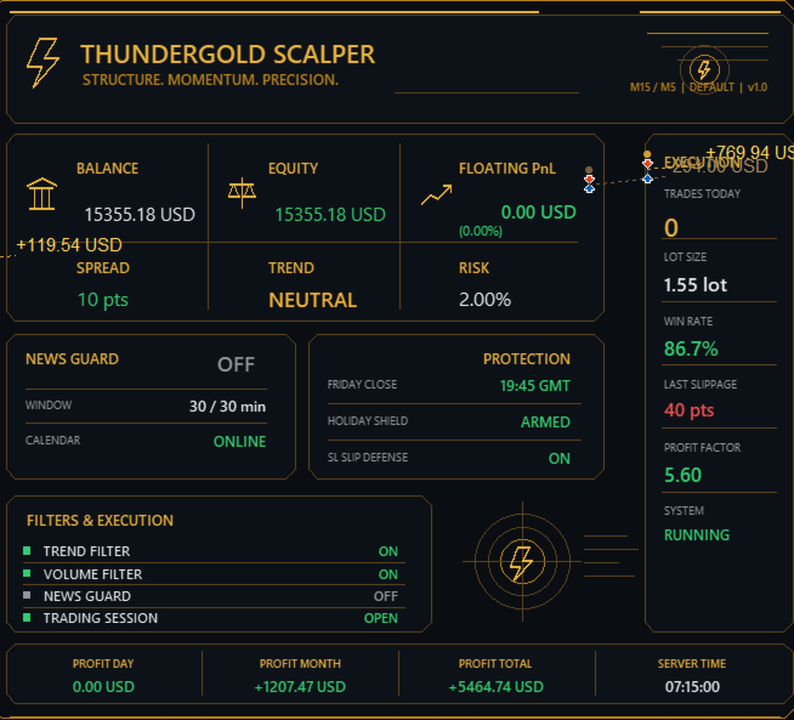
The panel is more useful than most. Alongside the expected balance, equity and floating P&L, it reports live spread, the current trend read, your risk setting, and the state of every filter and protection: news guard and its blocking window, calendar connectivity, Friday close time, holiday shield, stop-loss slippage defence, trend filter, volume filter and trading session status. It also tracks win rate, profit factor and — usefully — last slippage in points.
That last figure deserves a mention. Because the developer is explicit that this strategy is sensitive to execution quality, having a running slippage readout on the chart gives you an early, concrete signal about whether your broker is suitable. If last slippage is consistently wide, that is actionable information rather than a mystery.
Broker Choice Matters More Than Usual
The developer states directly that ThunderGold is sensitive to spread, slippage, liquidity and execution speed, and that broker conditions can therefore have a significant impact on results. This is not a disclaimer to skim past — for a short-stop scalper on gold, it is arguably the single largest variable outside the strategy itself.
A Raw Spread or Raw ECN account is strongly recommended. TMGM, Vantage and VT Markets are named as tested, and the live signal runs on TMGM. If you use Exness, there is a dedicated broker-type setting that applies the correct point adjustment; other tested brokers use the Default setting.
If your broker is not on that list, the developer’s guidance is sensible and we would echo it: run a MetaTrader 5 backtest using the “Every tick based on real ticks” model on your own symbol, or trial the EA on demo or at minimum lot before committing meaningful volume. Results genuinely can differ between brokers because of spread, commission, symbol specification, execution speed, liquidity and slippage.
MT4 or MT5 — Which Build?
Both editions run the same XAUUSD M15 strategy with the same protective stack. The differences are practical rather than strategic:
The MT5 build installs through the MetaTrader 5 marketplace, so activation is handled by the platform and future updates arrive directly in the terminal. The developer’s live signal runs on MT5, and MT5’s newer architecture generally handles gold symbols and multi-asset accounts more cleanly.
The MT4 build is a separate executable compiled for MetaTrader 4 and supplied as a standalone file. Its value is simple: if your broker, your existing setup or your habits keep you on MT4, you get the same system without changing platforms or running a second terminal.
Our guidance: choose the platform you actually trade on. Neither build has a strategic advantage, and there is no reason to switch platforms for this product. One caveat worth stating — the published live signal and backtest were produced on MT5, so MT4 users are relying on the two builds behaving equivalently. That is a reasonable expectation from the same developer, but it makes demo testing on your own MT4 broker more important rather than less.
ThunderGold or TwisterPro Scalper?
Both are XAUUSD scalpers on M15 from the same developer, so this is the comparison most buyers will want.
TwisterPro Scalper is the established sibling. It has been on the market considerably longer and has accumulated a large marketplace review base, which is a form of evidence ThunderGold simply cannot have yet. It runs entries through multiple independent validation layers and offers selectable trading modes. If your priority is a track record you can inspect and a body of buyer feedback to weigh, TwisterPro is the safer choice.
ThunderGold is the newer release, and its distinguishing feature is the breadth of its execution-protection layer — news, holiday, slippage, daily limits and cooldown all built in — alongside a documented multi-factor entry engine. If you want the more recent build with more environmental safeguards, this is it.
Our honest read: they are close relatives rather than competitors, and running both on the same account would double your gold exposure without either EA knowing about the other. Pick one, or run them on separate accounts.
What Early Buyers Are Saying

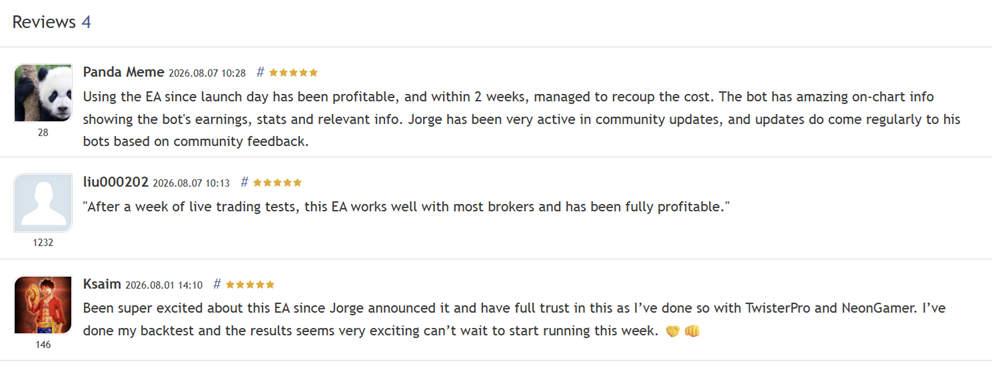
The review base is small and very new — a handful of five-star ratings, all posted within the launch period. The substance is limited but consistent. One buyer running it since launch day reported it had been profitable and that they had recouped the purchase cost within two weeks, singling out the on-chart panel for the detail it provides. Another, after a week of live testing, reported it working well across most brokers and running profitably.
One review is worth reading carefully for a different reason: it was posted by someone who had backtested the EA and was looking forward to running it, but had not yet started live trading. That is enthusiasm rather than evidence, and it is a useful reminder of what a launch-window review base actually represents.
The honest weight to place on all of this: it confirms the product installs, runs and has produced early profits for real buyers. It tells you nothing yet about how it behaves over months, or through the consecutive stop losses the developer himself has warned about. Treat it as a positive first signal and let your own testing be the evidence that decides.
Who ThunderGold Scalper Is For
It might be a fit if you:
- Want a genuinely no-grid gold scalper with a real stop loss and take profit on every trade
- Value environmental protections — news, holidays, slippage, overtrading limits — as much as entry logic
- Can accept clusters of small consecutive losses without changing your lot size in response
- Trade on a Raw Spread or Raw ECN account with good execution, ideally one of the tested brokers
- Will run 0.5%–1% risk starting at 0.01 lot rather than reaching for the 2% ceiling
- Appreciate a developer who documents his product’s weaknesses rather than hiding them
Look elsewhere or wait if you:
- Need a substantial live track record on a meaningful account size — the live record here is $100 over 11 weeks
- Would react to four or five stop losses in a row by increasing your position size
- Trade on a high-spread or slow-execution account, which the developer says will significantly affect results
- Want an established review base — consider TwisterPro Scalper, the same developer’s longer-standing product
- Would read the backtest’s compounded total as an expectation
Our Verdict
We rate ThunderGold Scalper 4 out of 5.
The positive lean is earned on architecture and honesty. This is a no-grid system with a real stop loss and take profit on every position, wrapped in the most complete execution-protection layer we have seen on a gold scalper in some time — news filtering, holiday protection, slippage adjustment, daily trade limits and cooldown control. The backtest, unusually, holds up under the kind of scrutiny that has undone several of its competitors: relative drawdown around 6% rather than a friendly headline concealing a 40% figure, and average wins roughly equal to average losses rather than a high win rate propped up by oversized losers. The live account, though small, is clean and undistorted. And the developer’s willingness to document his own strategy’s losing streaks — and to instruct buyers not to martingale out of them — is the kind of candour that is rare enough to count for something.
What holds it at four is evidence, not design. The live record is a $100 account over roughly 11 weeks; that demonstrates the strategy functions but not that it scales or endures. The product is weeks old with a launch-window review base. The backtest covers about seven months and 167 trades. And the developer’s own warning that broker conditions significantly affect results means your experience may differ materially from the published one.
Practical recommendation: this is a well-built product that needs you to verify it yourself. Use a Raw Spread or Raw ECN account, ideally one of the tested brokers, and watch the panel’s slippage readout early to confirm your execution is suitable. Start on demo, then run 0.01 lot at 0.5%–1% risk. Give it enough time to experience a losing streak, and treat how you respond to that as part of the test. Bought through CheaperForex at a lower price, running that evaluation costs very little.
How to Get ThunderGold Scalper Safely
Two legitimate sources, and only two.
The MQL5 marketplace — direct from the developer’s page. Here is the official MT5 listing, which also offers a free demo you can run in the strategy tester.
CheaperForex — the same EA at a lower price than the marketplace. Here is the product page.
Anywhere else offering it free or via a Telegram seller is a trap — there is no working cracked file, only malware or pay-and-vanish scams.
Frequently Asked Questions
Is ThunderGold Scalper legit, or a scam?
Legitimate. It is a published MQL5 marketplace product from an established developer with a public real-money live signal, a documented strategy and a free strategy-tester demo. If anything the listing under-promises: the developer explicitly documents the strategy’s tendency toward consecutive losses. The scams are the “free download” sites and Telegram sellers offering cracked copies that cannot exist — every legitimate marketplace EA is licence-protected, so a free copy is either malware or a payment scam.
Does it use a grid or martingale?
No. The developer states there is no grid strategy, and every position opens with an automatic stop loss and take profit plus a dynamic trailing stop. He also explicitly instructs users not to increase lot size after a losing trade, which is the opposite of martingale logic. The backtest supports the reading: average wins and average losses are roughly the same size, which is not what an averaging system produces.
Why does the developer warn about consecutive stop losses?
Because the strategy uses a relatively short stop loss. Short stops keep individual losses small but get hit more often, and they cluster in choppy conditions. The developer states this is a normal characteristic of the approach rather than a technical fault. The important instruction that goes with it: never increase lot size to recover. That failure mode — a trader “making it back” after a losing run — is what turns a manageable drawdown into a serious one.
How reliable is the live signal?
It is clean but small. The account shows a $100 initial deposit grown to roughly $191.90 with zero deposits and zero withdrawals over about 11 weeks, so the growth figure is genuine rather than inflated by account flows. The 76.8% live win rate with a real 23.2% loss rate is believable and sits sensibly below the backtest figure. The limitations are size and time: a $100 account cannot show how execution behaves at scale, and 11 weeks has not covered a full range of gold conditions.
What makes the backtest more credible than most?
Two figures. Relative drawdown is around 6% on both balance and equity — these are the deepest-percentage figures, and many competing reports show a low headline drawdown while recording a far worse relative one. And the average winning trade is roughly equal to the average losing trade, meaning the 87% win rate is not being manufactured by holding oversized losers. The caveats remain: about seven months, 167 trades, and aggressive compounding in the headline total.
Which broker should I use?
One with genuinely tight gold spreads and fast execution — the developer states results are significantly affected by spread, slippage, liquidity and execution speed. A Raw Spread or Raw ECN account is strongly recommended, and TMGM, Vantage and VT Markets are named as tested, with the live signal running on TMGM. Exness users should select the Exness broker type. If your broker is not listed, test on demo or at minimum lot first, and watch the panel’s slippage readout.
Should I buy the MT4 or MT5 version?
Whichever platform you already trade on — the strategy and protections are identical in both. The MT5 build installs through the MetaTrader 5 marketplace with updates arriving in the terminal; the MT4 build is a standalone file for MetaTrader 4 users who do not want to migrate. One point to note: the published live signal and backtest were produced on MT5, so MT4 buyers are relying on the two builds behaving equivalently — which makes demo testing on your own MT4 broker more important, not less.
Should I buy ThunderGold or TwisterPro Scalper?
TwisterPro Scalper is the established sibling with a much larger accumulated review base and a longer market history, making it the safer choice if a proven record matters most. ThunderGold is the newer release with a deeper execution-protection layer. They are close relatives, so running both on one account would double your gold exposure — pick one, or use separate accounts.
Why is it cheaper at CheaperForex?
The product is identical — the same EA and the same future updates from the developer. You pay less. Since this is a recent release whose live record is short and on a small account, testing on demo and validating on your own broker before scaling is essential, and paying less to run that evaluation is the practical approach.